On July 16, 1969, Apollo 11 departed our planet with a deafening roar thundering across the Florida coastline. The Apollo 11 launch vehicle was a Saturn V rocket and it carried a Lunar Module with the call sign "Eagle." The crew for this historic mission was Neil Armstrong (Commander), Michael Collins (Command Module Pilot), and Edwin "Buzz" Aldrin (Lunar Module Pilot). The primary objective of the Apollo 11 mission was to perform a manned lunar landing and return to Earth. This virtual reward commemorates the 50th Anniversary of man landing on the Moon.
To receive credit for finding this virtual cache there are two (2) Tasks that must be completed. You do not have to enter the Space and Rocket Center museum or cross the fence to accomplish the tasks.
Task #1: Post a photo of yourself (face not required per geocaching guidelines), your GPS/smartphone, or one of your geocaching signature items with the Saturn V rocket in the background. Pictures taken prior to the publication of this geocache are not acceptable.
Task #2: Find a memorial plaque (dated 2011) and email me the full name of the "Beloved Husband". His plaque is located on the stone wall (facing the parking lot) next to the black fence approximately 115 feet SouthEast of the posted coordinates (waypoint provided). He is a human and not a primate. Please do not post any photos or hints of the plaque. Thanks!
In front of you, standing approximately 363 feet tall with a diameter of 33 feet, is a full-scale replica of the Saturn V rocket used by NASA's Apollo program. The Saturn V is a 3-stage rocket boasting 5 Rocketdyne F-1 engines for the first stage. The F-1 engines, developed by Marshall Space Flight Center (MSFC) in Huntsville, use a propellant mix of kerosene and liquid oxygen to produce over 7,500,000 pounds of thrust needed to lift the 6 million pound rocket from Earth's gravity. The rocket's second and third stages utilize liquid hydrogen / liquid oxygen Rocketdyne J-2 engines to propel the craft into space and a trajectory to the Moon.
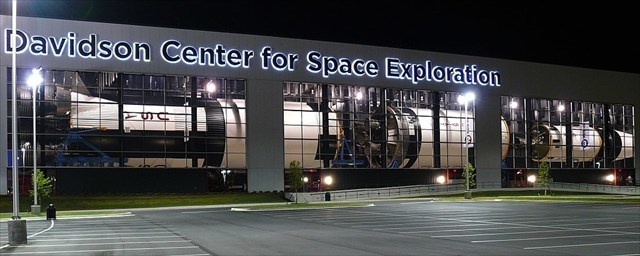
Adjacent to the Saturn V full-scale model is the Davidson Center for Space Exploration which showcases a real Saturn V rocket, one of the three remaining complete launch vehicles. This is the Saturn V Dynamic Test Vehicle, designated SA-500D, and was used by NASA to test rocket performance and verify designs of various subsystems. Built under the direction of Dr. Wernher von Braun, SA-500D served as the test vehicle for all of the Saturn support facilities at MSFC. The Davidson Center has a multitude of space artifacts on display, to include the Apollo 16 Command Module, Apollo 12 Mobile Quarantine Facility, and a moon rock brought back by Alan Bean. There is an admission fee required to enter the Davidson Center.
On July 20, 1969, the Lunar Module "Eagle" landed on the Moon at a site called Tranquility Base. Six hours later, Neil Armstrong became the first person/human to step onto the lunar surface proclaming "That's one small step for man, one giant leap for mankind." Lunar Module pilot Buzz Aldrin would join him 19 minutes later. The Moon landing was broadcast on live TV and was seen by millions. Apollo 11 fulfilled a national goal envisioned by President John F. Kennedy in 1961: "before this decade is out, of landing a man on the Moon and returning him safely to the Earth."
- Congratulations to bama.dell for FTF !
- Did you notice the publish date of this geocache?
Virtual Rewards 2.0 - 2019/2020
This Virtual Cache is part of a limited release of Virtuals created between June 4, 2019 and June 4, 2020. Only 4,000 cache owners were given the opportunity to hide a Virtual Cache. Learn more about Virtual Rewards 2.0 on the Geocaching Blog.