So, nun bekommt also auch die Stadt Göttingen endlich ihren Virtual Cache, nachdem es im Landkreis mit dem Mittelpunkt Deutschlands sowie dem Duderstädter Rathaus ja bereits zwei davon gibt. Und wohin sonst als zum heißgeliebten Wahrzeichen der Stadt, dem Gänseliesel, sollte er Euch führen........?
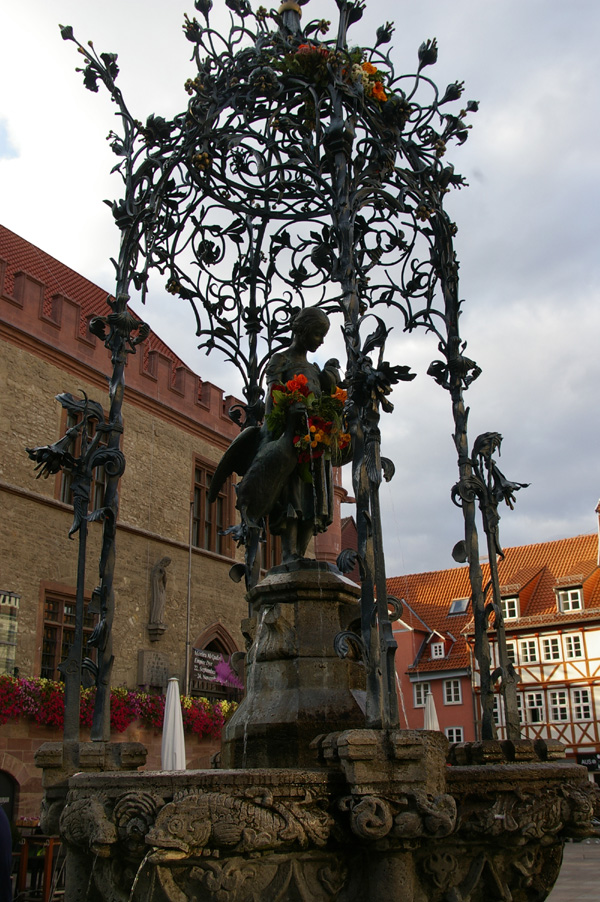
Der Gänseliesel-Brunnen ist ein Zierbrunnen vor dem Alten Rathaus in der Innenstadt von Göttingen in Niedersachsen. Der Brunnen mit einem Gänseliesel als Brunnenfigur wurde 1901 errichtet und gilt als Wahrzeichen der Universitätsstadt. Seit 1990 ist die Brunnenfigur eine Kopie, während sich die Originalfigur im Städtischen Museum befindet. Teile der Studentenschaft bezogen die Brunnenanlage bald in ihr Brauchtum ein. Nach ihrer Immatrikulation bestiegen die Studenten den Brunnen, um die Brunnenfigur zu küssen. Da dies häufig im Rahmen lautstarker Feiern geschah, wurde am 31. März 1926 eine Verordnung erlassen, die das Erklettern des Marktbrunnens und ein Küssen des Gänseliesels unter Strafe stellte. Weil sich die Studenten nicht daran hielten, kam es 1926 zu einem „Kuss-Prozess“. Nachdem im Sommersemester der cand. jur. Georg Graf Henckel von Donnersmarck auf frischer Tat ertappt wurde, musste er eine Geldstrafe von zehn Reichsmark (heute etwa 38,- Euro) zahlen. Der Jurastudent focht zwar die Ordnungsstrafe an und forderte vom Gericht „Kussfreiheit“ und „doch den Bann von den bronzenen Lippen zu lösen“, aber er hatte weder vor dem Göttinger Amtsgericht noch vor dem Berliner Kammergericht Erfolg. Das Kussverbot galt offiziell weiterhin, wurde aber kaum beachtet (d.h. das Küssen wurde toleriert, solange es "ohne Lärm vonstatten ging"). Deswegen gilt das Gänseliesel den Göttingern als das meistgeküsste Mädchen der Welt. Allerdings waren es in den letzten Jahrzehnten nicht mehr die Neuimmatrikulierten, die das Gänseliesel küssten, sondern Doktoranden nach ihrer erfolgreichen Prüfung. Dabei wird dem Gänseliesel ein Blumenstrauß überreicht. Anlässlich des 100-jährigen Jubiläums des Gänseliesels hob der Rat der Stadt das Kussverbot am 7. Juni 2001 offiziell auf.
Das Gänseliesel befindet sich auf dem Göttinger Marktplatz vor dem Alten Rathaus. Die Figur stellt ein barfüßiges Mädchen in einfacher Kleidung dar, das drei Gänse trägt. Geschaffen wurde der Gänselieselbrunnen 1901 von dem Bildhauer Paul Nissen (1869-1950) aus Charlottenburg und dem Architekten Heinrich Stöckhardt (1842-1920) aus Berlin. Zur Neugestaltung des Marktbrunnens hatte der Magistrat der Stadt Göttingen bereits 1898 einen Wettbewerb ausgeschrieben, in dem die Jury dem Entwurf "Gänsemädel" allerdings nur den zweiten Preis zuerkannte. Auf Betreiben des künstlerischen Beraters Prof. Dr. Friedrich Hartzer (der eigentlich den Juryvorsitz hätte übernehmen sollen, aber aufgrund einer Erkrankung verhindert war) und des Oberbürgermeisters Georg Friedrich Calsow wurde ihm schließlich aber doch der Vorzug vor den Entwürfen "Tugendbrunnen - Im Geiste der Alten" (1. Platz) und "Quelle" (3. Platz) gegeben. Das sandsteinerne Brunnenbecken hat einen Durchmesser von 4,40 Meter. Das bronzene Gänseliesel selbst ist 1,20 Meter hoch und steht unter einem mit Blüten geschmückten Baldachin, der ebenfalls aus Bronze ist. Die Höhe der Gesamtkomposition inklusive der Wetterspitze beträgt 7,10 Meter. Der Magistrat hatte sich nach langen Diskussionen für die Marktmitte als Standort des Brunnens entschieden, wo das Gänseliesel bis zur Neugestaltung des Marktplatzes 1968 stand. Seitdem hat es seinen Platz etwa 15 m weiter südlich, vor der Laube und dem Treppenaufgang des Alten Rathauses. Bei Renovierungsarbeiten im Jahr 1990 wurde die Figur durch eine Nachbildung ersetzt. Das Original befindet sich nun im Städtischen Museum.
(Quellen: Wikipedia und Internetseite der Stadt Göttingen)
Und noch eine Anmerkung an alle Auswärtigen: im lokalen Sprachgebrauch heißt es tatsächlich das Liesel, niemals "die" Liesel...!!!

The Gänseliesel Fountain is an ornamental fountain located in front of the Old Town Hall in the city center of Göttingen, Lower Saxony. Erected in 1901, the fountain—featuring the figure of "Gänseliesel" (the Goose Girl, or literally: Goose Lizzy)—is considered a landmark of this university city. Since 1990, the figure atop the fountain has been a replica, while the original is housed in the Municipal Museum. Students soon incorporated the fountain into their traditions; after matriculating, they would climb it to kiss the statue. As this often took place amidst boisterous celebrations, an ordinance was issued on March 31, 1926, making it a punishable offense to climb the market fountain or kiss the Gänseliesel. Because students disregarded the rule, a "kissing trial" ensued in 1926. After law student Georg Graf Henckel von Donnersmarck was caught in the act during the summer semester, he was fined ten Reichsmarks (equivalent to approximately 38 euros today). Although he challenged the penalty—demanding "freedom to kiss" and calling for the court to "lift the ban from the bronze lips"—he was unsuccessful before both the Göttingen Local Court and the Berlin Court of Appeal. While the ban on kissing officially remained in effect, it was largely ignored (meaning the act was tolerated as long as it took place "without noise"). Consequently, the people of Göttingen regard the Gänseliesel as the most-kissed girl in the world. In recent decades, however, the tradition has shifted: it is no longer newly matriculated students who kiss the Gänseliesel, but rather doctoral candidates following their successful examinations—often while presenting the statue with a bouquet of flowers. To mark the Gänseliesel’s centenary, the city council officially lifted the ban on kissing on June 7, 2001.
The Gänseliesel statue is located in Göttingen’s market square, in front of the Old Town Hall. The figure depicts a barefoot girl in simple clothing carrying three geese. The Gänseliesel fountain was created in 1901 by sculptor Paul Nissen (1869–1950) from Charlottenburg and architect Heinrich Stöckhardt (1842–1920) from Berlin. The Göttingen city administration had launched a competition to redesign the market fountain as early as 1898; however, the jury awarded the "Gänsemädel" ("Goose Girl") design only second prize. Yet, at the urging of artistic advisor Prof. Dr. Friedrich Hartzer (who was originally slated to chair the jury but was unable to do so due to illness) and Mayor Georg Friedrich Calsow, it was ultimately selected over the designs "Tugendbrunnen – Im Geiste der Alten" ("Fountain of Virtue – In the Spirit of the Ancients," 1st place) and "Quelle" ("Spring," 3rd place). The sandstone fountain basin has a diameter of 4.40 meters. The bronze Gänseliesel figure itself stands 1.20 meters tall beneath a blossom-adorned canopy, which is also made of bronze. The total height of the composition, including the finial, is 7.10 meters. After lengthy deliberations, the city administration had chosen the center of the market square as the fountain's location; the Gänseliesel stood there until the square was redesigned in 1968. Since then, it has been situated about 15 meters further south, in front of the Old Town Hall’s arcade and staircase. During renovation work in 1990, the figure was replaced by a replica. The original is now housed in the Municipal Museum.
(Sources: Wikipedia and the City of Göttingen's website)

Logbedingungen
Zum Beweis Eures Besuches erfüllt Ihr bitte folgende Aufgaben:
1) Am Denkmalsockel und der Brunnenschale befinden sich insgesamt drei Plaketten. Eine davon nennt den Architekten und den Bildhauer, zusammen mit einer Jahreszahl. Die einfache Quersumme dieser Jahreszahl sei = A. Eine weitere erinnert an die Erneuerung des Brunnens durch einen lokalen Steinmetzbetrieb im Jahre 1968. Findet hier den Firmennamen (Familiennamen) heraus. Der Anfangsbuchstabe, umgewandelt in eine Zahl, sei = B. Die letzte Plakette erwähnt, von wem die Beleuchtung des Brunnens gestiftet wurde. Hier wird wieder der Familiennamen benötigt. Aus wievielen Buchstaben besteht er? Diese Zahl sei = C. ACHTUNG: Da die dritte Plakette während der letzten Renovierung zu Ostern 2023 entfernt wurde, gebe ich Euch hier den gesuchten Namen: Leinemann.
Nun multipliziert zum Abschluss A, B und C, und Ihr erhaltet eine vierstellige Zahl (XXXX). Diese setzt bitte in folgende Email-Adresse ein: LieselXXXX@gmail.com. Dann schreibt an diese Adresse eine Nachricht mit Eurem Cachernamen als Betreff. Wenn alles richtig ist, bekommt Ihr eine automatische Antwort und dürft den Virtual sofort loggen. Anmerkung: Emails ohne Inhalt landen anscheinend gerne im Spam-Ordner. Fügt also am besten irgendeinen Text hinzu.
2) Nehmt ein Foto von Euch, Eurem GPS oder einem persönlichen Gegenstand vor dem Gänseliesel auf und fügt es Eurem Logeintrag bei. Besonders gern gesehen sind dabei natürlich Bilder, die Euch beim Küssen des Gänseliesels zeigen (dann erhöht sich die T-Wertung allerdings auf ca. 3.5)!
P.S. Vergesst nicht, auch den raren Webcam Cache am Marktplatz zu loggen (falls noch nicht geschehen). Dazu könnt Ihr praktischerweise gleich am Gänseliesel stehen bleiben.

Logging conditions
In order to prove your visit, please complete the following tasks:
1) There's a total of three little plaques attached to the pedestal and the water basin. One of them mentions the architect (Stöckhardt) and the sculptor (Nissen), together with the year of completion (not inauguration). The simple checksum of this year is "A". Another plaque commemorates the restoration of the monument in the year 1968 by a local stonemason (company). Find out the name (surname, appearing after the abbreviation "Chr."). Its initial letter, converted into a number (A=1, B=2, C=3) is "B". The third one mentions the donors of the lighting equipment (German: Beleuchtung) for the well. Again, you will need the family name. How many letters does it contain? This number is "C". ATTENTION: as the third plaque has been removed during the latest renovation works around Easter 2023, I will give you the name in question here: Leinemann.
Now multiply A, B and C, and you will get a four-digit number (XXXX). Insert it into the following email address: LieselXXXX@gmail.com. Then send a message with your cacher name as the subject to this address. If everything is correct, you will receive an automated answer and may log the Virtual Cache immediately. Note: emails without content tend to end up in the spam folder. So, it's best to add some text.
2) Take a photo of yourself, your GPS or a personal item in front of the Gänseliesel and add it to your log entry. Of course, you are more than welcome to take a picture that shows you kissing the statue (in that case, the T rating will increase to approx. 3.5)!
P.S. While you are here, don't forget to log the rare Webcam Cache on the market square as well (if you haven't already done so). Guess what? You can remain standing next to the Gänseliesel for that!
--------------------------------------------------------------------------------------------------------------------------
Virtual Rewards 2.0 - 2019/2020
This Virtual Cache is part of a limited release of Virtuals created between June 4, 2019 and June 4, 2020. Only 4,000 cache owners were given the opportunity to hide a Virtual Cache. Learn more about Virtual Rewards 2.0 on the Geocaching Blog.