PLEASE READ THE REQUIREMENTS TO LOG THIS CACHE. IF THE PHOTO DOES NOT FULLFILL THE REQUIREMENT, THE LOG WILL BE DELETED WITHOUT WARNING !!!! (7/2 2023)
**********************
"The Bridge on the River Kwai" is a 1957 war film directed by David Lean and based on the novel Le Pont de la Rivière Kwaï (1952) by Pierre Boulle. The film uses the historical setting of the construction of the Burma Railway in 1942–1943.
สะพานข้ามแม่น้ำแคว "เป็นภาพยนตร์สงครามปีคศ 1957 ที่กำกับโดย David Lean และมีพื้นฐานมาจากนวนิยาย Le Pont de la RivièreKwaï (1952 ) ซึ่งเป็นบทประพันธ์ของ Pierre Boulle ภาพยนตร์เรื่องนี้สร้างขึ้นโดยการอ้างอิงทางประวัติศาสตร์ของการก่อสร้างรถไฟสายไทยพม่าในปี 1942-1943
The idea of building a permanent rail link between Burma through Thailand to China was first raised in the 1880's by the British colonial authorities in Burma. However no investment was forthcoming and the idea was shelved.
As early as 1939, Japanese agents in Thailand were preparing the ground for the construction of the railway, once Japanese forces had taken control of South-East Asia. The railway was intended purely as a strategic military supply line for the movement of troops and equipment to the Burma Front, and ultimately for the invasion of India.
The Japanese had originally intended to use an Asian workforce to construct the railway, and indeed most of the railway labourers were from Burma, Java and Malaya - some 240,000 seems to be the most reliable estimate. However with the fall of Malaya, Singapore and Indonesia in 1942, the occupying forces found themselves with a large number of prisoners of war, an event they had not planned for. What to do with these prisoners was a vexed question for the Japanese military administration for the first few weeks of their rule. It was then decided that these men - skilled, disciplined military personnel - were to be used to further the Japanese war effort.
Surveying the Railway Gradually the PoWs were grouped into 'Forces' and sent to work on various projects. The first group of PoWs who were ultimately to work on the railway, were those of 'A Force'. These 3,000 men were sent by ship from Singapore to various places in Burma to work on airfield construction. Later in 1942 these isolated groups were concentrated at Thanbyuzayat to begin work on the Burma end of the railway. Construction began in June 1942, under the direction of the Imperial Japanese Army's 5th and 9th Railway Regiments. Gradually more forces were sent to Burma and Thailand; in total more than 60,000 prisoners of war were transported to the railway project during 1942-3. At the same time the 'Sweat Army' of labourers from Burma, ostensibly volunteers but many conscripted by the puppet Burmese government, toiled on the construction work. Conditions in Malaya after the capitulation of the Allies caused the collapse of agricultural production, forcing many undernourished Malayan plantation workers - mostly of Tamil extraction - to volunteer for work on the railway, the terms being "A dollar and a pound of rice per day". Many went purely for the rice.
The 415km line linking the Thai and Burmese railway systems was constructed simultaneously from both ends, Thanbyuzyat in Burma and Nong Pladuk in Thailand. The numbers of deaths speak for themselves. Disease (particularly dysentery, malaria, beriberi and savage cholera epidemics), starvation rations, overwork, poor or no accommodation or sanitation, and the individual brutality of Japanese and Korean engineers and guards, took their inevitable toll. Over 13,000 prisoners of war perished during the period between late 1942 and late 1945. The numbers of deaths of the Asian labourers is harder to calculate; around 100,000 seems to be the most reliable figure. During the infamous 'speedo' period, July to October 1943, the desperation of the Japanese engineers to finish construction on time, under severe pressure from their superiors in Tokyo, meant that many men were forced to do grinding manual labour around the clock - 62 hours work out of 72 hours appears to be the record. Rest days were rare. This, combined with the first outbreak of cholera, caused the death toll to reach its peak during this time.
The Thai and Burmese sections of line were joined near Konkoita in October 1943. Actual construction took a mere sixteen months - some would say a remarkable engineering feat. After the line was completed all of the PoWs were transferred from remote jungle camps to base camps and hospitals. Some, after recovery, formed new work parties destined for Japan, others returned to Singapore. A large number of PoWs remained in the Thailand base camps until the end of the war.
PoW's Moving The railway continued to operate, with some interruptions, until the final victory of Allied forces in August 1945. Slowly the prisoners of war and Asian labourers were rehabilitated and returned home. Some former PoW's remained in Thailand and Burma to recover their comrades from remote maintenance camps, and to work on grave recovery parties. The railway then fell into disuse through lack of maintenance, and in 1947 the line and rolling stock were sold to the Thai Government. By 1957 the Thai government re-opened the section of line from Nong Pladuk to Nam Tok, and this part of the railway still operates today. Much of the abandoned section has now been reclaimed by the jungle, but embankments, cuttings and bridge sites can still be found
(Source: Thailand - Burma railway centre)
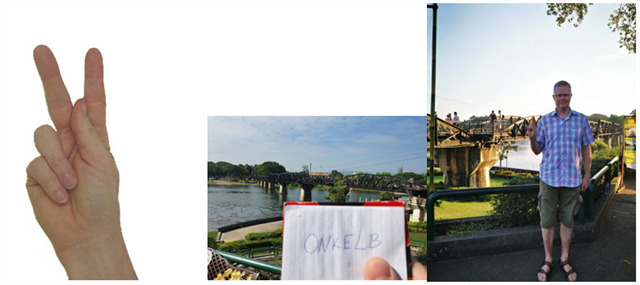
To log this cache you must take a picture with the brigde in the background and upload the picture together with your log. Also on the picture you must either show your geocacher name or the deaf sign for the letter "K". If you choose to show the deaf letter "k", please hold your hand near the body to avoid any misunderstanding from the mugglers. You do not need to show your face on the picture.
Logs without the picture and the demands mentioned above, will be deleted without any warning.
ในการบันทึกแคชนี้คุณต้องถ่ายภาพโดยมีสะพานอยู่ด้านหลัง นอกจากนี้ในรูปภาพคุณต้องแสดงชื่อ Geocach ของคุณหรือทำภาษามือเครื่องหมายคนหูหนวกสำหรับตัวอักษรตัวเค "K" หากคุณเลือกที่จะแสดงตัวอักษรคนหูหนวกตัวเค "k" โปรดเอามือของคุณไว้ใกล้ตัวเพื่อหลีกเลี่ยงความเข้าใจผิด คุณไม่จำเป็นต้องแสดงใบหน้าของคุณบนภาพ บันทึกที่ไม่มีภาพและข้อเรียกร้องที่กล่าวถึงข้างต้นจะถูกลบโดยไม่มีคำเตือนใด ๆ
Virtual Rewards 2.0 - 2019/2020
This Virtual Cache is part of a limited release of Virtuals created between June 4, 2019 and June 4, 2020. Only 4,000 cache owners were given the opportunity to hide a Virtual Cache. Learn more about Virtual Rewards 2.0 on the Geocaching Blog.
Virtual Cache นี้เป็นส่วนหนึ่งของ Virtuals รุ่นที่ จำกัด ระหว่างวันที่ 4 มิถุนายน 2019 ถึง 4 มิถุนายน 2020 เจ้าของแคชเพียง 4,000 รายเท่านั้นที่ได้รับโอกาสให้ซ่อน Virtual Cache เรียนรู้เพิ่มเติมเกี่ยวกับ Virtual Rewards 2.0 บนบล็อก Geocaching Geocaching Blog