Pullman National Monument
Chicago's First National Park
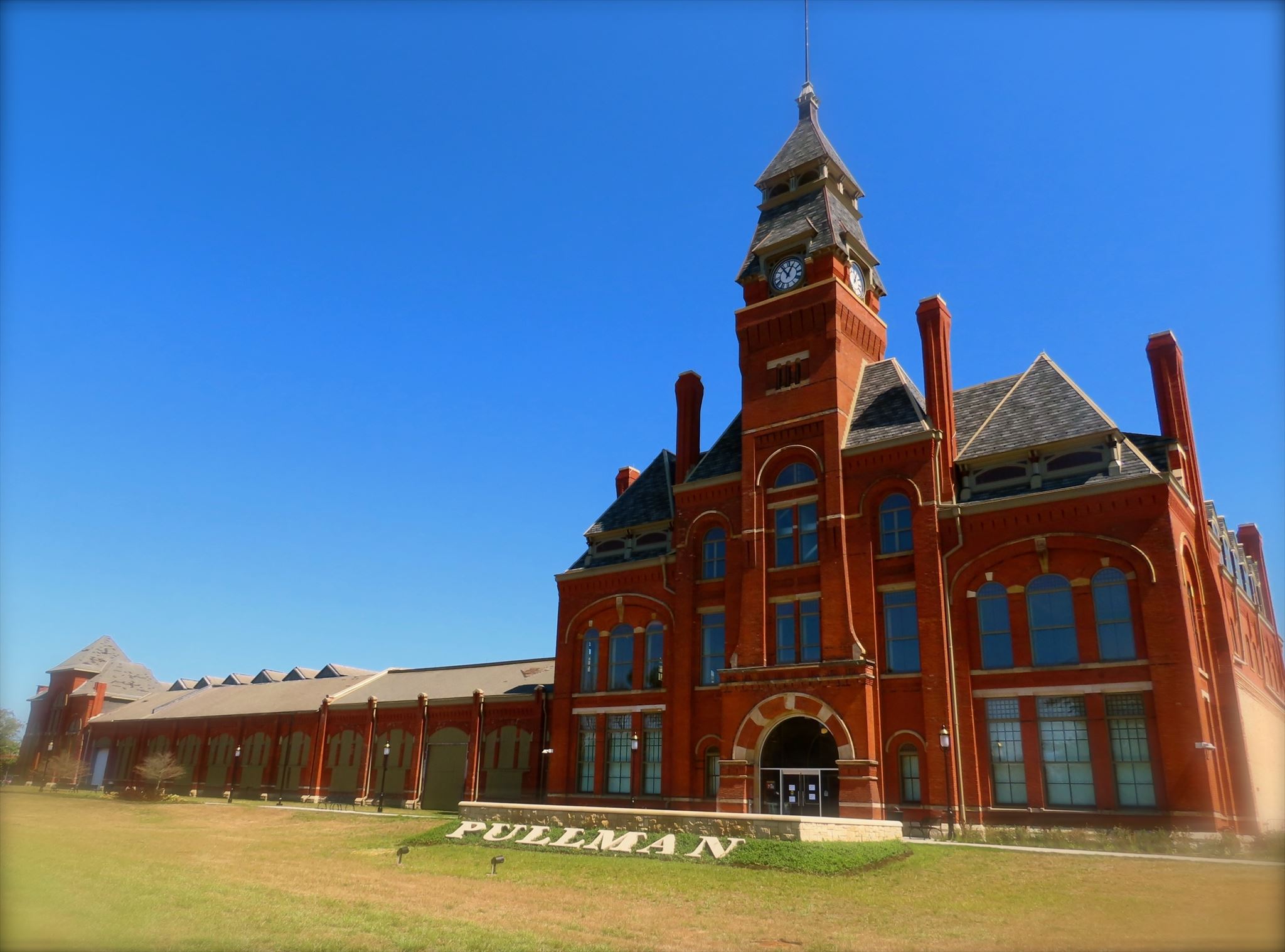
The Historic Pullman District is an active community. Geocachers are welcome to experience the historic neighborhood while respecting the privacy of Pullman residents.
The Pullman National Monument has overlapping designations, including Pullman National Historic Landmark District, Pullman State Historic Site, and City of Chicago Landmark.
This virtual cache is placed with National Park Service permission.
The Pullman Story
The Pullman National Monument preserves the history of the industrial complex developed by George M. Pullman, where freight and luxury passenger rail cars were mass-produced from 1881 to 1981. At the hub of the 700-foot long factory was the Administration Clock Tower Building, now the Pullman National Monument Visitor Center.
The Pullman Historic District (Pullman) is significant for its origins as the first planned company town in the United States. George Pullman built the town to house the Pullman Palace Car Company's employees. The luxury railcars with service employees, known as Pullman Porters, would accommodate 26 million people at the company's peak. Later, Pullman would become the scene of the violent 1894 Pullman strike and a catalyst for the first all African American labor union. The Brotherhood of Sleeping Car Porters would significantly impact the Civil Rights movement.
Believing pleasant surroundings would attract quality employees and encourage productivity, Pullman constructed an "ideal" town adjacent to his factory. Workers would benefit from above standard accommodations and amenities, but the cost was high. Privately owned Pullman differed from other communities. George Pullman maintained absolute control and oversaw it with a paternalistic iron fist.
Beautifully landscaped with parks, a lake, promenades, and carriage paths, the town, designed by Solon S. Berman, featured 1,300 housing units reflective of employee status and class. Complete with shops, a church, theater, water tower, library, gas works, and train depot, the community drew national accolades when completed in 1884. Annexed to Chicago in 1889, Pullman became a leading attraction of the World's Columbian Exposition of 1893.
During the 1893 economic recession, Pullman laid off hundreds of employees and drastically cut the wages of the remainder. Without corresponding rent or utility reductions, workers could not feed their families. When Pullman refused to negotiate with delegates, angry workers walked off the job.
Led by Eugene V. Debs, the American Railway Union (ARU) supported the strike by boycotting Pullman cars on all railroads, rail traffic stopped in 27 states. Railway General Managers sought help from the federal government.
President Cleveland signed a federal injunction (the first) after strikers derailed a locomotive attached to a U.S. mail train. Six thousand federal and state troops, 3,100 police, and 5,000 deputy marshals ascended on the city; the strike turned bloody. Thirty workers died, and 57 were wounded. The strike was broken. Federal troops were recalled, and the factory reopened. In the aftermath of the strike, the state ordered the company to sell off its residential holdings signaling the end of Pullman's ideal town experiment.
The Pullman strike left a legacy in the labor movement, impacting negotiations today. President Cleveland signed the bill making the first Monday in September a federal holiday named Labor Day. In 1925, the Pullman Porters founded the Brotherhood of Sleeping Car Porters, the first African American labor union to sign a collective bargaining agreement with a major U.S. corporation.
Eventually, the railroad industry declined, the Pullman Company shuttered, and the factory buildings were abandoned. On February 19, 2015, President Barack Obama designated Pullman a National Monument, making it the first unit of the National Park Service in Chicago and the nation's 406th NPS site.
To learn more, stop at the visitor center located in the Administration Clock Tower Building. Also, consider a visit to A. Philip Randolph Pullman Porter Museum, located within the boundaries of the Pullman National Monument.
Verify your visit:
When logging online include a picture of a sign that has: Your caching name, date of visit, and having the Clock Tower in the background. Include yourself in the picture if you'd like, but it’s not required.
Virtual Rewards 2.0 - 2019/2020
This Virtual Cache is part of a limited release of Virtuals created between June 4, 2019 and June 4, 2020. Only 4,000 cache owners were allowed to hide a Virtual Cache. Learn more about Virtual Rewards 2.0 on the Geocaching Blog.