DEUTSCH
(ENGLISH BELOW)
Zum 138. Jahrestag der
Eröffnung am 12. September 1883
Die lange Geschichte des Wiener Rathauses leicht gekürzt.
Nachdem das Alte Rathaus in der Wipplingerstrasse nach dem Fall der Stadtmauer und Eingemeindung der Vorstädte (1850) zu klein für die Verwaltung geworden ist, musste nach einer Alternative gesucht werden. Aufgrund des Rückbaus der Stadtmauer und des Glacis', sowie gleichzeitigem Baubeginn der Ringstrasse, gab es in diesem Bereich dementsprechend neues Bauland. Die Vergabe der Gründe der ehemaligen Befestigungs-anlagen wurde von Kaiser Franz Joseph I. im Jahre 1858 dem Stadterweiterungsfonds (unterstand dem Innenministerium) übertragen.
Dieser Stadterweiterungsfond (1858 - 2017) bot der Stadt mehrere Grundstücke für den Neubau des Rathauses an, unter anderem hinter der Börse (ca. 7200 m² groß) bzw. gegenüber dem Stadtpark zwischen Johannes- und Weihburggasse (ca. 14.600m² groß). Interessant - auch der Platz gegenüber dem Stephansdom, nachfolgend ab 1866 mit dem "Haas-Haus" (Teppichhaus Haas&Söhne) bebaut, stand kurz zur Diskussion. Die Stadt entschied sich inkl. einer Aufzahlung von 250.000 Gulden schließlich für den Stadtparkbereich, für welchen 1868 auch die Bauausschreibung erfolgte.
Infolge von Bauverzögerungen wurde der Bauplatz jedoch schon bald als "Communalloch" bezeichnet.
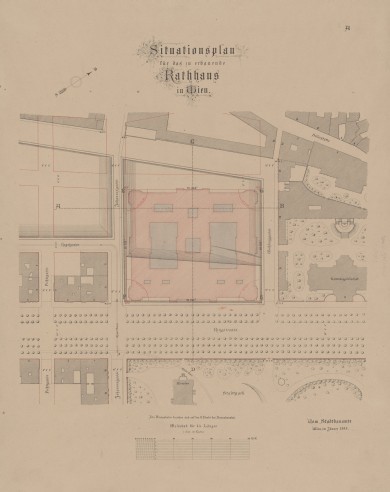
Ursprünglich geplanter Standort Nähe Stadtpark
DER WETTBEWERB
Neben dem erhöhten Platzbedarf und damit verbundener Ansprüche durch die verschiedenen Abteilungen, gab es auch den Wunsch nach einem repräsentativen Gebäude. Im Mai 1868 wurde vom Gemeinderat die Wettbewerbsausschreibung veröffentlicht. Bis zum 1. September 1869 konnten Pläne anonymisiert eingereicht werden und insgesamt langten 64 Entwürfe ein, von denen schließlich die besten 12 ausgezeichnet wurden.
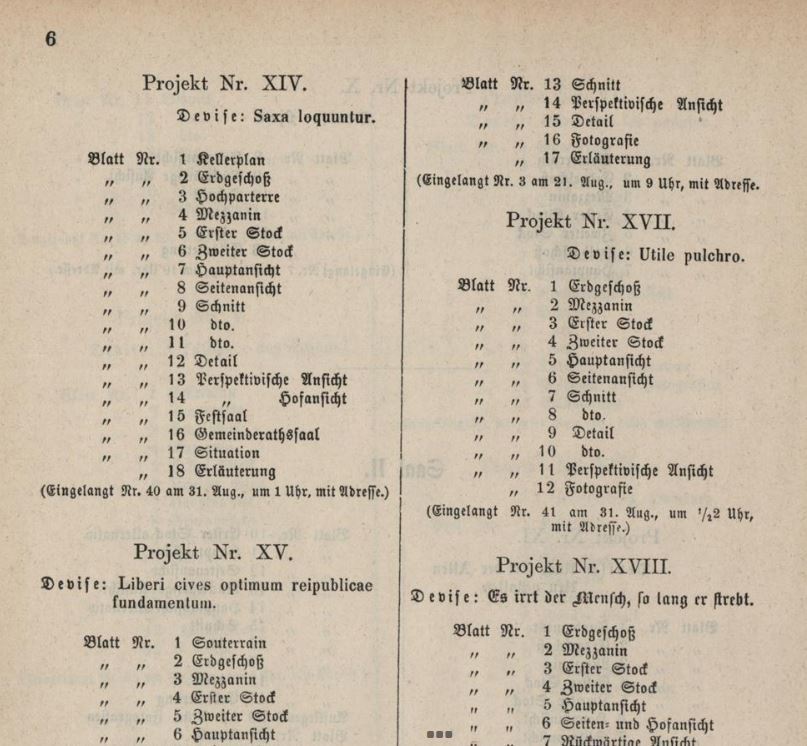
Ausstellungskatalog Künstlerhaus
Als Sieger ging schließlich k&k Oberbaurat Friedrich Schmidt mit seinem eingereichten Projekt "Saxa loquuntur" (Die Steine sprechen) hervor.
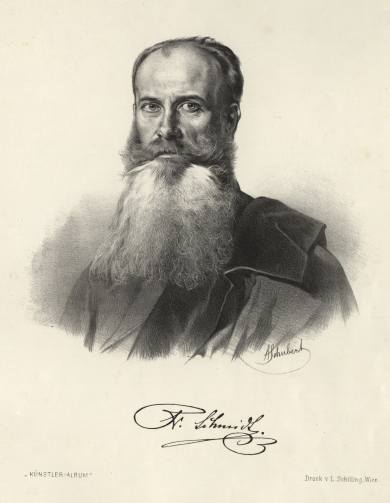
Friedrich Schmidt
Schmidt war seit 1859 an der Akademie der Bildenden Künste tätig, als Dombaumeister für den Stephansdom (ab 1862) zuständig und für die Pläne mehrerer Bauten in Wien (Brigittakirche, Kirche Maria vom Siege, Lazaristenkirche, Sühnhaus) verantwortlich.
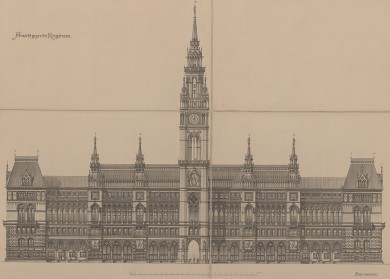
Siegerprojekt
1. Preis Friedrich Schmidt: "Saxa Loquuntur"
2. Preis: Ambroise Baudry: "Ojala"
3. Preis: Ernest Chardon und Marcel Lambert: "L’art unit les peuples"
Mit List zu einem neuen Standort
Dass das Rathaus schließlich hier am ehemaligen k&k Parade- und Exerzierplatz steht, ist wiederum Bürgermeister Cajetan Felder zu verdanken, dem der Platz beim Stadtpark zu wenig repräsentativ war. Er überreichte 1870 die vom Gemeinderat beschlossenen Pläne zur Verbauung dem Kaiser, welcher der Umsetzung überraschenderweise zustimmte. Allerdings war der Kaiser schon länger über die Pläne Felders eingeweiht - es war also eine List gegenüber dem, diesem Bauplatz, abgeneigten Gemeinderat, aber auch gegenüber dem Architekten, der diesem Platz Anfangs ebenfalls nicht wohlwollend gegenüberstand.
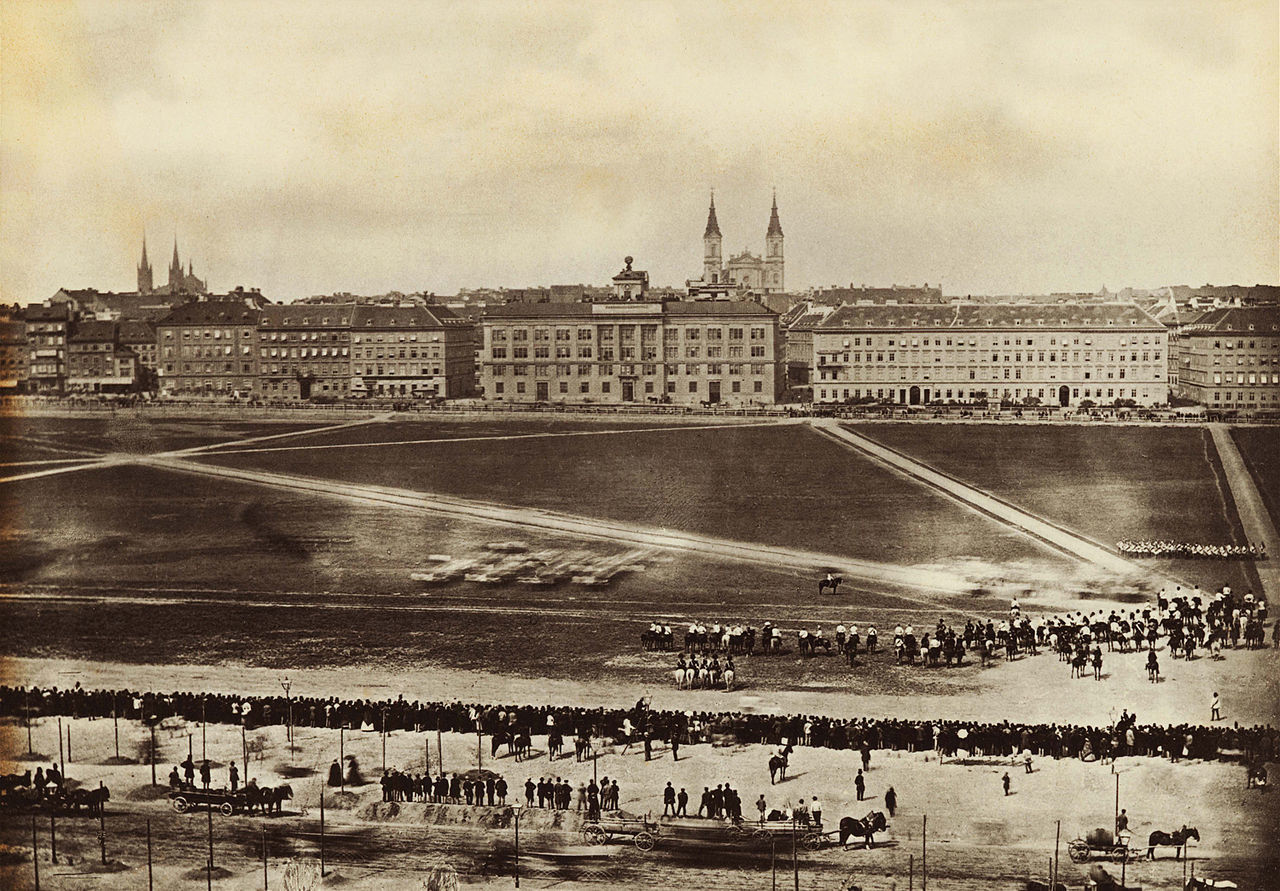
Bild Exerzierplatz
Ehem. Parade- und Exerzierplatz. In der Bildmitte das noch heute bestehende Haus Friedrich Schmidt Platz Nr.3, hier untergebracht damals das ehemalige k&k Eich- und Vermessungswesen.
Nach dem Spatenstich am 23. Mai 1872, erfolgte am 14. Juni 1873 die Grundsteinlegung und nach 10 jähriger Bauzeit legte man zur 2. Säkularfeier des Sieges über die Türken am 12. September 1883 den Schlussstein in der Turmnische des Festsaals im 1.Stock. Zu beiden Anlässen war der Kaiser geladen und auch anwesend.
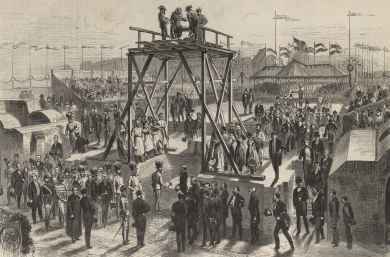
Grundsteinlegung 1873
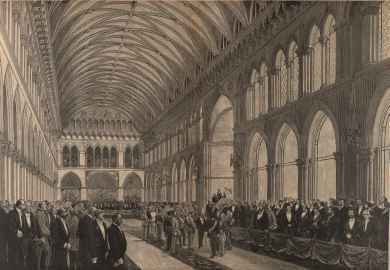
Festakt zur Schlusssteinlegung 12.09.1883
Die Baukosten
waren natürlich auch schon damals ein Thema. Die Stadt war im Jahre 1866 mit 8,4 Millionen Gulden verschuldet. In diese Zeit fielen allerdings auch die Donauregulierung, der Bau der 1. Wr. Hochquellen-Wasserleitung, der Bau des Zentralfriedhofes sowie die Weltausstellung 1873, also alles sehr kostenintensive Projekte. Nach einer zusätzlichen Börsenkrise in diesem Jahr stand die Stadt quasi vor dem Bankrott, hätte nicht Niederösterreich mit einer Anleihe von 40 Mio. Gulden ausgeholfen. Totzdem war dies der Grundstein für eine moderne Metropole - Wien wurde unter Bürgermeister Cajetan Felder zur Weltstadt.
Und endlich konnte es auch mit dem Bau losgehen. Doch die Kosten für den Bau "explodieren". Nachdem die Stadt Wien für den Neubau ursprünglich 8,5 Mio. Gulden veranschlagte, hatte sich der Bau in der Endabrechnung auf 14 Millionen Gulden (=123 Mio. Euro/Stand 2002) erhöht. Allein 4,1 Millionen Gulden kosteten die Steinmetzarbeiten.
Ein typisches (österreichisches?) Schicksal traf Cajetan Felder, der zur Eröffnung des Rathauses 1883 nicht eingeladen war und daraufhin Zeit seines Lebens das Gebäude nicht betrat.
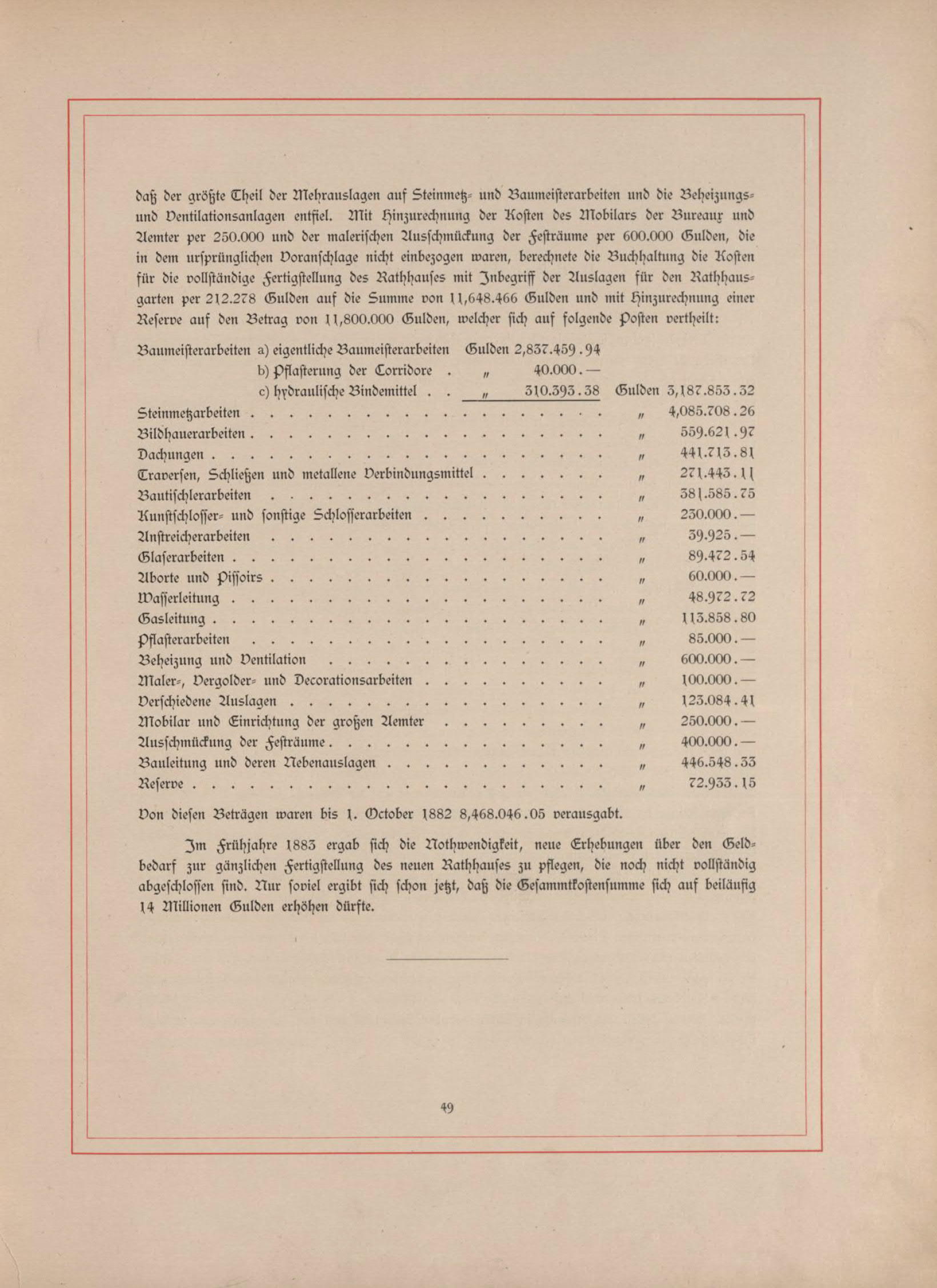
Die Abrechnung
Generalsanierung ab 2012
Die mehr als130 Jährige Geschichte des Rathauses hat neben einigen (reparierten) Schäden aus dem 2. Weltkrieg auch sonst schon Spuren hinterlassen. Seit 2012 findet an den Fassaden im Innen- und Aussenbereich die Generalsanierung statt, welche in 11 Abschnitte geteilt ist und 2024 ihren Abschluss finden soll. Knapp 36 Millionen Euro fließen in die Sanierung.
Hier noch ein paar Gebäudedaten:
Grundfläche ca. 19 600m² Verbaute Fläche ca. 14 000m²
Grundriss ca. 152 x 127 Meter Fläche aller Geschoße ca 113 000m²
Räume ca. 1 575 Länge der Gänge ca. 2,5 Km
Höhe Nebentürme 65 Meter Höhe Hauptturm 98 Meter + 5,3 Meter Rathausmann
-
Deine Aufgabe/Logbedingung:
1. Begib dich nun zum Header: Wieviele Rathausmänner stehen auf der Turmspitze?
2. Begib dich nun zu Wegpunkt 2: Welche Zahl steht auf der blauen Tafel (ohne Komma)?
3. Weiter gehts zu Wegpunkt 3: Welche Zahl steht auf der gelben Tafel (ohne Komma)?
4. Begib dich nun zu Wegpunkt 4 oder 5 und mache ein Foto von deinem Zielführungsgerät und im Hintergrund das Rathaus. Gerne darfst auch du auf dem Foto sein, musst aber nicht.
Du darfst natürlich auch Fotos von beiden Fotopunkten (WP 4+5) hinaufladen, aber sie sind im Laufe des Jahres nicht immer zugänglich!
Wenn Du alles ermittelt hast, sende eine E-Mail an Zahl1-Zahl2-Zahl3@gmx.at, im Betreff bitte deinen GC-Namen.
Also zum Beispiel 1-234-56@gmx.at
Bei korrekter Antwort bekommst du postwendend die Logerlaubnis.
Quellen- und Bildernachweis:
Karl Weiß, Festschrift aus Anlaß der Vollendung des neuen Rathhauses: Wien 1883; Illustrierte Zeitung, 16.9.1883;
https://www.geschichtewiki.wien.gv.at/Wien_Geschichte_Wiki
https://www.wienbibliothek.at/
Virtual Rewards 2.0 - 2019/2020
This Virtual Cache is part of a limited release of Virtuals created between June 4, 2019 and December 31, 2020. Only 4,000 cache owners were given the opportunity to hide a Virtual Cache. Learn more about Virtual Rewards 2.0 on the Geocaching Blog.
ENGLISH
On the 138th anniversary of the opening on September 12, 1883
The long history of the Vienna City Hall is slightly shortened.
After the old town hall in the Wipplingerstrasse became too small for the administration after the fall of the city wall and the incorporation of the suburbs (1850), an alternative had to be found. Due to the demolition of the city wall and the glacis, as well as the simultaneous start of construction on the Ringstrasse, there was accordingly new building land in this area. The assignment of the grounds for the former fortifications was assigned by Emperor Franz Joseph I in 1858 to the City Expansion Fund (subordinate to the Ministry of the Interior).
This city expansion fund (1858 - 2017) offered the city several plots of land for the new construction of the town hall, including behind the stock exchange (approx. 7200 m²) and across from the city park between Johannes- and Weihburggasse (approx. 14,600 m²). Interesting - the square across from St. Stephen's Cathedral, subsequently built with the "Haas-Haus" (Haas & Sons carpet store) from 1866, was also briefly discussed. The city finally decided, including a payment of 250,000 gulden, for the city park area, for which the building tender was issued in 1868.
As a result of construction delays, however, the building site was soon referred to as the "communal hole".
Originally planned location near the city park
THE COMPETITION
In addition to the increased space requirements and the associated demands from the various departments, there was also the desire for a representative building. In May 1868 the municipal council published the competition announcement. Up to September 1, 1869, plans could be submitted anonymously and a total of 64 drafts were received, of which the best 12 were ultimately awarded.
Exhibition catalog Künstlerhaus
The winner was k & k Oberbaurat Friedrich Schmidt with his submitted project "Saxa loquuntur" (The stones speak).
Friedrich Schmidt
Schmidt had worked at the Academy of Fine Arts since 1859, as master builder for St. Stephen's Cathedral (from 1862) and responsible for the plans for several buildings in Vienna (Brigittakirche, Kirche Maria vom Siege, Lazaristenkirche, Sühnhaus).
Picture winning project
1st prize Friedrich Schmidt: "Saxa Loquuntur"
2nd prize: Ambroise Baudry: "Ojala"
3rd prize: Ernest Chardon and Marcel Lambert: "L’art unit les peuples"
With List to a new location
The fact that the town hall is finally here on the former k & k parade ground is again thanks to Mayor Cajetan Felder, for whom the square near the city park was not very representative. In 1870 he presented the plans for the building that had been decided by the local council to the emperor, who surprisingly agreed to their implementation. However, the emperor had been inaugurated about Felder's plans for a long time - so it was a ruse against the local council, who was averse to this building site, but also against the architect, who was also not sympathetic to this place at the beginning.
Picture parade ground
Former Paradeground. In the center of the picture is the house Friedrich Schmidt Platz Nr.3, which still exists today, where the former k & k calibration and measurement system was housed.
June 14., 1873
September 12., 1883
After the groundbreaking on May 23, 1872, the foundation stone was laid on June 14, 1873 and after 10 years of construction, the keystone was laid in the tower niche of the ballroom on the 1st floor for the 2nd secular celebration of the victory over the Turks on September 12, 1883. The emperor was invited and also present on both occasions.
The construction costs
were of course an issue even then. In 1866 the city was in debt with 8.4 million gulden. During this time, however, the Danube regulation fell, the construction of the 1st vienna spring water main, the construction of the central cemetery and the 1873 World Exhibition, all very cost-intensive projects. After an additional stock market crisis this year, the city was practically on the verge of bankruptcy, had it not been for Lower Austria to help out with a loan of 40 million gulden. Nevertheless, this was the foundation stone for a modern metropolis - Vienna became a cosmopolitan city under Mayor Cajetan Felder.
And finally the construction could start. But the construction costs "explode". After the City of Vienna originally estimated 8.5 million gulden for the new building, the construction had increased to 14 million gulden in the final accounts (= 123 million euros / as of 2002). The stone carving cost 4.1 million gulden alone.
A typical (Austrian?) Fate met Cajetan Felder, who was not invited to the opening of the town hall in 1883 and then did not enter the building for the rest of his life.
The billing
General renovation from 2012
The more than 130-year history of the town hall has left its mark on some (repaired) damage from World War II as well. The general renovation of the interior and exterior facades has been taking place since 2012, which is divided into 11 sections and should be completed in 2024. Almost 36 million euro will go into the renovation.
Here are a few more building data:
Base area approx. 19,600m² built-up area approx 14,000m²
Floor plan approx. 152 x 127 meters area of all floors approx. 113,000 m²
Rooms approx. 1,575 corridors length approx. 2.5 km
Height of side towers 65 meters height of main tower 98 meters + 5.3 meters Rathausmann
Your task / log condition:
1. Now go to the header: How many town hall men are on the top of the tower?
2. Now go to waypoint 2: Which number is on the blue board (without a comma)?
3. Continue to waypoint 3: Which number is on the yellow board (without a comma)?
4. Now go to waypoint 4 or 5 and take a photo of your guidance device and the town hall in the background. You are welcome to be in the photo, but you don't have to.
You can of course upload photos from both photo points (WP 4 + 5), but they are not always accessible during the year!
When you have determined everything, send an email to Zahl1-Zahl2-Zahl3@gmx.at, please include your GC name in the subject.
For example 1-234-56@gmx.at
If you answer correctly, you will receive logging permission immediately.
Source and picture credits:
Karl Weiß, Festschrift on the occasion of the completion of the new town hall: Vienna 1883; Illustrierte Zeitung, September 16, 1883;
https://www.geschichtewiki.wien.gv.at/Wien_Geschichte_Wiki
https://www.wienbibliothek.at/
Virtual Rewards 2.0 - 2019/2020
This Virtual Cache is part of a limited release of Virtuals created between June 4, 2019 and December 31, 2020. Only 4,000 cache owners were given the opportunity to hide a Virtual Cache. Learn more about Virtual Rewards 2.0 on the Geocaching Blog.