
El 1882, quan es va enderrocar el castell romànic dels Montcada al nucli antic de Vic, van aparèixer entre la runa les restes d’un temple romà. Era l’antic temple romà d’Ausa i estava conservat en magnífiques condicions. L’edifici data del segle II, després de la conquesta romana d’Hispània. La seva reconstrucció va durar 77 anys (1883-1959), però actualment és un dels dos únics temples romans a tot Espanya que es conserven pràcticament complets.
El temple, construït sobre un pòdium, consta d’una cel·la i un atri amb 8 columnes. Es van trobar gairebé íntegres dues de les parets de la cel·la. Un capitell, un tros de fust de columna i els fragments originals del frontó localitzats entre la runa van permetre reconstruir l’exterior del monument.
El castell que ocupava l’espai del temple va ser construït el 897 per Guifré el Pilós i a partir del segle XI va ser propietat i residència de la família dels Montcada que va reaprofitar les quatre parets del temple per construir-hi el pati central del castell. Després es va utilitzar l’edifici com a residència del veguer, seu de la cúria reial, graner de la ciutat i, finalment, presó i pedrera. Al segle XIX havia perdut per complet el seu aspecte de fortalesa i s’havia convertit en un feréstec casalot. Actualment encara es conserven part de les voltes i parets del castell dels sectors nord i ponent.
Font: http://patrimoni.gencat.cat/ca/coleccio/temple-roma-de-vic
In 1882, when the Romanesque castle of Montcada in the old town of Vic was demolished, the remains of a Roman temple appeared among the ruins. This was the ancient Roman temple of Ausa which had been preserved in excellent condition. The building dates from the 2nd century, after the Roman conquest of Hispania. The reconstruction lasted for 77 years (1883-1959), but it is currently one of only two Roman temples throughout Spain to have been preserved practically complete.
The temple, built on a podium, consists of a cella (small chamber) and an atrium with 8 columns. Two of the walls of the cella were found almost intact. A capital, a section of the shaft of the column and the original fragments of the pediment were found amongst the rubble which allowed the exterior of the monument to be reconstructed.
The castle which occupied the temple area was built in 897 by Guifré el Pilós (Wilfred the Hairy) and, from the 11th century, was the property and residence of the Montcada family who reused the four walls of the temple to construct the castle’s central courtyard. Afterwards, the building was used as a residence of the veguer (feudal administrator), headquarters of the Royal Curia, the city’s granary and, finally, a prison and quarry. By the 19th century, it had lost its fortified appearance completely and had been converted into a rather forbidding mansion. Still preserved today are part of the vaults and walls of the north and west sections of the castle.
http://patrimoni.gencat.cat/en/collection/roman-temple-vic
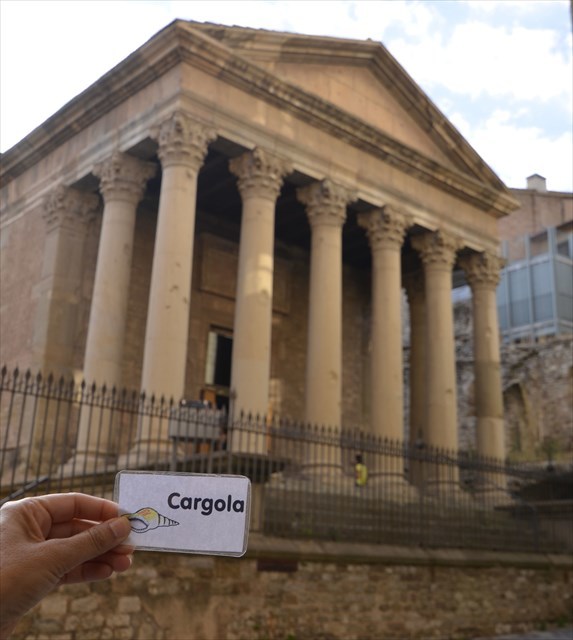
Per poder registrar aquest catxé virtual com a trobat, heu de fer-vos una foto on es vegi el vostre nick o avatar amb el temple de fons
To register this virtual cache as found, you must make a photo where you see your nick or avatar with the temple at background

Virtual Rewards 2.0 - 2019/2020
Aquest catxé virtual forma part de la sèrie limitada de Virtuals creats entre el 4 de juny de 2019 i el 4 de juny de 2020. Només 4.000 propietaris de catxés tenen l'oportunitat d'amagar un catxé virtual. Per saber més sobre els catxés virtuals 2.0 consulteu a Geocaching Blog.
Virtual Rewards 2.0 - 2019/2020
This Virtual Cache is part of a limited release of Virtuals created between June 4, 2019 and June 4, 2020. Only 4,000 cache owners were given the opportunity to hide a Virtual Cache. Learn more about Virtual Rewards 2.0 on the Geocaching Blog.