STEILNESET MEMORIAL
The Steilneset Memorial is a monument in Vardø, Norway, commemorating the trial and execution in 1621 of 91 people for witchcraft. The memorial was designed by artist Louise Bourgeois and architect Peter Zumthor, and was opened in 2011. It was Bourgeois' last major work.
Wikipedia
The Damned, the Possessed and the Beloved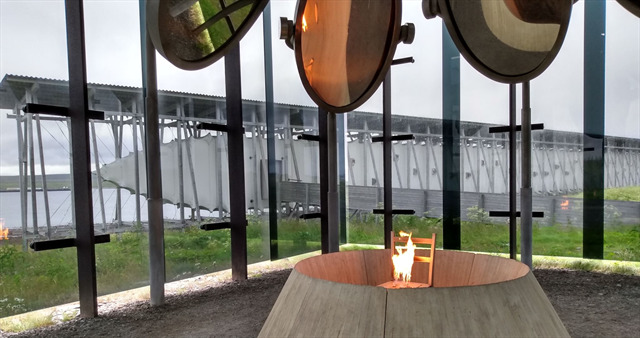
The sculpture by the Franco-American artist Louise Bourgeois (1911-2010) entitled "The Damned, the Possessed and the Beloved", is a perpetual flame that projects through a steel chair, which in turn is placed inside a concrete cone. the flames are refelcted by seven circular mirrors, like judges surrounding the accused. The entire installation is housed inside a black glass cube.
The memorial building
The memorial building consists of a long structure made of pine scaffold. Between the supporting poles hangs a cocoon made of wood that houses a black, 125 metres (410-feet) long corridor, lit by 91 small windows, one for each victim. On the walls inside are 91 plaques with simple texts that summarise the information we know from each trial.
nordnorge.com//EN-ost-finnmark/?News=469
The memorial building can be entered from both ends of the corridor. The written plaques inside the monument are in Norwegian only. At both ends of the corridor there are free guidebooks with an english translation of all the written texts inside the memorial.
Historical Background
The exhibition commemorates those who were executed during witchcraft trials in Finnmark, from 1600 to 1692. Brief texts about all those who were accused of witchcraft and sentenced to death, evoke a drama that was played out in courtrooms in Finnmark some 400 years ago.
The witchcraft trials in Finnmark took place towards the end of the period that saw persecution of witches all over Europe. What we know about Finnmark witchcraft trials mainly derives from court records of trials heard in local courts. The court records are now kept in a codex form in the Regional State Archives of Tromsø.
During the witchcraft trials in Finnmark, 135 persons - 111 women and 24 men - were prosecuted for practising witchcraft. Most of them lived in Vardø or Vadsø and these towns' immediate surroundings, and Vardøhus Castle played an important part in the trials. Of the persons tried, 91 persons - 77 women and 14 men - were executed. Use of torture was common during the Finnmark witchcraft trials, and the severest torture was carried out in the castle.
The outcome of the water ordeal was often used as evidence in a witchcraft trial, as it was held to be God's judgement. The procedure consisted of throwing the accused person into the sea with his or her hands and feet tied. Water, which was considered a sacred element, was thought to repel evil, so the suspect's rising to the surface and floating was an indication of guilt. Sinking was a sign of innocense. One-third of all who were exectued, were subjected to the water ordeal, and every one of them floated.
Norwegians and Samis lived side by side in the seventeenth-century Finnmark, and both ethnic groups suffered from the ongoing persecution of witches. Approximately four out of five persons accused were Norwegians (mostly women). The others were Samis (mostly men).
The Finnmark witchcraft trials were intense, characterised by clusters of trials lasting for short periods of time. Most of the death sentences were passed in so-called panics, meaning one trial led to another in rapid succession. In Finnmark, the panics only involved women.
This exhibition emphasises what is individual for every person who was executed during the witch-hunt in Finnmark. Each woman and man is named by her or his name. Correct historical information about these persons is made available to us. The texts serve as a reminder of thow the injustice of an implacable judiciary affects a community. They also reflect diversity, imagination, stamina and strength in the people involved.
Logging requirement:
Take a photo from inside the sculpure "The Damned, the Possessed and the Beloved" - with yourself and the eternal flame, and submit with your log. If you want to stay anonymous, use the mirrors and take a photo of the flame with some part of yourself in it - see examples:
Virtual Rewards 2.0 - 2019/2020
This Virtual Cache is part of a limited release of Virtuals created between June 4, 2019 and June 4, 2020. Only 4,000 cache owners were given the opportunity to hide a Virtual Cache. Learn more about Virtual Rewards 2.0 on the Geocaching Blog.