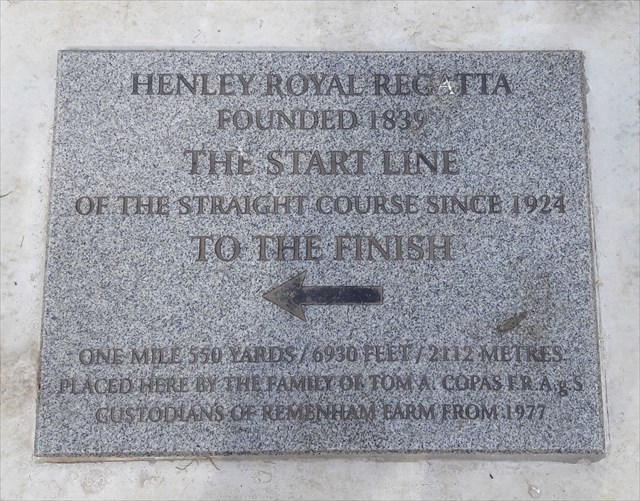
The listed coordinates are for a plaque on the Berkshire bank of the River Thames close to Temple Island marking the start line of the world-famous Henley Royal Regatta. As the following photo shows, the plaque gives the date at which the regatta was first held (1839) and the date that the start line was moved to this point (1924).
Known initially simply as the Henley Regatta, the event received its royal patronage in 1851, when Prince Albert became the first royal patron. Since the prince’s death, every reigning monarch has consented to be the patron.
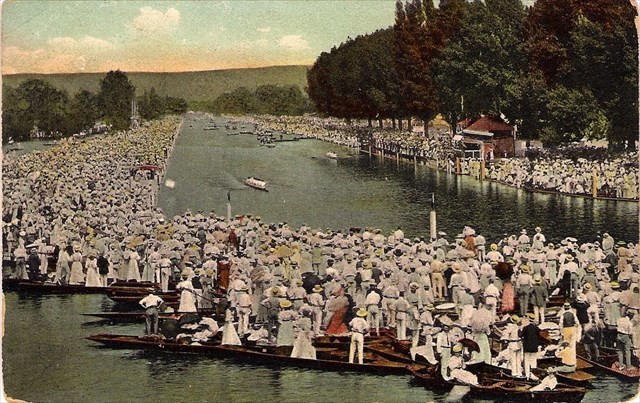
This picture of the Finish appears to have been taken from Henley Bridge and
(judging from the attire) probably during the Edwardian era.
First held on 14th June 1839, the regatta has taken place every year (with the exception of the war years) on the first weekend in July. It is regarded very much as part of the English social season and as with other events in the season, certain enclosures have strict dress codes. In the Stewards’ Enclosure, for example, men are required to wear lounge suits or blazers while women are to wear dresses or skirts with hemlines below the knee, with hats being ‘encouraged’. It was not until the heat-wave of 1976 that men were permitted to remove their jackets in the Stewards’ Enclosure.
The 1839 event proved so successful that the regatta was expanded the next year from one day to two. As the event’s popularity has grown over the years it has further expanded: to three days in 1886, four days in 1906 to the present five days in 1986. Today, the regatta attracts crews from all over the world. Details of the 1839 event can be found on the cache page for the nearby Trad cache (https://coord.info/GC886RB).
Although the course distance has always been described as being ‘about one mile and 550 yards’ from Temple Island upstream towards Henley Bridge, the course itself has undergone several changes over the years.
The Old Course (1839–1885) ran from a point just upstream (Henley end) of Temple Island. At the first regatta in 1839 the finish line was Henley Bridge itself but for the following year the finish was moved downstream slightly, eventually to a point opposite the lawn of the Red Lion Hotel which then became the standard finish line. A grandstand was erected for the Stewards and their guests outside the Red Lion. Other spectators could watch from the adjacent roadway (in front of the Little White Hart Hotel) while those with carriages surveyed the scene from a vantage point on Henley Bridge. There were three racing lanes during this period.
The New Course (1886–1922) started just downstream of Temple Island, on the Bucks side and finished opposite the upstream end of Phyllis Court, very close to the current finish line. There were two slight bends (at Remenham and just after Fawley) and a staggered start line was designed to compensate for any advantages/disadvantages that might result from these. The number of lanes was reduced from three to two as part of these changes.
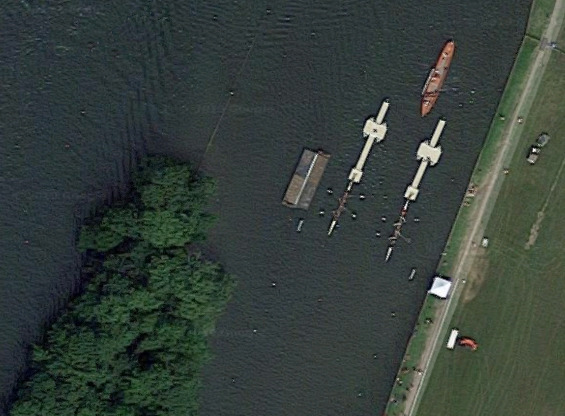
The Experimental Course (1923) and the Straight Course (1924 onwards). Around 1920, the Stewards began to consider ways of straightening the course and as a first step decided to experiment with moving the start to the Berks side of the river. But at that time the channel on the Berks side of Temple Island was little more than a shallow backwater so the start line for the 1923 event had to be set upstream (Henley side) of the island. But the experiment was deemed successful enough to justify a permanent change. So, with the consent of the landowners of the island and the river bank the Berks channel was widened and deepened to permit the start line to be placed down-stream of the island. The work was completed in time for the 1924 regatta at which point the start line was moved to its present position – on the Berks side of the river and downstream of the island, as shown above.
Click here for more information about the history of Henley Royal Regatta.
To claim the Cache:
1. What prominent feature can be seen in the far distance, in the direction of the Finish?
2. What is the compass bearing (in degrees) of this feature from the listed coordinates?
3. A photograph of Temple Island should be posted with you log, including (if possible) your GPSr, geo-hound, etc. There is no need for the photograph to include yourself.
Please email your answers to Q1 and Q2 to us through our profile. Please do not mention this information in your log.
Note: Since 1924, the 'prominent feature' has been used by coxes as an ‘aiming point’ as they navigate up the course.
Please note also that logs not supported by answers emailed to us within a reasonable period of time may be deleted without warning.
Congratulations to rosela-R for being the first to submit his log and correct answers, and to VR7 for running a very close second. Very well done, folks.
22.07.19: And massive congratulations to Tom Tom's Army for achieving their 7500 milestone.
Virtual Rewards 2.0 - 2019/2020
This Virtual Cache is part of a limited release of Virtuals created between June 4, 2019 and June 4, 2020. Only 4,000 cache owners were given the opportunity to hide a Virtual Cache. Learn more about Virtual Rewards 2.0 on the Geocaching Blog.