The Story of the Lost Patrol
The Northwest Mounted Police began in 1904 to dispatch dog team patrols to the high north to deliver mail, keep the law in the new frontier and to protect Canadian interests. Their route from Fort McPherson to Dawson City took them some 550 miles over some of the toughest, coldest terrain in Canada. These patrols, though very tough on men and dogs, went without incident until 1911. That year, the tragedy struck as an expedition, led by Inspector Francis J. Fitzgerald, which included Constables G.F. Kinney, R.O.H. Taylor and a guide, Special Constable Sam Carter, perished near Fort McPherson.
Francis Joseph Fitzgerald was a Nova Scotian who became a celebrated Boer War veteran and the first commander of the Royal Northwest Mounted Police detachment at Herschel Island in the Western Arctic (1903). Fitzgerald served with the militia in Halifax until the age of 19 and then enlisted as a constable in the North-West Mounted Police on 19 November 1888. He spent the next nine years in the Maple Creek District, Saskatchewan. At age 28, under the command of Inspector John Douglas Moodie, Fitzgerald was the first to chart an overland route from Edmonton to Fort Selkirk, Yukon via northern British Columbia and the Pelly River (1897). The voyage took eleven months, having covered about 1,000 miles (1,600 km). As a result of this achievement, Fitzgerald was promoted corporal in 1899.
In late 1910 Fitzgerald was selected for the contingent to be sent to George V’s coronation. To get him out of the north in time, it was decided that he would head the annual patrol that winter from Fort McPherson to Dawson, a distance of some 470 miles (750 km). Given the competitive spirit within the police, Fitzgerald undoubtedly saw this trip as an opportunity to break the time record set by an earlier patrol. He therefore decided to lighten the load on his sleds by reducing food and equipment, confident that the quantities normally taken would not be needed.
On 21 December 1910 Fitzgerald left Fort McPherson with three other constables. From the outset, the patrol was slowed by heavy snow and temperatures as low as −62 °C (−80 °F). They were unable to find the route across the Richardson Mountains. Nine days were wasted searching for it. With supplies dwindling, Fitzgerald reluctantly had to admit defeat and turn back toward Fort McPherson. The patrol now faced a desperate struggle. As food ran out, they began eating their dogs. In the last entry in his diary, on 5 February, Fitzgerald recorded that five were left and the men were so weak they could travel only a short distance. Within a few days all four died, three from starvation and exposure, including Fitzgerald, and one by suicide.
When the four failed to return to Dawson, a search party led by Corporal William John Dempster set out to find the missing patrol. Dempster found the bodies and, as a result of the successful search, Dempster became a celebrated hero. The Dempster Highway is named after him. The grisly discoveries of the bodies of Taylor and Kinney, then Carter and Fitzgerald, were all made within 50 km of Fort McPherson on March 21-22, 1911.
The Virtual Cache
This virtual cache takes you to the site where constables C.F. Kinney and R.D.H. Taylor perished. It is located on the northwestern bank of the Peel River, a few hundred yards north from the Northwest Territories / Yukon Territory border. There is a monument, maintained by RCMP, containing a wooden pyramid with a memorial plaque and a flag pole. Your task is to get to the location and take a photo of yourself or a personal item (such as a GPSr) in front of the memorial plaque and add the photo to your log. Showing your face in the photo is not required. My own photo at the memorial:
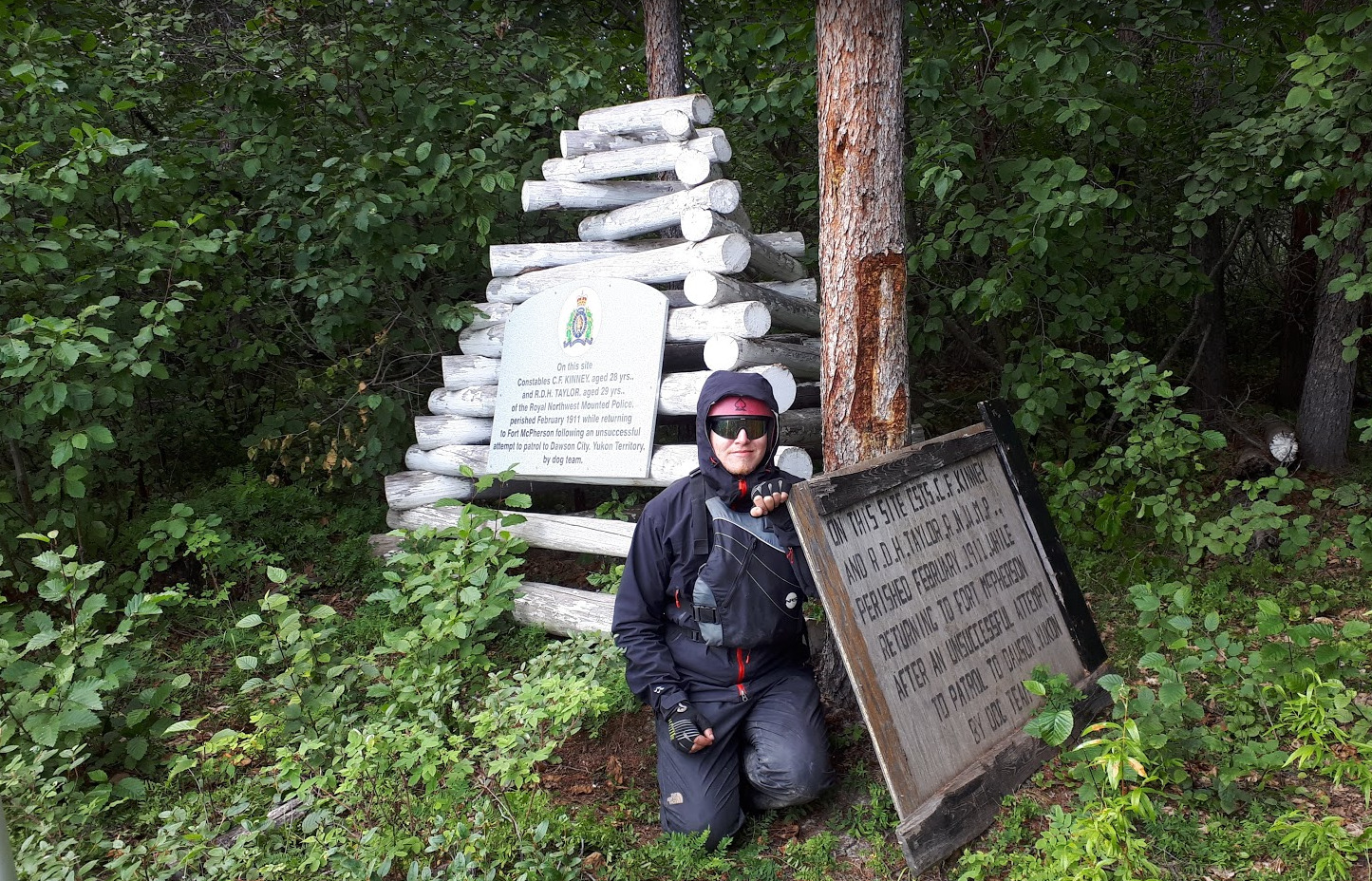
There are no roads nearby (the Dempster Highway passes some 30 km to the north), so using a boat (or a dog sled in the winter!) is most likely required to reach the site. Use your common sense and do not try to reach the site without an experienced guide as the cache is located in the wilderness with no cell phone coverage.
Virtual Rewards 2.0 - 2019/2020
This Virtual Cache is part of a limited release of Virtuals created between June 4, 2019 and June 4, 2020. Only 4,000 cache owners were given the opportunity to hide a Virtual Cache. Learn more about Virtual Rewards 2.0 on the Geocaching Blog.