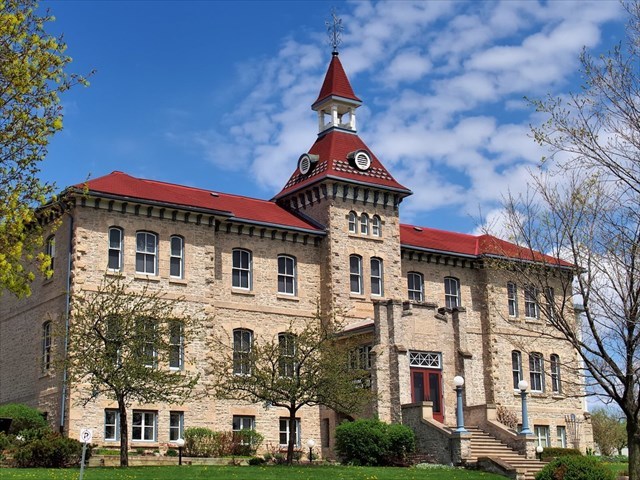
The Wellington County House of Industry and Refuge National Historic Site of Canada is a former working farm with a large stone building standing high on a hill. It is located beside the Grand River in the former hamlet of Aboyne between Elora and Fergus in southwestern Ontario. For almost a century, this was the county poorhouse: today it is the county museum and archives.
The Wellington County House of Industry and Refuge was built in 1876-1877 as the shelter of last resort for the homeless and destitute in Wellington County. Its original inhabitants traded their domestic or agricultural labour for spartan living accommodations. In later years it became a home for the elderly and infirm. The institution closed in 1971 and the main building was rehabilitated as the Wellington county Archives and Museum in 1987-88. Part of the farm survives in agricultural production.
The Wellington County House of Industry and Refuge was designated a national historic site in 1995 as the oldest rural poorhouse or “alms house” in the Country that is still standing. It is an important 19th-century social institution because it provides an excellent illustration of the origins of the 20th-century theme of state involvement in social policy.
General admission to the “Poor House” is via donation and the times that the Museum is open is:
Monday to Friday: 9:30 am - 4:30 pm
Saturday and Sunday: 1:00 - 5:00 pm
The Museum and Archives are open daily throughout the year, except on government and statutory holidays. The 1877 Heritage Barn closes seasonally from November through April.
LOGGING THE VIRTUAL
This virtual may take some time to complete because you will be visiting the exhibits in the museum to find the answers. I encourage you to set aside some time to visit the exhibits to really enjoy them and take in the information presented there. These questions are all taken from the permanent exhibits in this museum.
If These Walls Could Speak
This is likely the first exhibit you will visit because it starts on the second level across from the stairs. There is a very large mural of some of the people who resided at the Poor House and it captured my attention for a long time. I wondered about the people and their stories. I encourage you to take some time to look at the mural and then ask yourself: have we changed much in regards to the notion of the deserving versus the undeserving poor?
1. How many Holstein cows do you see, including calves? (this does not include the Jersey cows; check the diorama)
2. How many canes do you see in the large mural (large mural *only*; Note: the answer is NOT 4).
3. How many people are wearing glasses in the large mural?
4. There were many deaths at the Poor House and you will need to find the plaque that discusses this (it is on the same floor level as If These Walls Could Speak). Who died June 17? How old was he and what was the cause?
Far From Home: A Soldier's Life At The Front
This major gallery installation features a life-size trench and takes an in-depth look at the young soldiers and nurses who served in World War I. Descendants of Wellington County soldiers were used as models for the mannequins and painting in the gallery.
It's 11 am, a quiet time in the trenches. The night-time bombardments and; trench raids are over. Private Ken Anderson surveys No Man's land for movement. Beside him Private Glasford Adsett does sentry duty. Seated, private Jim Rogers pulls out a photo of his mother Annie. He kicks at a rat at his feet. Their feet are all freezing and they are covered in lice.
5.How many rats are in the trenches exhibit? (look carefully)
6. Mount Forest: one name is different from all the others. What is this name? (hint: step out of the trenches exhibit and look up) Note: it's not FW Campbell
The Jewel: Classic Movie Theatre
Here you will see some seating and original stage curtains from the Palmerston Library theatre, which was located on the top floor of the Palmerston Library. The theatre operated as an opera hall, community centre, and movie theatre from 1905 until 1947. Unused since the 1990s, it was closed and converted into more accessible space for the public during renovations in 2015.
Each plywood seatback had a number plate to correspond to a seating plan. Also, underneath each seat is a wire rack to store a brimmed hat, a very common accessory worn by men in the first half of the 20th century.
7. When you first enter the theatre, look at the first poster on the left. What is the title of the movie?
8. There is a woman listed on this poster, what is her name and her role? (hint: initials CSB).
First Story: The Neutrals in Wellington County
As they ploughed their fields over the past two centuries, farmers of Wellington County uncovered the stone axes and arrowheads of our earliest farmers -- the "Attawandaron" (Neutrals). In the cedar and elm forests of Puslinch Township, evidence of two settlements of the Neutral Nation was excavated in the 1980s: a 15th century village (named the "Ivan Elliot Site" after the farmer who owned the land) and a 16th century hamlet, named the "Raymond Reid Site". Both of these sites date to a time before European contact.
9. In the 17th century, by whom were the Neutrals conquered?
NOTE: as of September 14, 2022, failure to properly post the necessary photo within 24 hours of your "found it log" will result in your "found it" log being deleted with no warning nor any explanation from me (because it's crystal clear in the write up). I will no longer chase people to properly log this virtual so read the instructions for #10 carefully (below). Do NOT send the photo in your message to me with your answers - that's not where it goes. If you're having trouble figuring out where to take the photo, look at photos from past cachers.
10. Include a pic of yourself or something of yours (your thumb, for example) standing in the doorway of the Poor House next to the mural that shows the woman with her children coming up the stairs. This mural is inside the museum, NOT outside. This was the original doorway to the Poor House. Post this photo in your found it log - do NOT send it to me. Note: this is required to log a find.
Virtual Rewards 2.0 - 2019/2020
This Virtual Cache is part of a limited release of Virtuals created between June 4, 2019 and June 4, 2020. Only 4,000 cache owners were given the opportunity to hide a Virtual Cache. Learn more about Virtual Rewards 2.0 on the Geocaching Blog.