[Ita]
E' un punto panoramico che abbraccia tutta la storia di ivrea
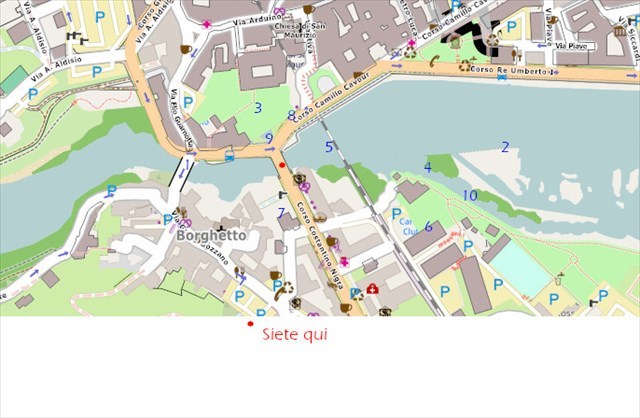
se lo pensiamo intorno al 100 d.c vediamo a Ovest il Ponte Vecchio(1), già presente anche se probabilmente costruito in legno e a est, in mezzo alla dora possiamo immaginarci le barche che probabilmente navigavano il fiume e un altro ponte, il pons major (2) Una bella storia del ponte vecchio è raccontata benissimo dai Croass e la puoi leggere nel loro sito
Nel XIII secolo questo punto è dominato a Nord dal Castellazzo(3), il castello costruito dai Marchesi di Monferrato andato completamente distrutto. La leggenda vuole che sia stata la rivolta popolana avviata dal gesto di Violetta, che trovandosi nel castello per pagare lo jus primae noctis aveva tagliato la testa al Marchese esponendola dal balcone conficcata su una spada. La rivolta contro il marchese a chi gli era fedele e l'acclamazione di Violetta sono i temi del nostro Carnevale, che si trasformano in battaglie delle arance e rappresentazione dei personaggi storici per alcuni giorni ma per mille dialoghi feste e celebrazioni durante l'anno.
La Dora probabilmente in questo periodo ospitava mulini(4), Violetta infatti era la figlia di un mugnaio: la mugnaia!
Nel 1858 viene costruito il ponte su cui siete appoggiati
La notte di Natale del 1944 un'azione partigiana spezza con l'esplosivo il ponte ferroviario(5). La missione, compiuta dalla brigata Rosselli, guidata da Alimiro, scongiura un bombardamento alleato: il ponte è obiettivo strategico perché permette il trasporto delle lavorazioni dell'acciaieria di Cogne. L'azione condotta da due sabotatori (Alimiro e D'Artagnan) è ancor più degna di nota se si considera che il ponte era presidiato; che la palazzina(6) alle spalle dello stadio della canoa ospitava la caserma della X MAS e che il comando nazista alloggiava nella villetta(7) che, guardando verso sud a destra, è il secondo edificio. Per chi vuole approfondire l'argomento può trovare maggiori informazioni qui:
http://www.memoriadellealpi.org/download/GRUPPO01~PDF_SENTIERI/IVREA-memorie.pdf
I bombardamenti c'erano comunque già stati e la gente si affollava nel rifugio antiaereo che ha l'accesso alla destra della fontana(8)
Nel 1957 viene costruita dall'artista Emilio Greco, la fontana dedicata a Camillo Olivetti(9) che rappresenta una colonna di tasti della macchina da scrivere
Lo stadio della canoa(10) è stato portato allo stato attuale nel 2016 e da allora è parte dei circuiti di numerosi campionati. In tutte le stagioni dell'anno è facile vedere canoisti che si allenano nelle acque della dora
Per loggare il cache è necessario recarsi davanti al pannello informativo a GZ e inviare un messaggio all'owner con l'ultima data completa riportata.
[eng]
It's a panoramic spot from where it's possible to see all the phases of the history of Ivrea.
from around 100 a.d. there is the Ponte Vecchio (1) to the West, already there at the time, even though it was probably made of wood, and to the East, in the middle of the Dora river, we can imagine the boats navigating it and another bridge, the pons major (2). A well written history of the Ponte Vecchio has been written by the Croass and it can be read on their website.
From the XIII century there was the Castellazzo (3) to the North, the castle built by the marquisis of Monferrato, that was completely destroyed. According to the legend the destruction of the castle was caused by the rebellion started by Violetta, that while being in the castle for the jus primae noctis had beheaded the marquis and put his head on the balcony, impaled on a sword. The rebellion against the marquis and those who were loyal to him and the acclamation of Violetta are the main themes of our Carnival, and are now represented by the Battle of the Oranges and the parade of the historical characters for a few days, and by countless celebrations during the whole year. At the time there were probably mills on the Dora river (4) since Violetta was the daughter of a miller.
The bridge you're on was built in 1858.
On Christmas Night in 1944 an action of the partisans destoyed the railway bridge with explosive (5). The mission, accomplished by the GL brigade lead by Alimiro, avoided a bombing by the Allies: the bridge was a stategic objective because it made the transportation of the products of the steelworks of Cogne possible.The action the two saboteurs (Alimiro and D'Artagnan) were able to carry out is even more impressive if we consider the fact that the bridge was manned, the buildings (6) behind the canoeing stadium were fascist bases and the nazi commando was located in the villa (7) that, looking South and to the right, is the second building. For whoever feels like getting further information about these events, more details are available here:
http://www.memoriadellealpi.org/download/GRUPPO01~PDF_SENTIERI/IVREA-memorie.pdf
There had already been bombings of the city and in those occasions people used to use the bomb shelter located to the right of the fountain (8)
In 1957 the Artist Emilio Greco built the fountain dedicated to Camillo Olivetti(9) which represents a column of key of the typewriter.
The canoeing stadium is the way it looks now since 2016, and from that year on it hosted countless championships. It's possible to see canoeists training in the river in every season of the year.
To log the cache it's necessary to go in front the explanatory table on GZ and send a message to the owner containing the last complete date shown.
Virtual Rewards 2.0 - 2019/2020
This Virtual Cache is part of a limited release of Virtuals created between June 4, 2019 and June 4, 2020. Only 4,000 cache owners were given the opportunity to hide a Virtual Cache. Learn more about Virtual Rewards 2.0 on the Geocaching Blog.