
Un sentito grazie a ilTozzo per la sua idea e il suo aiuto nella creazione di questa cache.
A big thank you to ilTozzo for sharing his idea and helping in the creation of this cache.
ITALIANO / ENGLISH
A Milano, le prime ipotesi e proposte di costruzione di una linea metropolitana risalgono addirittura alla metà dell’Ottocento, anche se prima di vedere un progetto concreto dovrà passare quasi un secolo: nel 1952 l’amministrazione comunale approvò un progetto, ideato dall’ingegner Amerigo Belloni, per la costruzione di 4 linee. Nell’ottobre del 1955 venne fondata la Società Metropolitana Milanese; il suo primo presidente fu Ercole Bottani (1897-1978), ingegnere e insegnante al Politecnico, che all’epoca si impegnò per promuovere la costruzione della metropolitana. Celebre la sua frase: “Queste cose si possono fare solo a Milano, e perciò si devono fare”: la neonata società, infatti, aveva come unico scopo quello di occuparsi della costruzione e della gestione della nuova infrastruttura.
Il 4 maggio 1957 fu aperto il primo cantiere; fu introdotto un metodo del tutto innovativo di costruzione, poi esportato in tutto il mondo come "Metodo Milano", che prevedeva la costruzione quasi completamente in sotterranea, in modo da ridurre al minimo i disagi viabilistici e il sovraccarico sulle fondamenta dei palazzi. I lavori si conclusero nel 1964: il 1 novembre di quell’anno i treni della M1 fecero il loro viaggio inaugurale lungo il percorso da Sesto Marelli a Lotto. Nell’aprile dello stesso anno erano già iniziati i lavori per la costruzione della seconda linea, che terminarono cinque anni dopo, con l’inaugurazione del 4 ottobre.
Le stazioni delle prime due linee della metropolitana furono disegnate dagli architetti Franco Albini e Franca Helg, mentre il designer olandese Bob Noorda ne curò la segnaletica: questo progetto fu innovativo per l’epoca, tanto che vinse il premio Compasso d’Oro nel 1964 ed è ad oggi studiato e imitato in tutto il mondo. La particolarità dell’allestimento delle stazioni era quella di coniugare funzionalità e facilità di utilizzo; i particolari più innovativi erano la pavimentazione, il design dei corrimano e gli orologi presenti nei mezzanini, anche se l’elemento caratterizzante era l’uso di una fascia colorata lungo le pareti che riportasse tutte le informazioni necessarie per orientarsi all’interno della stazione, insieme al nome stesso della stazione ripetuto diverse volte, in modo che fosse ben visibile anche da un treno in movimento. Elementi e concetti simili, seppur con alcune differenze stilistiche, sono stati adottati anche per le linee successive. L'unico elemento comune a tutte le linee è il Noorda, il carattere di scrittura usato per i nomi delle stazioni e per tutto il resto della segnaletica delle stesse; come suggerisce il nome, fu creato da Bob Noorda appositamente per l'uso nella metropolitana di Milano.
Attualmente la rete metropolitana milanese è la più estesa in Italia e la sesta in Europa, con un totale di 111,8 km e 134 fermate suddivise su 5 linee.
The idea of a Metro in Milan had been around since the half of XIX Century, but to see a real project people had to wait about one century: in 1952 the City Council approved the project by engineer Amerigo Belloni, which included the construction of 4 lines. In October 1955 was founded the society Metropolitana Milanese; its first chairman was Ercole Bottani (1897-1978), an engineer and professor at the Politecnico University, who promoted the construction of the metro; one of his famous sentences was: “This kind of things can be done only in Milan, that’s why we ought to do them”. The newborn society had as its only aim to handle the construction and the management of the new metro.
On 4th May 1957 the roadworks started; it was introduced an innovative method of building (later exported all over the world and known as "Milan Method") which involved construction almost completely underground, to minimize road disruption and overloading on the foundations of the buildings. The construction works ended in 1964: the 1st of November the first trains made their opening trip along the route from Sesto Marelli to Lotto. During the same year, in April, the roadworks for the construction of the second line had already started, and they ended five years later, with the opening ceremony of the 4th of October.
The stations of the first two lines were designed by architects Franco Albini and Franca Helg, while Dutch designer Bob Noorda took care to the graphics and the signposting. This project was innovative for that time, and it won the Compasso d’Oro prize in 1964; still today, it’s studied and followed all over the world. The most particular details in the stations were the paving, the design of the handrails and the clocks in the mezzanine, but the most characteristic element was the usage of a long colored band all along the walls which showed all the needed information, including the name of the station itself repeated many times, so that it could be seen even from a moving train. Similar elements and concepts were adopted also for the other new lines, only with some stylistic differences. The only common element in all lines is the Noorda, the font used for the names of the stations and all the other signs in them; as the name suggests, it was created by Bob Noorda specifically for the Milan Metro.
Now, the metro system of Milan is the largest Italy and the sixth of Europe, with 5 lines, 111.8 km of extension and 134 stations.
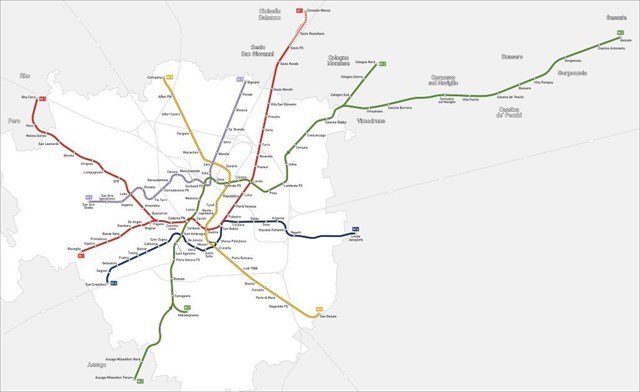
Estensione attuale della Metropolitana di Milano / Current extension of the Milan Metro

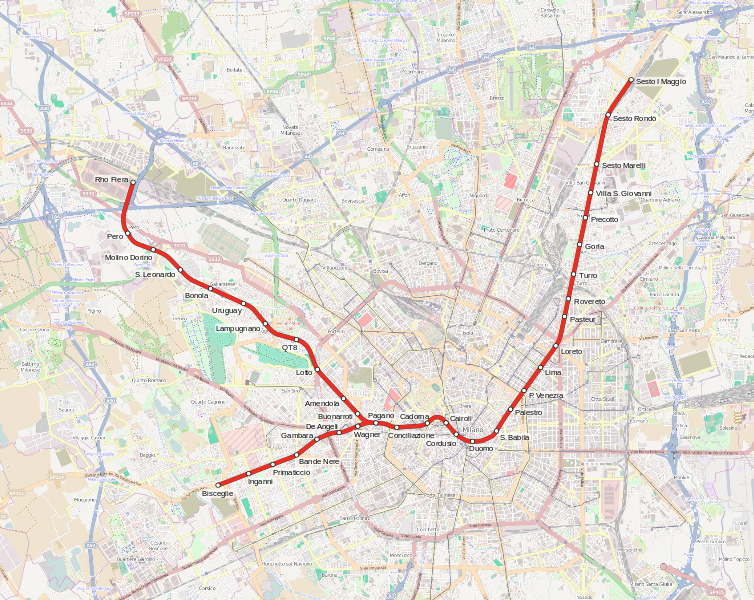
La linea 1 della metropolitana è caratterizzata dal colore rosso e collega la periferia nord-est della città con il centro, da cui poi si divide in due diramazioni verso sud-ovest e nord-ovest; quest’ultimo ramo raggiunge Rho e il polo fieristico lì situato. Il suo percorso totale è lungo 27 km e comprende 38 stazioni. È la linea più antica della città, inaugurata nel 1964 nella tratta Sesto Marelli - Lotto, che è stata poi successivamente estesa a quella attuale, completata nel 2005. Attualmente, sono in costruzione due nuove fermate per allungare il percorso fino alla città di Monza.
Metro Line 1 is characterized by red color and it connects the north-eastern part of the city with the center, where it splits into two branches going south-west and north-west; the latter one ends in Rho, connecting the city with its Exhibition Center. The complete route is 27 km long and includes 38 stations. It’s the oldest line of the city, it was opened in 1964 when the route was only from Sesto Marelli to Lotto; it has been subject to many extensions during the years, until 2005 when it reached the current one. Two new stations are under construction, and this extension will connect Milan with the city of Monza.

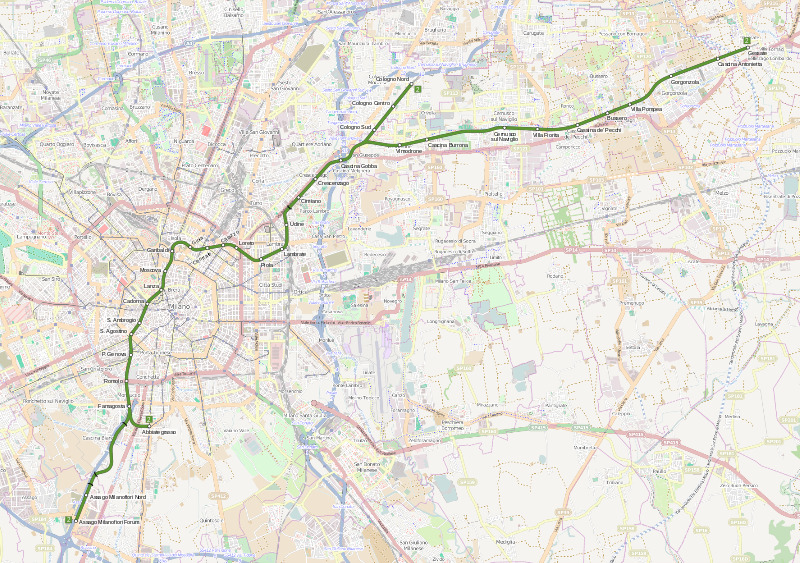
La linea 2 della metropolitana è caratterizzata dal colore verde e collega l'hinterland a est di Milano con la periferia sud, passando per il centro e toccando, lungo il suo percorso, ben quattro stazioni ferroviare, tra cui le tre più importanti della città. È la linea più lunga della rete, con 40,4 km di estensione totale e 35 stazioni, di cui 15 si trovano al di fuori dell'area urbana.; è anche l'unica linea a percorrere alcuni tratti allo scoperto anziché sottoterra. Fu inaugurata nel 1969 nella tratta Cascina Gobba - Caiazzo, mentre l'ultima estensione risale al 2011, con l'apertura delle due fermate nel comune di Assago, a sud di Milano.
Metro Line 2 is characterized by green color and it connects the eastern suburbs with the southern area of the city, passing through the center and touching, along its route, 4 different railway stations, including the three main ones. It’s the longest line of the system, with an extension of 40,4 km and a total number of 35 stations; 15 of them are outside the city borders. It’s also the only line with some parts that are in the open and not underground. It was opened in 1969, when the route was Cascina Gobba - Caiazzo, while the last extension was made in 2011, with the opening of two station in the town of Assago, south of Milan.

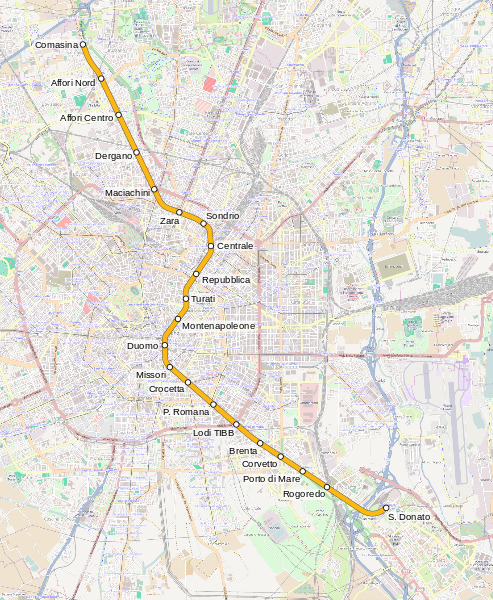
La linea 3 della metropolitana è caratterizzata dal colore giallo e collega la periferia nord con la periferia sud-est della città di Milano. Sebbene il progetto di costruzione fu approvato nel 1977, i lavori di costruzione iniziarono nel 1981 e l’inaugurazione di una breve tratta (Centrale - Duomo) avvenne solamente nel 1990, in occasione del Mondiali di Calcio. Nel 1991 raggiunse la sua estensione attuale verso sud, mentre il proseguimento a nord proseguì una fermata alla volta, fino all’attuale capolinea di Comasina, aperto nel 2011. Ad oggi, comprende 21 stazioni per un totale di 16,6 km. Il progetto grafico e architettonico fu assegnato a Claudio Dini, che cercò di aumentare la luminosità delle stazioni e di ridurre gli spazi morti, utilizzando anche materiali di maggior pregio rispetto alle linee precedenti.
Metro Line 3 is characterized by yellow color and it connects the northern area of the city with the south-eastern area. Even if the project had been approved in 1977 and the construction works started in 1981, the opening of a very short part of the line (Centrale - Duomo) was only in 1990, on the occasion of the FIFA World Cup. In 1991 the south extension was completed, while the northern one continued one station at a time, until the current end-stop of Comasina, opened in 2011. Currently, it is 16,6 km long and includes 21 stations. The graphic and design project was made by Claudio Dini, who tried to eliminate “dead” areas and make stations more bright; he also used more precious marterial in comparison to the first two lines.

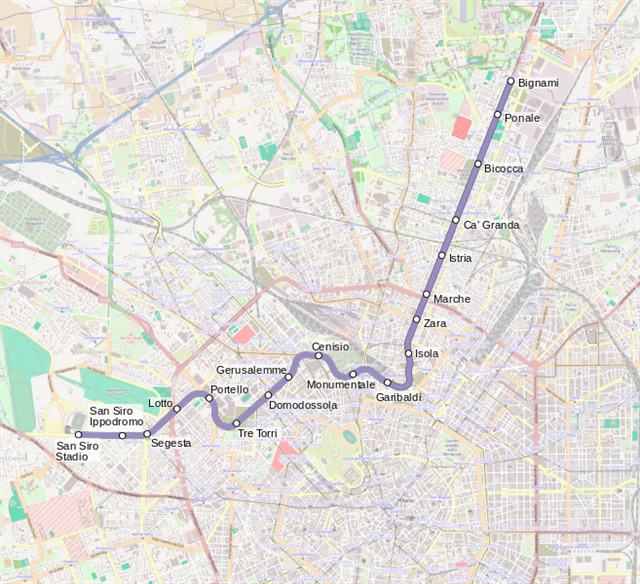
La linea 5 della metropolitana è caratterizzata dal colore lilla e collega la periferia nord-est allo stadio San Siro, nella periferia ovest, passando per la parte nord della città; infatti, è l’unica linea a non attraversare il centro di Milano. Comprende 19 stazioni e si estende per un totale di 12,9 km. I lavori di costruzione iniziarono nel 2007 e la prima tratta (Bignami - Zara) fu inaugurata nel 2013, mentre la linea raggiunse l’estensione attuale solo due anni dopo, con l’apertura della fermata Tre Torri. È la più moderna tra le linee della rete metropolitana, sia per quanto riguarda architettura e design delle stazioni, sia per le caratteristiche tecniche dei treni, che hanno un sistema di guida completamente automatico. Nonostante sia la quarta linea in ordine cronologico, le è stato assegnato il numero 5 poiché è stata la quinta linea in ordine di progettazione.
Metro Line 5 is characterized by lilac color and it connects the north-eastern area of the city with the San Siro stadium, in the western area, passing in the northern part of the city; indeed, it’s the only line that doesn’t pass through the city center. It includes 19 stations on a 12,9 km long route. The construction works started in 2007 and the first part of the line (Bignami - Zara) was opened in 2013; it was completed only two years later with the opening of the station Tre Torri. It’s the most modern line of the system, both in the architecture and design, and in the technical features of the trains, which have a completely automated guiding system. Even if it’s the fourth line to be opened in the city, it is named with the number 5 because it was the fifth in order of planning.
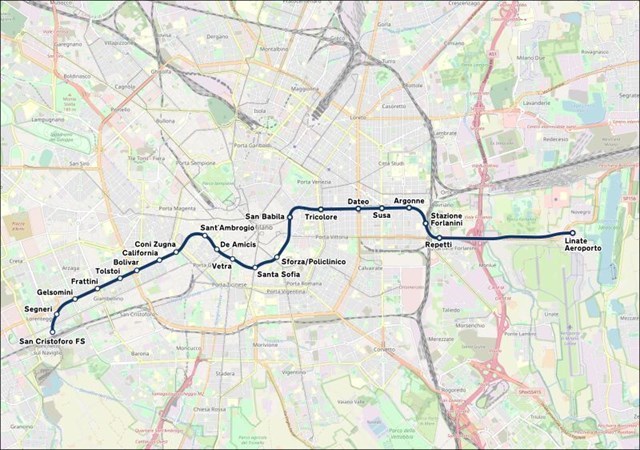
La linea 4 della metropolitana è caratterizzata dal colore blu e collega l’aeroporto di Linate, situato nella periferia est della città, con la periferia a sud-ovest, passando per il centro. Ha le stesse caratteristiche della M5, in particolare per quanto riguarda il materiale tecnico: anche questa linea ha, infatti, treni con sistema di guida automatizzato. I lavori di costruzione sono iniziati nel 2012 e l’apertura della prima tratta (Linate - San Babila) è avvenuta alla fine del 2022, mentre l’apertura della linea completa è avvenuta ottobre 2024. Comprende un totale di 21 stazioni, con una lunghezza di 15 km.
Metro Line 4 is characterized by blue color and it connects Linate Airport, right outside of the city in the eastern part, with the south-west area, passing through the city center. It has the same features of M5, especially the technical ones: this line has completely automated trains, too. The construction works started in 2012 and the opening the first part (Linate - San Babila) happened at end of 2022, while the complete opening happened in October 2024. It includes 21 stations and a 15 km long route.
La Cache
Per loggare questa cache dovrete allegare al vostro log sei foto che ritraggano voi (non necessariamente il vostro viso) o, in alternativa, un oggetto personale o un foglio con scritto il vostro nickname insieme ad alcuni elementi legati alla Metropolitana di Milano. In mancanza di anche solo una foto tra quelle richieste, il log non sarà considerato valido.
-
Alle coordinate dei waypoint vi troverete di fronte a uno degli ingressi della fermata Piola della metropolitana: scendete le scale fino al mezzanino e cercate, nel punto corrispondente alle coordinate del listing, la targa che commemora Ercole Bottani: qui dovrete scattare la prima foto, insieme alla targa.
-
Le altre cinque foto vanno scattate in altrettante stazioni della metropolitana, una per ogni linea (M1, M2, M3, M4, M5). Nelle foto deve vedersi OBBLIGATORIAMENTE il cartello "ufficiale" con il nome della stazione e il colore corrispondente alla linea (insieme a voi o al vostro oggetto personale), ma non è necessario che sia scattata nella zona binari: può essere presa lungo le scale, anche da fuori; l’importante è che si vedano il nome e il colore. Foto fatte nelle stazioni del Passante Ferroviario (linee S) non saranno ritenute valide, anche se prese nelle stazione dove incrocia con le linee della metro. Foto fatte al nome della stazione in altri punti (schermi, indicazioni, cartelli, etc...) che non siano il cartello ufficiale all'esterno o nella zona binari non saranno ritenute valide.
N.B. Questa cache può essere completata anche senza accedere ai treni e senza comprare alcun tipo di biglietto. Per avere maggiori informazioni sugli orari di apertura, visitate il sito dell’ATM.
The Cache
To log this cache you will have to attach six pictures to your log: they must show you (you don’t have to show your face), or a personal object, or a piece of paper with your nickname written on it, together with some details of the Milan Metro. Even if only one of the requested pictures is missing, your log will not be considered valid.
-
At the coordinates of waypoints you’ll find one of the entrances to Piola Metro station: go down the stairs to the mezzanine and look for the commemorative plaque for Ercole Bottani (roughly at posted coordinates): you have to take your first picture here, with the plaque.
-
The other five pictures must be taken in five different metro stations, one for each line and its related color (M1, M2, M3, M4, M5). The pictures MUST show the "official" sign with name of the station and the color matching the line (together with you or your personal item), but it’s not necessary to take it in the platform area: it can be shot along the stairs from outside; the only mandatory element is the name of the station and its matching color. Photos taken in or around the Underground train stations (S Lines) will not be considered valid, even if taken in stations where it crosses the metro line. Photos including the name of the station in any point (screens, signs, directions, etc...) other than the official sign in the platform area or on the outside will not be considered valid.
NOTE: this cache can be completed without entering the Metro system and without buying any kind of ticket. To be informed about the opening hours, visit the ATM website.
Virtual Rewards 2.0 - 2019/2020
Questa Virtual Cache è parte di una serie limitata creata tra il 4 Giugno 2019 e il 31 Dicembre 2020. Solo 4.000 geocacher hanno ricevuto la possibilità di nascondere una Virtual Cache. Trovi maggiori informazioni sulle Virtual Reward 2.0 sul Geocaching Blog.
This Virtual Cache is part of a limited release of Virtuals created between June 4, 2019 and December 31, 2020. Only 4,000 cache owners were given the opportunity to hide a Virtual Cache. Learn more about Virtual Rewards 2.0 on the Geocaching Blog.