One of a series of simple, easy to find, caches at railway stations in and around Tasman.
Welcome aboard the New Zealand Rail service to Gowan Bridge! Last stop Glenhope, next stop Gowan Bridge.
When construction of the line ceased in 1917 due to shortages of men and materials diverted to the war effort, five of the six kilometres to Kawatiri had completed formation, the last kilometre requiring a tunnel and two bridges. A new Minister of Public Works, Gordon Coates, set about an all out effort to finish the various rail projects around the country, including completing this one at least to Murchison. A new construction camp at Woodhen Bend was built across the river and slightly towards Nelson from Kawatiri today. It was to soon change its name when a postoffice was installed and called Pikimanu.
The tunnel was slow work as only 30 men could work on it, fifteen at each face. They would use a hand-drill and hammer to to make 40 holes, place the gelegnite and then use picks, shovels and and a horse drawn dray to remove the material. Forty sticks of gelignite was the maximum that could be safely lit before the first one exploded. After a painfully slow 60m of progress a compressor was provided which made big improvements to the drilling. Government funding was also a problem, keeping the work force small - 27 men in 1921, up to still only 50 in 1923. In 1927 the new Minster increased the workforce to 80 men, perhaps after more nagging by by the Progress League who were complaining in loud terms about the slow progress.
The 6 kilometres from Glenhope to Kawatiri took 14 years to build, in terms of opening dates of the two stations. Kawatiri opened in 1926, and the new station did little to improve the profitibility of the line. It was a flag station only (stop on request) and was serviced by a train from Glenhope. As it was not manned, even heavy freight would only be delivered if it could be collected the same day. Outwards freight still had to be delivered for loading at Glenhope. However Kawatiri was popular for the occasional summer excursions. People would take day excursions to enjoy exploring the area or taking a Spiers bus to Lake Rotoroa.
The station was closed in July of 1931, having been opened for just five years and twenty-one days. The next month the non-political Railway Board toured the route from Glenhope to Inangahua at the behest of the Progress League. They gave the the League a "courteous and attentive hearing "and subjected them to a vigorous questioning. In October they announced that operations to Kawatiri would not be resumed as the little freight there was could easily be handled by road transport. That same month work was also suspended on the east coast and Westport lines - this was two years into the Great Depression - although both east coast and Westport were completed once the depression was over. Glenhope became the end of the line and remained that way until the line was pulled up in 1955.
The passenger platform still exists, you can see it right up at the roadside barrier, at the published coordinates for this cache. However I doubt that the shelter and information panels are mounted on an original goods platform, I think this was added especially for information boards, much like another in Tapawera. The cache itself is a short way down the rail line. Make sure you carry on past the cache and do the walkway across the nearby bridge and through the tunnel!
|
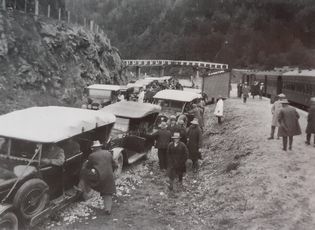
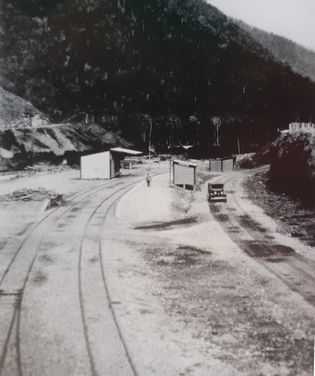
Kawatiri in the late 1920s.
Left: Looking towards Murchison
(taken from Wairoa Road overbridge)
Below: Looking towards Nelson. Newmans Bros collecting passengers for Inangahua.
|
|
To find the cache, read the information boards.
The cache can be found at S 41° 41.ABC E 172° 37.DEF, where:
A =What date in August did the deputation to Ngaio leave?
B = What was a vital commodity that could not be supplied locally?
C = What is just beside the blacksmith's shop? (one word)
D = What is the return fare for the Gala Excursion on June 12, 1954?
E = What was 19 tons?
F = The Nelson mudflat was reclaimed with material from the hillside on which road?
∑(A..F) = 30
If the answer is a word, use the first letter.
If the answer is a letter, use its position in the alphabet.
If the answer is more than one digit, use the last digit.
If the answer is a single digit, use it!
Kawa and tiri may refer to the ceremony of removing tapu from food from the river so that it can be eaten. Or it may be a corruption of Kawatere, a native parakeet.
Piki - bend, manu - flying creature. Pikimanu is the maori translation for Woodhen Bend. Woodhen is the English name for the weka.
References:
Voller, L: "Rails to Nowhere: The History of the Nelson Railway", published by the Nikau Press 1991
O'Donnell, B: "When Nelson had a Railway", published by the Schematics 2005
Scoble, J: "Names and Opening and Closing Dates of Railway Stations", published by the Rail Heritage Trust of New Zealand, 2010.