One of a series of simple, easy to find, caches at railway stations in and around Tasman.
Welcome aboard the Midland Rail service to Gowan Bridge. Last stop Kaka, next stop Kawatiri.
Glenhope is named for its location in the Hope Valley, beside the LIttle Hope River. I can understand why they did not call this stop Little Hope!
The opening of the line, after a few false starts in predicting the opening day from April 1912 when it was opened for goods only, finally settling on September, was a major event. The railway had reached the Buller catchment and the days of expensive haulage over the Tadmor saddle were gone. The Minister of Railways was there, as well as two recent ministers of Public Works, and members from both sides of the legislature. A special train brought people from all over the Neslon line and there was even a large contingent from Murchison.
|
The connection to Glenhope marked a new period of prosperity. In 1914, two years after connection, revenue had tripled over the 1906 figures. About this time a verandah was added to the station building, the only station on the Nelson line to get one, as the weather in Glenhope was more akin to that of the west coast, than that of Nelson. The line had been relaid with heavier rail that allowed speeds up to 80 km/h. Two new engines were purchased, so that the line began the 1920 with one "F", two "Fa"s and two "Wf"s. During this time there was discussion of extending the line to Tahunanui Beach, but this did not eventuate. This proseperity was followed by the 1920s, when a number of recessions occured resulting in the full blown depression of 1929-1935. In 1920 there were 123 men employed in the locomotive, traffic and maintenance sections. By the end of the decade that had dropped to mid 80s and by the end of the depression staffing had dwindled to just 45. Train kilometres were halved, most lost from the Belgrove to Glenhope section. Naturally there was a loss in revenue, and although the savings in operating loss were significant they were not enough to impress the board.
Glenhope was a small but lively community centred around the station. A clay tennis court was set up in the station yards, dances were held in the station building and concerts in the goods shed where the loading dock made an excellent stage. The bush and river were popular for picnics for those wishing to travel "to the end of the line." The biggest news for Glenhope was the visit in 1920 by HRH Edward Prince of Wales (later to be King Edward VIII). Crowds lined every station on the line. It is not recorded how many were at Nelson to greet him, but there were 2000 at Richmond and little Glenhope even boasted a crowd of over two hundred. Nine years later was the 1929 Murchison earthquake, one of Glenhope's busiest times - many houses lost their chimneys just as winter was setting in and the station helped with the refugees who fearing living in their houses as aftershocks continued for another five months. Glenhope became a distribution centre for relief supplies. The schoolhouse was unsafe and its ten students continued their lessons with their teacher in the stationmaster's house.
|
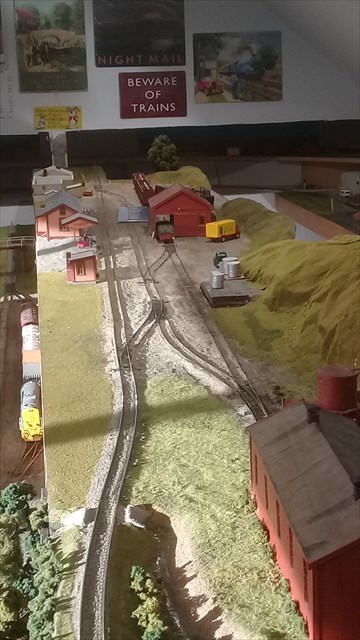 Model of Glenhope yards about 1950. Top of photo is south. Model of Glenhope yards about 1950. Top of photo is south.
|
Nelson trains were mixed - a combination of freight and passenger services. This resulted in numerous complaints by passengers over the time trains took to get to their destinations as they often had to add or remove wagons at many of the stops. But without competition and without high passenger numbers there was no incentive for NZR to do anything about this. In the 1920s better roads and more private vehicles provided that incentive and NZR instituted a passenger only service, connecting the Nelson ferry from Wellington to Glenhope for transfer to a NZR car to Reefton where rail provided a connection to Greymouth. The inaugural service left Nelson at 7:40am on 6 December 1926 and arrived at Glenhope three hours later, fully an hour less than it would take if freight were included. Greymouth was reached about 7pm. A return service left Glenhope in the evening to arrive in Nelson in time for the overnight ferry to Wellington. Alas passenger numbers for this service remained low, and after four months the express service was cancelled.
Incidentally - electricity did not arrive to the Glenhope community until long after the railroad had gone which, as you are probably well aware of by now, was in 1955.
To get to the cache park at the way point, go through the gate and walk past Glenhope station building. Although this looks like private farm land, be assured this is DoC land - you are free to wander around. However there may be grazing animals, make sure you keep the gate closed, even if you do not see any animals about. The house near the car park knows of the cache and is expecting you - they are probably playing Spot the Geocacher. Have a look through the windows of the station building and check out the restoration progress. Then walk on to the maintenance yards. The cache is near a big concrete pad, which used to be a coal bunker, right by some inspection pits. The pits are not deep, but they are not pleasant either. Don't fall in. The engine shed was just a little further on.
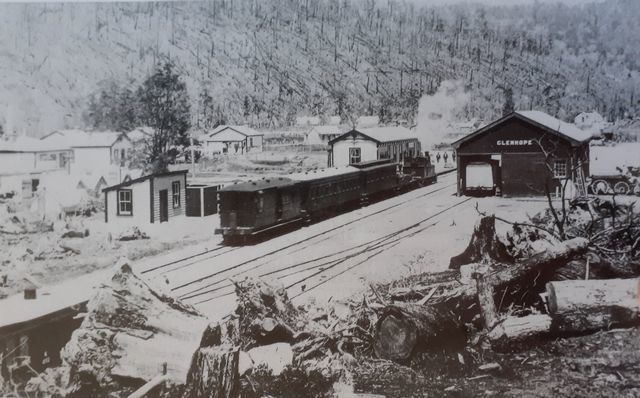
Glenhope, about 1913-14
References:
Voller, L: "Rails to Nowhere: The History of the Nelson Railway", published by the Nikau Press 1991
O'Donnell, B: "When Nelson had a Railway", published by the Schematics 2005
Scoble, J: "Names and Opening and Closing Dates of Railway Stations", published by the Rail Heritage Trust of New Zealand, 2010.