Lava flow
Lava flows are one of the characteristic manifestations of volcanic activity. They form when magma rises into a volcanic crater and spills into the surrounding area. Flows reach different lengths and different thicknesses. When volcanic activity occurs repeatedly, they often overlap.

Lava flow on the slopes of Kanaga volcano (Aleutian Islands).
The main factor influencing lava behavior is its viscosity. This depends mainly on the silica content. As a rule, the higher the SiO2 content, the more viscous the lava is and the slower it flows.
Lava with a high silica content, called acidic or felsic lava (SiO2 content more than 60 %), practically does not flow at all. These include rhyolite and dacite rocks. They tend to form rather huge blocks of rock - lava domes. Rhyolite bodies known from Slovakia, for example in the vicinity of Nová Baňa.

Lava flows on the Budinská skala with observable cracks that formed during the solidification of the lava flow. In the middle of the picture is the cave Jánošíkova izba.
The opposite is mafic lava (with SiO2 content less than 45 %). The rocks formed by this type of lava are basalts, in the Slovak volcanics they occur in the final phase (eg the basalt formation of the Cerová vrchovina). Mafic lavas are low-viscosity, flowing rapidly, creating lava flows up to several tens of kilometers long. During solidification, typical five or hexagonal prism, often form in these lavas.
Andesites, which make up the majority of the Central Slovakia volcanic field, originated from a transitional type of lava, also called intermediate lava. Depending on the exact chemical composition, they are more or less viscous. When solidified, they form massive blocks of stone, often crimped with parallel layers that occur during solidification and are later propagated by weathering processes.
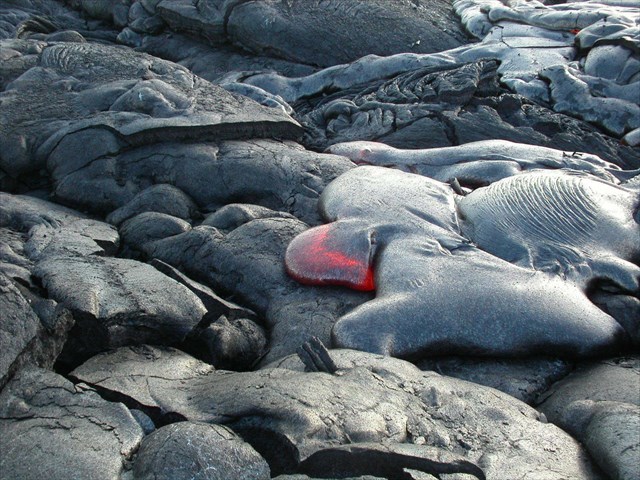
The basalt lava flow of the Hawaiian volcano Kilauea. This type of morphology is called Pahoehoe - from the Hawaiian word Pāhoehoe, which means a smooth, unbroken stone.
After solidification, other observable signs in the volcanic rock, tell about the solidification process itself. This is, for example, the occurrence of mineral grains. Their presence signals a slow cooling when the minerals had a chance to crystallize to a size observable to the human eye. On the contrary, lava which solidified very quickly, often takes the form of glass - a uniform mass without any grains of minerals. Or the rock has the form of scoria.
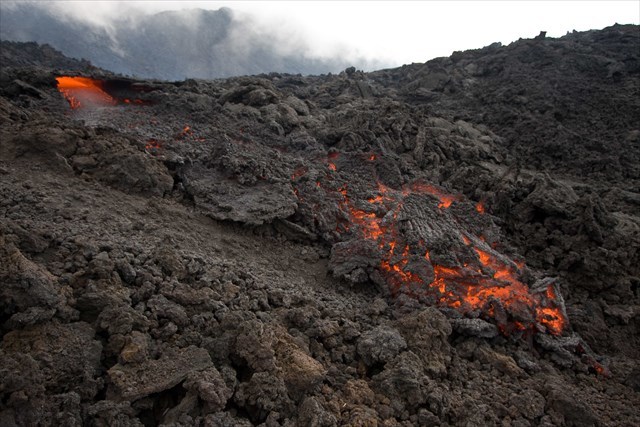
Lava flow full of sharp-edged rock fragments. This lava flow morphology is called Aa (from Hawaiian ʻAʻā, meaning rough stone).
Another feature is the presence of pores, such as remnants of volcanic gases, which tend to be present in the molten rock. If the lava mass solidifies slowly, the gases will be released and almost no pores can be observed in the rock. However, if the lava solidifies extremely quickly, it also encloses volcanic gases and there are clearly visible small bubbles in the rock (up to a few millimeters in diameter), almost evenly distributed in the rock mass. The extreme is pumice, a rock so porous that it floats on water.
Javorie Stratovolcano
Javorie is one of the mountains in central Slovakia, which are of volcanic origin. These volcanoes were active in the Tertiary, about 15 to 10 million years ago. The cause of volcanism was tectonic movements, called back arc extension at lithospheric plate collision. Volcanic activity with a similar formation mechanism can currently be observed in Japan.

Map of regional geomorphological division of Slovakia. Legend:
.....
- Neogene volcanoes
.....
- Cristalline basement (tatricum) + nappes (choč, krížna)
.....
- Basins
.....
- Veporic cristalline basement
.....
- Klippen belt
.....
- Flysch
The development of the volcano - stratovolcano in the Javorie took place in three main phases. The oldest, presented by the starohutský complex (named after the village of Stará Huta) developed in the Badenian period (about 15 million years ago). Several thousand years of calm followed, then volcanic activity resumed.
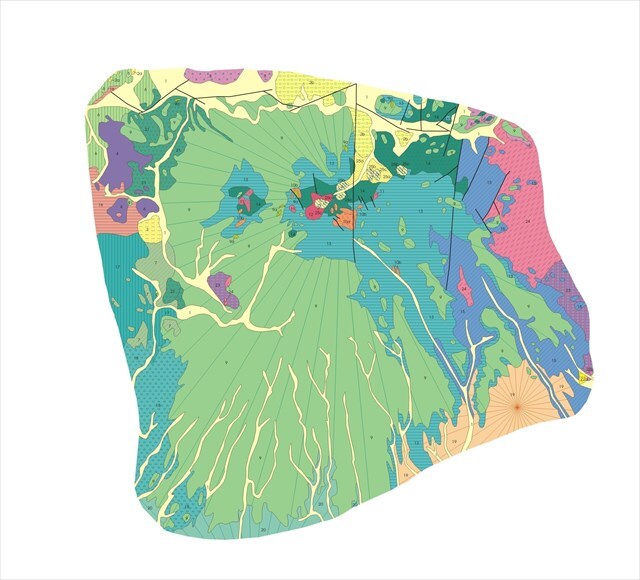
Geological map of Javorie.
The second phase is quite complicated, both in terms of construction and tectonic development. It consists of andesite rocks of the Syroň formation (lava domes and intrusions), more basic rocks of the Blýskavica formation and diorite porphires of the Kalinka and Kráľová complexes, intensively altered by hydrothermal processes.
The third phase is presented by massive andesite lava flows in the Sarmatian period (about 13 million years ago), which can be found in the wider Javoria area, cover Ostrôžky and also reach the neighboring mountains - Krupinská planina and also to foothills of Poľana.