Messier 97 (M97), also known as the Owl Nebula, is a famous planetary nebula located in Ursa Major constellation.
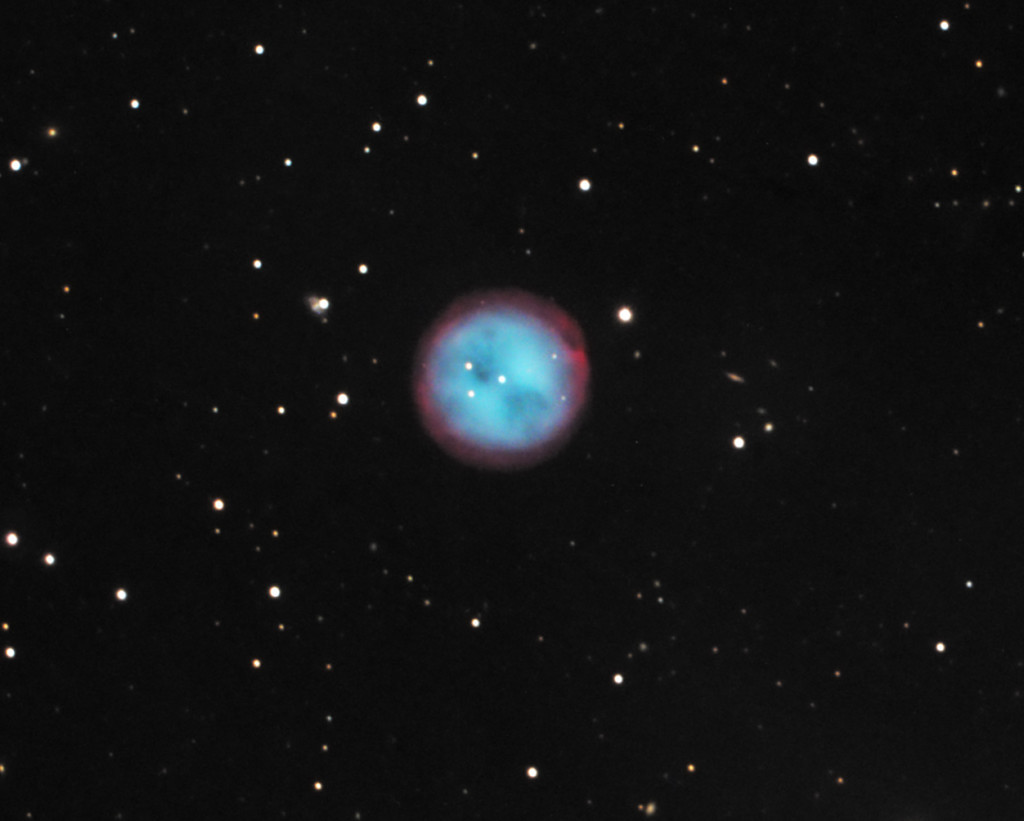
The nebula lies at a distance of 2,030 light years from Earth and has an apparent magnitude of 9.9. It has the designation NGC 3587 in the New General Catalogue.
Messier 97 occupies an area 3.4 by 3.3 arc minutes in apparent size, which corresponds to a spatial diameter of 1.82 light years. It was named the Owl Nebula because of its appearance in larger telescopes, which reveal two dark patches that look like the eyes of an owl. These were first sketched by William Parsons, 3rd Earl of Rosse in 1848.
The estimated age of the Owl Nebula is about 8,000 years. The nebula is expanding at a velocity in the range from 27 to 39 km/s. It contains about 0.13 solar masses of material, including the elements hydrogen, helium, nitrogen, oxygen and sulphur. The matter within the nebula has a density of less than 100 particles per cubic centimetre.
The Owl Nebula was discovered by French astronomer Pierre Méchain on February 16, 1781. Méchain reported the discovery to his friend and colleague Charles Messier, who added the nebula to his catalogue.
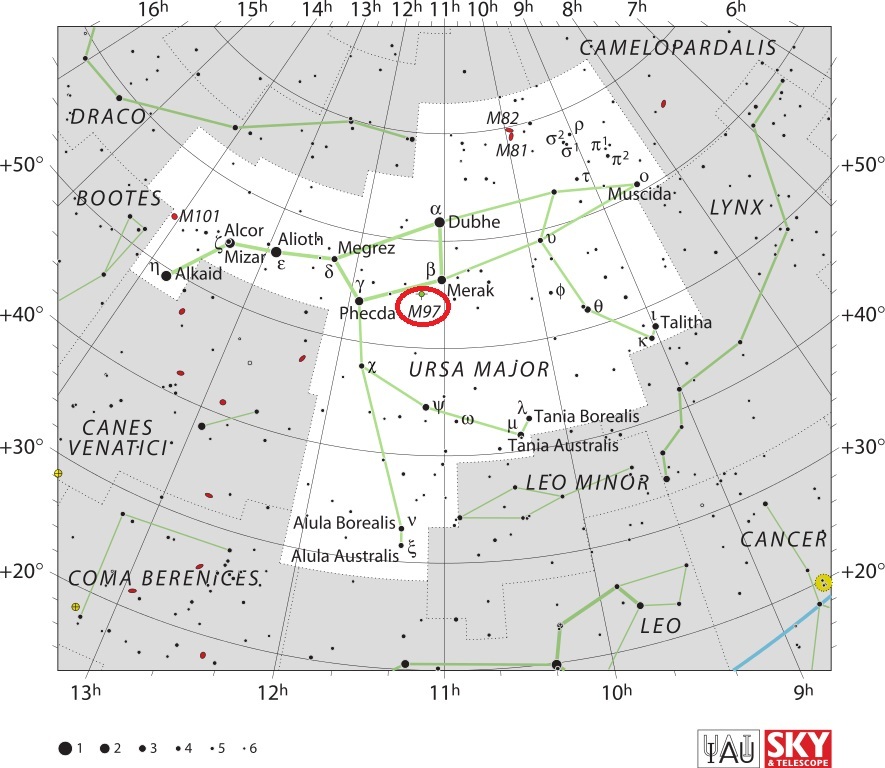 The Owl Nebula aka M97 is circled on the star map.