Master McGrath's EarthCache
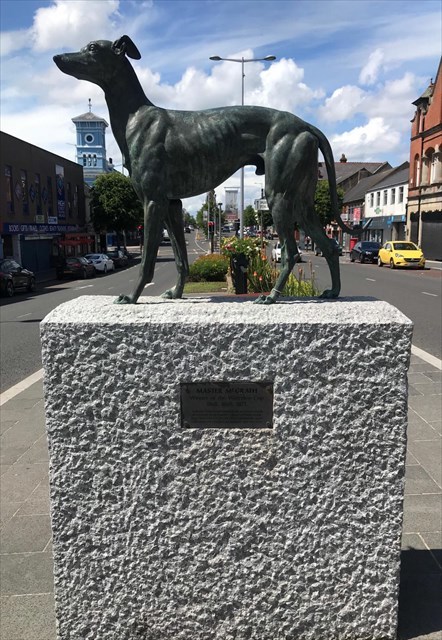
The given coordinates are for the Master McGrath statue which comprises a granite plinth surmounted by a bronze statue of Master McGrath. Master McGrath was the most renowned greyhound in history, winning the Waterloo Cup, then greyhound racings greatest event, three times in four years (1868, 1869 & 1871).
Since this cache is an EarthCache, there is no physical container to search for. Instead, you will learn something about the geology of the stone used to form the plinth of the statue and answer a few simple questions set out below.
The Granite Plinth
The inside of the Earth is very hot. Hot enough to melt rocks. These liquid or molten rocks are known as magma. If the molten rock remains underground it will cool slowly and gradually solidify over time forming large interlocking crystals. Granite is one of the rocks formed in this way. The crystals normally found in granite mainly consist of feldspar and quartz with minor amounts of mica and other minerals. The colour of the feldspar is responsible for giving the overall colour to the granite which can be a red, pink, grey or white colour with dark mineral grains visible throughout the rock. Granite is a popular building material because of its durability and resistance to weathering.
Most rocks have a Specific Gravity of between 2.5 and 2.9 which means that a cubic metre of rock would weigh 2,500kg to 2,900kg. Of course there are exceptions, but 90% of the rocks found on the earth's surface would be in that SG range. Granite has an SG value of 2.75.
The Bronze Statue
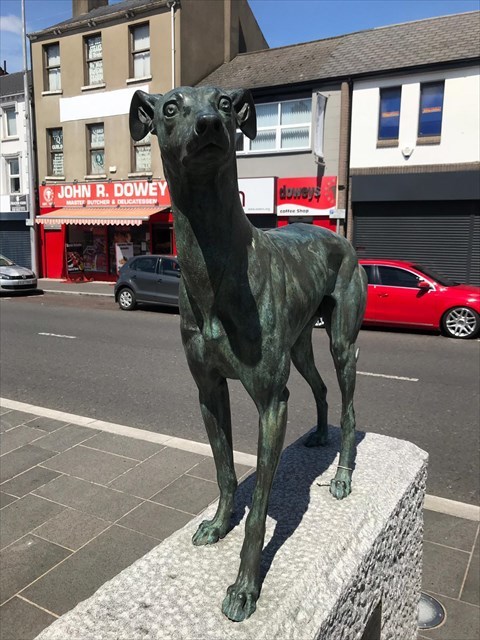
The statue of the dog is of bronze which is a copper and tin alloy usually containing around 90 per cent copper and up to 10 per cent tin. Copper and tin deposits can both be found in large masses of molten rock that cooled and solidified deep in the Earth's crust in a similar way to granite.
Your Tasks:
1) Examine the granite plinth, what is the predominant colour of the feldspar?
2) Describe the texture of the granite plinth.
3) The granite plinth is rectangular is shape. Estimate the mass of the plinth in tonnes. You will have to work out the volume of the plinth in cubic metres first by measuring it on site. Determine the length, breadth and height of the plinth then multiply these three numbers together e.g. 2 x 2 x 2 = 8 cubic metres. For each cubic metre of rock, the mass is about 2.75 tonnes (e.g. 8 x 2.75 = 22tonnes).
4) Why do you think that granite is a good choice of stone for this location?
5) From information available nearby, how many Irishmen held a nomination for the Waterloo Cup in 1868?
6) Upload a photo of either yourself or a personal item at the Master McGrath statue. Artistic creativity is welcome, for example Master McGrath may be 'sniffing' your ear while you stand beside him or your dog may think he's more famous than Master McGrath (see my GSD, Schäfer below).

Please log your find and upload your photo after sending your e-mail / message containing the answers to Q1 - 5. Please do not post the answers in your log.
Have fun, good luck and enjoy.