Limestone is a sedimentary rock made of calcium carbonate (CaCO3) in the form of the mineral calcite. It is usually an organic sedimentary rock that forms from the build up of shell, coral and algae. It can also be a chemical sedimentary rock formed by the precipitation of calcium carbonate from lake or ocean water.
Carboniferous Limestone is a collective term for the range of limestones occurring widely throughout Great Britain and Ireland that were deposited during the Carboniferous Period. These rocks formed between 363 and 325 million years ago. Carboniferous Limestone is generally light-grey in colour, and is hard. It was formed in warm, shallow tropical seas full of life. The rock is made up of the shells and hard parts of millions of sea creatures covered in carbonate mud, and the rock is full of fossils.
Carboniferous Limestone has horizontal layers with bedding planes, and vertical joints. These joints are weaknesses in the rock, which are affected by both denudation (wearing away of Earth) and weathering. They also lead to the most important characteristic of Carboniferous Limestone – its permeability. Water seeps through the joints in the limestone. The Carboniferous Limestone has been folded by massive Earth movements which can be seen by the fact that the rocks are now above sea-level. Within England and Wales, the entire limestone group, which includes mudstones and some thin sandstones, is known as the Carboniferous Limestone Supergroup.
A fossil is any preserved remains, impression, or trace of any once-living thing from a past geological age. Examples include bones, shells, exoskeletons, stone imprints of animals, objects preserved in amber, hair, oil, coal, and DNA remnants. All the discovered fossils are known as the fossil record.
Paleontology is the study of fossils: their age, method of formation, and evolutionary significance. Specimens are usually considered to be fossils if they are over 10,000 years old. The oldest fossils are around 3.5 billion years old to 4 billion years old. The observation in the 19th century that certain fossils were associated with certain rocks led to the recognition of a geological timescale and the relative ages of different fossils. The development of radiometric dating techniques in the early 20th century allowed scientists to measure the accurate ages of rocks and the fossils they host.
There are many processes that lead to fossilization, including permineralisation, casts and molds, replacement and recrystallization, and carbonisation.
To complete this EarthCache, you need to answer the following questions:
1) Describe the difference in texture between the 'portal' and the rock it is embedded in
2) Suggest what rock type the 'portal' is made of.
3) Measure the length of the longest fossil you can see in the rock. (whole crinoid stems that are made up of ossicles)
4) Estimate the number of crinoid fossils in the 'portal' (the longer ones rather than the small circular ones).
Please post a photo of yourself or your GPS at the stone to prove you visited and haven't just used the photo and guessed.
THIS IS THE STONE YOU NEED TO LOOK AT:
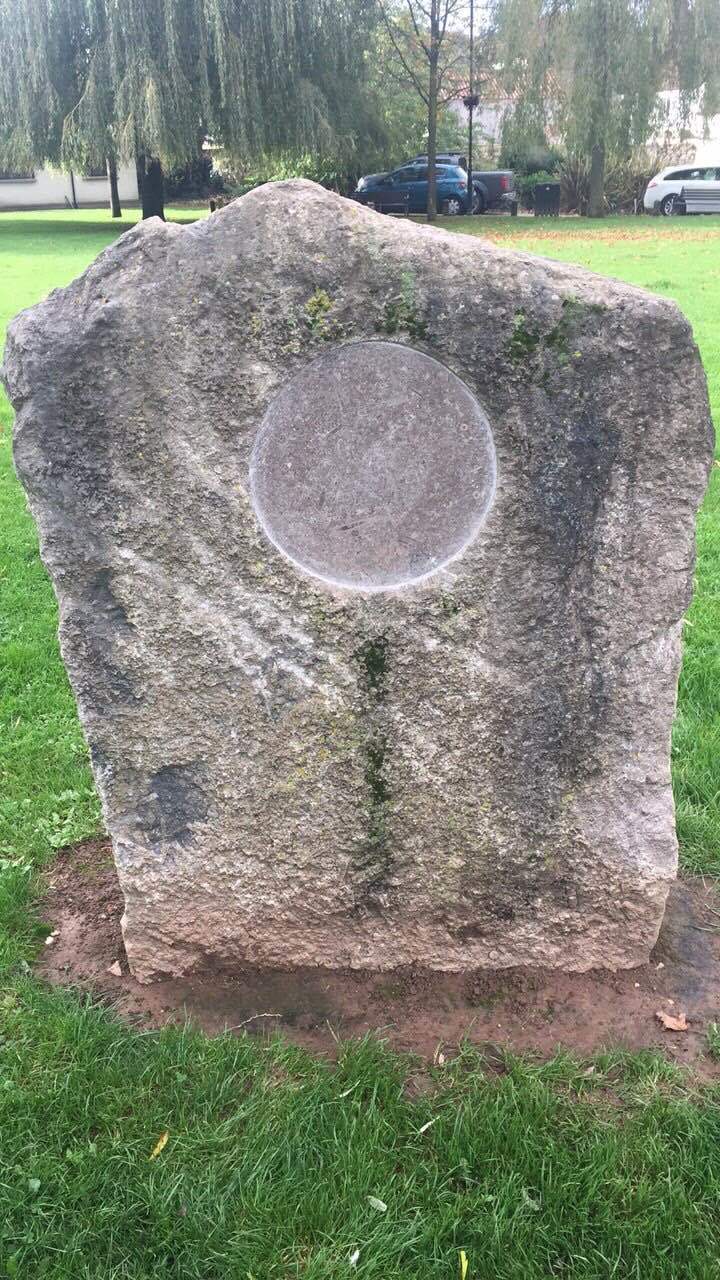
Please message your answers at the same time as logging the cache. Any logs failing to send answers will be deleted. Thank you