To log this earthcache, please don’t stress about answering the questions. Simply send your best attempts in a private message to me, (the cache owner), and then go ahead and log it as found.
You don’t need to wait for my approval. All attempts will be accepted.
Go ahead and have fun learning! 
- [REQUIRED] Please post a photo in your log of yourself or a personal item at the outcrop to prove you visited the site.
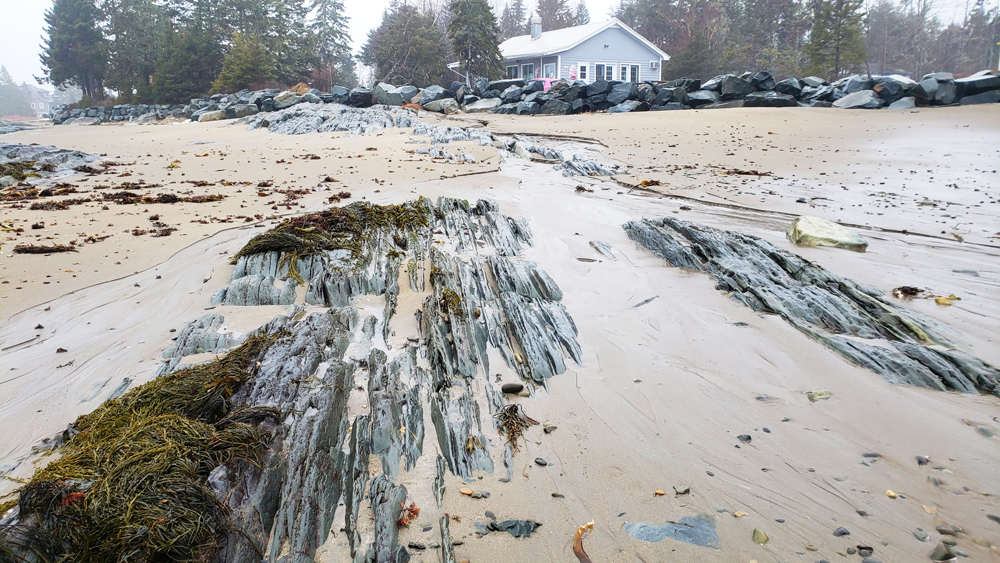
- Describe the cross-lamination on the outcrop. Which way are the grooves tilted? You can use any method to describe this, north, west etc, or in relation to the water view or road view.
- How long is the outcrop, from the rock wall to the shore?
- How wide is it at the widest point?
At Green Bay, at the cache coordinates, you will see an outcrop extending from the rock wall at the road toward the water. This outcrop is an example of cross-lamination. Cross-lamination occurs by changes in the supply of sediment. The changes create layers by small differences in the type of sediment that occur throughout the rock in layers. The fine sand, silt, and mud that form these rock layers were deposited by a series of currents and then metamorphosed and folded.
Different weathering rates highlight the layering in a series of turbidite deposits. Curved lamination in fine-grained sandstone originated as sand ripples formed by a medium-energy turbidity current.

Weathering can make the differences even more clear as each layer erodes at different speeds, thus revealing parallel structures in the rock formation. Cross-lamination can occur in grain size, clay percentage, microfossil content, organic material content or mineral content and often result in pronounced differences in colour between the laminae. It can occur in many different types of sedimentary rock, from coarse sandstone to fine shales, mudstones or in evaporites.
The beautifully sculpted outcrops were deposited by turbidity currents travelling with medium-energy flow. Layers like these became thicker and more common in Meguma around the middle of the Cambrian period, one sign that the environment was slowly changing.
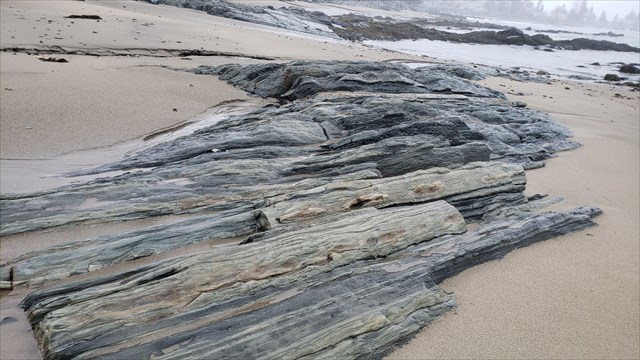
The outcrop is deeply grooved because the sandstone layers are more resistant to weathering than the others. Weathering on the surface of the sandstone has revealed many fine, curved mini-layers known as cross-laminations. Because of this, some parts of the outcrop look more like driftwood than rock. Cross-laminations form as a current flows across a bed of fine sand, creating ripples. Wind creates sand dunes in the desert in a similar way, but on a much larger scale.
The finer-grained layers here lack cross-laminations. That's because the tiny particles of silt and mud were more easily suspended in the water and settled hours or days later, after the turbidity current had passed by.
Cross-laminations from as water currents pass over a rippled, sandy surface. Sand grains roll or bound up the back of a ripple, but fall down the far side and accumulate there. Over time, a ripple moves in the direction of the current as laminations build up along it’s steep downstream face. If the sand is coarser and the layers wider, this feature is known as cross-bedding instead.