To log this earthcache, please don’t stress about answering the questions. Simply send your best attempts in a private message to me, (the cache owner), and then go ahead and log it as found.
You don’t need to wait for my approval. All attempts will be accepted.
Go ahead and have fun learning! 
- [REQUIRED] Please post a photo in your log of yourself or a personal item with the Mill to prove you visited the site.
- Is this sediment mature or immature?
- Look at the tilt of the outcrop. What is the angel?
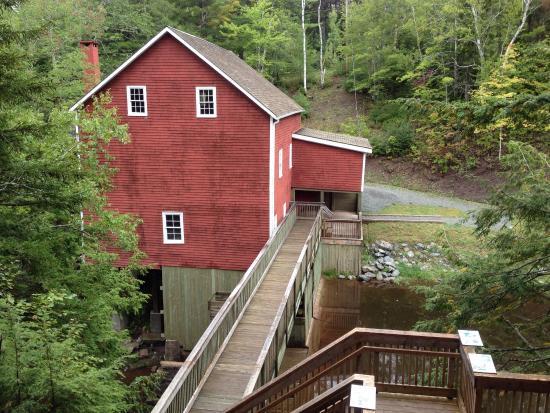
At Balmoral Mills, just southeast of the Mill, you can find a conglomerate that is part of a sequence of rock layers known as the Mabou Group.
A Conglomerate
A conglomerate is a coarse-grained sedimentary rock composed of rounded fragments within a matrix of finer grained material. Conglomerates have larger pebbles or small rocks spread throughout the main outcrop that can be easily seen.
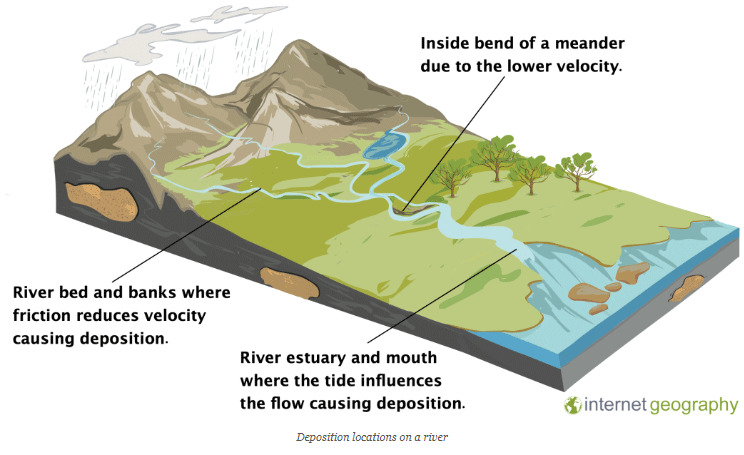
The layers of rock exposed here were deposited by an ancient river that flowed energetically out of adjacent highlands. When the river emerged from high ground onto a flat plain, it lost energy and dropped much of the sediment it carried.
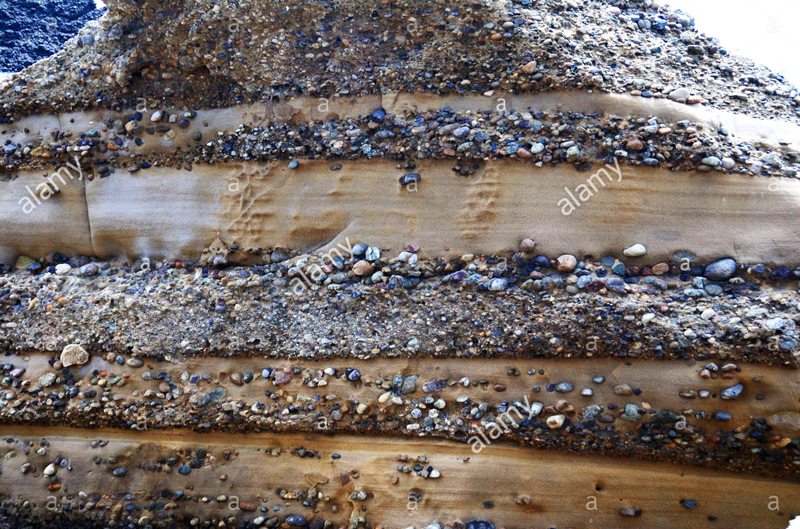
You can see tilted sedimentary layering with variation in the size and distribution of pebbles and by the subtle alignment of pebble shapes in this outcrop of conglomerate. You can see where the variation in the pebbles sizes running along and marking off the layers.
Maturity of sediment
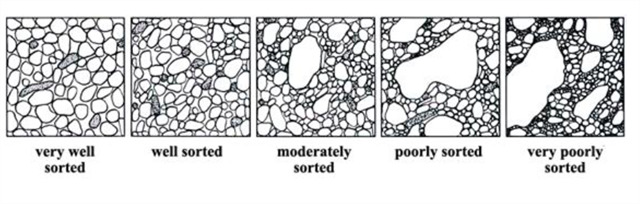
In sedimentary geology, maturity describes the composition and texture of grains in clastic rocks, most typically sandstones, resulting from different amounts of sediment transportation. A sediment is mature when the grains in a sediment become well-sorted and well-rounded due to weathering or abrasion of the grains during transport. There are two components to describe maturity, texture and composition. Texture describes how rounded and sorted the sample is while composition describes how much the composition trends toward stable minerals and components.
A mature sediment is more uniform in appearance, for the sediment grains are well rounded, are of a similar size and exhibit little compositional variation. Conversely, an immature sediment contains more angular grains, diverse grain sizes, and is compositionally diverse.
In the following image, the sediment on the left is more mature than the sediment on the right:
Here is a sample of an extreme version of a conglomerate showing how different the layering can be: