Located at the Black Sands Beach off Conzelman Road in the Marin Headlands. There is parking at the trailhead from the road with room for about 10 cars. It is a short hike down from the road on a wide trail with many steps to a beach that is typically sparsely visited.

![]()
The Franciscan Complex
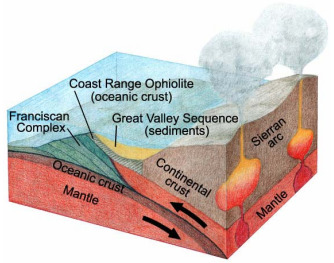
The San Andreas fault system is a relatively new geologic feature in the Bay Area; originating to the south 28 million years ago, but extending through the Bay Area only 6-10 million years ago. In contrast, older rocks of coastal California indicate that, before the Pacific Plate started slipping northward past the North American Plate on the San Andreas fault system, the Pacific ocean floor was subducted (moved) beneath the western edge of the North American Plate. The distinctive rocks of the world-famous Franciscan Complex, named at San Francisco and underlying much of coastal Northern California, formed in this subduction zone. In the Bay Area, rocks of the Franciscan Complex form the basement for the Coast Ranges east of the San Andreas Fault. The Franciscan rocks range in age from about 200 to 80 million years old. They represent an accretionary wedge, a complex body of rock that accumulates in a subduction zone. Rock types are primarily greywacke sandstone and argillite shed off the continental margin, but also contain lessor amounts of greenstone (altered ocean floor basalt), deep sea radiolarian chert, limestone, serpentinite (altered mantle material) and a variety of high-grade metamorphic rocks such as blueschist (high-pressure), amphibolite and eclogite (high-temperature). These rocks are typically highly fractured and disrupted and may be mixed together on a local scale to create what is called a mélange (French for “mixture” or “blend”).
![]()
Franciscan Rock Types
Pillow Basalt
Pillow basalt is a volcanic rock that forms when lava of basaltic composition is erupted underwater. The rapid cooling of the lava by cold water on all sides forms the pillow-shaped bodies, which can then break open and extrude more of the hot lava from inside. The rapid cooling also creates pillows that are composed of volcanic glass on the outside and that have very tiny, almost invisible crystals on the interior. Pillow basalt typically forms at volcanoes at mid-ocean ridges or at oceanic hot-spot volcanoes, such as those that formed the Hawaiian Islands. Basalt forms the crust of all the ocean basins and is therefore the most common rock in the Earth’s crust. The pillow basalt found at the west end of this beach erupted far out and deep under the Pacific Ocean over 150 million years old.

![]()
Basalt has a lower percentage of silica and a higher percentage of iron and magnesium than other volcanic rocks. These characteristics give it a very dark, almost black color. Hot, mineral-rich seawater flowed through much of the basalt that is part of the Franciscan Complex, changing some of its minerals into chlorite and other green minerals. This altered basalt is called greenstone.
Sometimes basalt in the Franciscan Complex will have small white or pink speckles or even small round holes in it. These are the result of gas bubbles that were captured in the lava when it cooled. Sometimes the gas bubbles are empty, but other time they get filled with quartz or calcite that precipitated out of mineral-rich water circulating through the basalt, producing the speckles. Sometimes the gas bubbles in Franciscan basalt get filled with a bright orange semi-precious form of quartz called carnelian. If basalt is erupted too far under the ocean, the pressure from all the overlying water will not allow the gas bubbles to form. This is the case for most Franciscan basalt, but the basalt at Point Bonita is an exception.
Chert
Chert underlies about 50 percent of the Marin Headlands. Because chert is resistant to weathering, it forms many of the ridge tops. At places, the chert is found in depositional contact with the underlying basalt, but most contacts are formed by faults. The chert is bedded and is composed predominately of 2- to 10-cm thick red chert layers that alternate with thinner, dark-red shale beds Because of the prominent thin bedding, these rocks are commonly called ribbon chert. Franciscan chert formed on the deep ocean floor far out to sea where little sediment from the continent could reach. It was deposited at a rate of 1 mm per thousand years. The chert contains tiny bits of iron in dust blown from deserts into the middle of the ocean. Red chert indicates an oxidized state of this iron, whereas green chert indicates a reduced condition for the iron in the chert. You can see both red and green ribbon chert at the east end of this beach.
Causes of Black Sand
On continents, sand is largely comprised of clear to whitish quartz grains, because quartz is more resistant to weathering than most of the other abundant rock-forming minerals. As a result, most beach sand is white to tan. In tropical and sub-tropical areas, much of the sand is derived from pulverized coral material, and again is white to tan. However, where the "parent material" is basalt, there is little quartz and the weathering results in black sand. This is usually where lava flows reach the ocean and cool quickly, causing it to shatter into sand-sized black fragments. This generally occurs only in areas with relatively recent lava flows and little other sediment supply
This beach is called Black Sand Beach, but it is not typical of the black sand beaches you may have heard of, like those on Hawaii associated with fresh lava flows. You'll typically find black sand beaches in three settings: in areas where volcanic flows meet a body of water, at places with high wave energy and a supply of sand-sized, dark, heavy minerals (like magnetite or hornblend), or in places where the sand source is primarily dark-colored rock fragments. The latter is the case here at Black Sand Beach. The dark color of the sand comes from different Franciscan rock types found in the cliffs above. Contributors to the sand include hard silica grains from dark red, orange and green chert, grains of black to green pillow basalt, and some dark greywacke sandstone pieces. There is no nearby source of lighter colored silica to make the beach white or tan.
Logging Requirements:
To log this EarthCache you will need to physically visit this location. Based on your observations at the location, please send a message to me with the answers to the following questions:
1) At the posted coordinates, pick up a handful of dry sand and describe what you see:
- Are the pieces round or angular?
- Would you say this sand is fine, medium, coarse, or very coarse? (think in terms of sand paper)
- What colors do you see and why do you think these colors are present?
- Are the pieces glossy or dull?
- Does it feel heavier or lighter than traditional sand?
2) What do you think is the source of the "black sand"?
- Do you think it is comprised mainly of basalt or chert?
- What is the basis of your conclusions? What evidence do you see at this location?
3) While at this location take a picture of you or your GPSer at the beach and post the picture with your log. Please make sure your picture captures the black sand. If you prefer privacy, a picture of your signed caching name in the black sand will suffice as will any other photo of a personal item to evidence your visit to this site.
Once you have emailed your answers, feel free to log your find immediately - you do not need to wait for a response. We will respond to your email to confirm if your answers were correct.
Ref:
https://www.nps.gov/goga/learn/education/upload/Geology%20of%20the%20Golden%20Gate%20Headlands%20Field%20Guide.pdf
https://www.nps.gov/goga/learn/education/pillow-basalt-faq.htm
https://pubs.usgs.gov/bul/b2188%202/b2188ch3.pdf