The physical cache is not at the posted coordinates but it is close by. You will need to correctly answer the following questions in order to obtain the correct coordinates for the physical cache container and the log.
***CONGRATULATIONS TO Ekuflar FOR FTF***
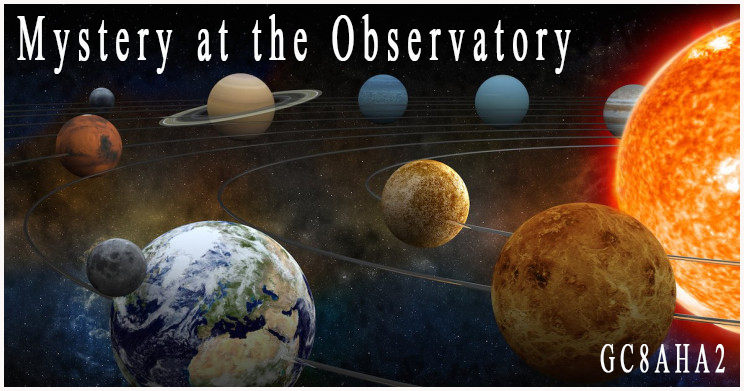 Mankind has always explored in search of more knowledge. With more than 300 robotic spacecraft having explored destinations beyond Earth orbit, including 24 astronauts who orbited the moon, what we have learned about our solar system and neighboring planets is astonishing. We have put together some interesting facts and hope you enjoy learning about our planets and our Sun.
Our planetary system is located in an outer spiral arm of the Milky Way galaxy. Our solar system consists of our star, the Sun, and everything bound to it by gravity — the planets Mercury, Venus, Earth, Mars, Jupiter, Saturn, Uranus and Neptune, dwarf planets such as Pluto, dozens of moons and millions of asteroids, comets and meteoroids. Beyond our own solar system, we have discovered thousands of planetary systems orbiting other stars in the Milky Way. Believe it or not, there are more planets than stars in our galaxy.
Another cache in our Movie and Trivia Series.
This puzzle uses the familiar substitution layout and is listed below.
| The FINAL COORDINATES are as follows: N 35° AB.CDE W 85° FG.HIJ |
Simply take the number associated with the correct answer, and substitute it for the corresponding letter in the coordinates.
A - Mercury
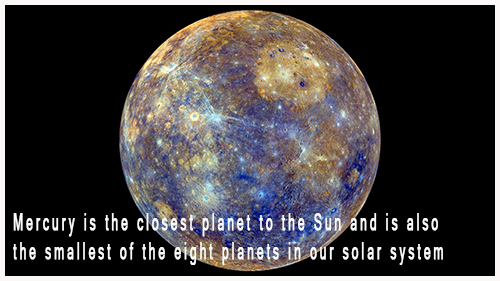
Mercury is the fastest planet, zipping around the Sun every 88 Earth days. It is appropriately named for the swiftest of the ancient Roman gods. Mercury spins slowly on its axis and completes one rotation every 59 Earth days. Mercury's axis of rotation is tilted just 2 degrees with respect to the plane of its orbit around the Sun. That means it spins nearly perfectly upright and does not experience seasons as many other planets do.
Question: How many earth days make up ONE day on Mercury?
9 16
5 375
8 176
0 59
B - Venus
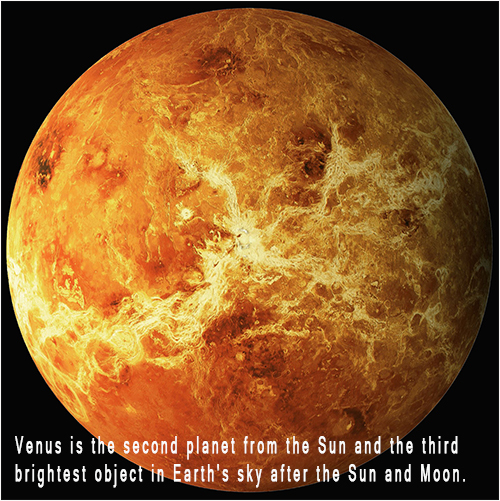 Venus spins slowly in the opposite direction most planets do. Venus is one of just two planets that rotate from east to west. Only Venus and Uranus have this "backward" rotation. Its thick atmosphere traps heat in a runaway greenhouse effect, making it the hottest planet in our solar system—with surface temperatures hot enough to melt lead. It takes sunlight 6 minutes to travel from the Sun to Venus. But the Sun doesn't rise and set each "day" on Venus as it does on most other planets. On Venus, one day-night cycle takes 117 Earth days because Venus rotates in the direction opposite of its orbital revolution around the Sun. It completes one rotation in 243 Earth days — the longest day of any planet in our solar system, even longer than a whole year on Venus.
Question: What is the name of the spacecraft that survived the intense heat and crushing pressure of Venus’ surface for more than two hours?
4 ASTRO - 2
1 Soviet Union’s Venera 13
9 Kepler
6 New Horizons
C - Earth
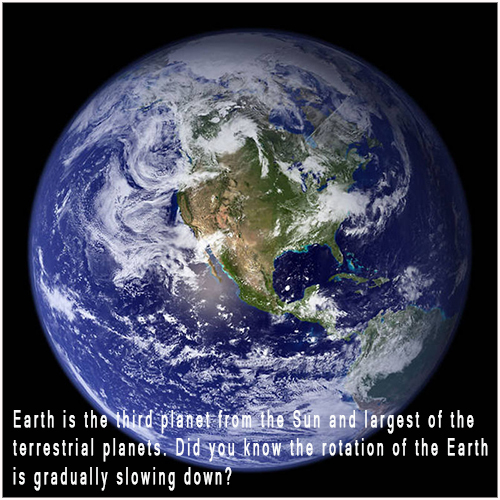
Our home planet is the third planet from the Sun, and the only place we know of so far that’s inhabited by living things. The name Earth is at least 1,000 years old. All of the planets, except for Earth, were named after Greek and Roman gods and goddesses. Our home planet Earth is a rocky, terrestrial planet. It has a solid and active surface with mountains, valleys, canyons, plains and so much more. Earth is special because it is an ocean planet. Water covers 70 percent of Earth's surface. Earth's atmosphere is made mostly of nitrogen and has plenty of oxygen for us to breathe. The atmosphere also protects us from incoming meteoroids, most of which break up before they can hit the surface.
Question: The name Earth is a Germanic word, which simply means...
1 home
5 the beginning
2 blue planet
0 ground or soil
D - Mars
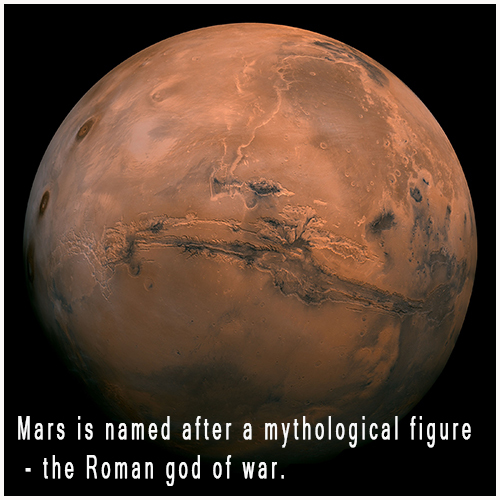
Mars is about half the size of Earth. If Earth were the size of a nickel, Mars would be about as big as a raspberry. A large canyon system called Valles Marineris is long enough to stretch from California to New York—more than 3,000 miles. This Martian canyon is 200 miles (320 kilometers) at its widest and 4.3 miles (7 kilometers) at its deepest. That's about 10 times the size of Earth's Grand Canyon. There is water on Mars today and it is in the form of water-ice just under the surface in the polar regions as well as in briny (salty) water, which seasonally flows down some hillsides and crater walls.
Question: Mars is home to the largest volcano in the solar system, what is its name?
7 API Mons
6 Olympus Mons
5 Hathor Mons
4 Kali Mons
E - Jupiter
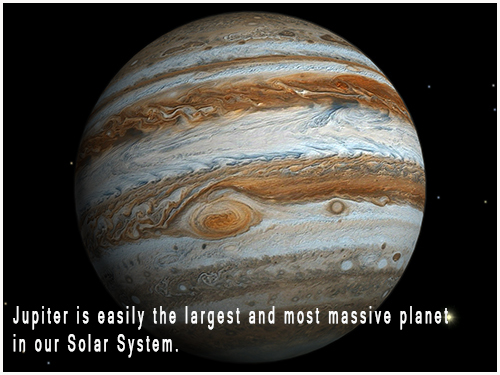
Jupiter holds a unique place in the history of space exploration. In 1610, Astronomer Galileo Galilei used a new invention called the telescope to look at Jupiter and discovered the first moons known to exist beyond Earth. Fifth in line from the Sun, Jupiter is, by far, the largest planet in the solar system – more than twice as massive as all the other planets combined. Eleven Earths could fit across Jupiter’s equator. Jupiter has more than 75 moons. The planet has the shortest day in the solar system. One day on Jupiter takes only about 10 hours. Jupiter has the same ingredients as a star, but it did not grow massive enough to ignite.
Question: What is the name of Jupiter’s iconic giant storm that is bigger than Earth and has raged for hundreds of years?
4 Thueban Facula
0 Great Red Spot
9 Abeeso
2 Clavius
F = Saturn
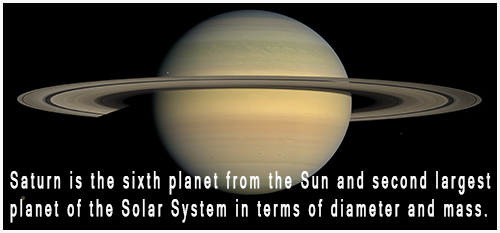
Adorned with thousands of beautiful ringlets, Saturn is unique among the planets. When Galileo Galilei saw Saturn through a telescope in the 1600s, he wasn't sure what he was seeing. At first, he thought he was looking at three planets or a planet with handles. Now we know those "handles" turned out to be the rings of Saturn. Saturn is nine times wider than Earth. That doesn’t even include Saturn’s rings. If Earth were the size of a nickel, Saturn would be about as big as a volleyball. Saturn has 53 known moons with an additional 29 moons awaiting confirmation of their discovery—that is a total of 82 moons.
Question: What happens to Saturn twice every 29 and a half years?
1 appears ringless/without rings
2 The rings expand by 10%
5 the rings become more red and become easier to see
4 a new ring is added and is eventually absorbed into the main ring layers
G - Uranus
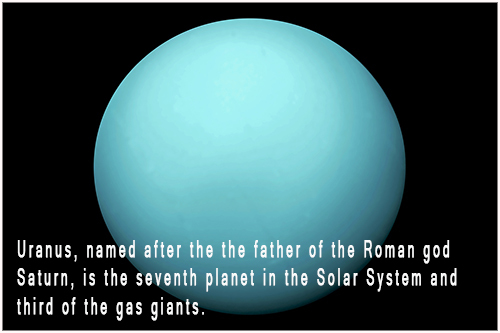
Uranus was discovered in 1781 by astronomer William Herschel, although he originally thought it was either a comet or a star. Uranus is made of water, methane, and ammonia fluids above a small rocky center The methane makes Uranus blue. Uranus has 27 known moons, and they are named after characters from the works of William Shakespeare and Alexander Pope. Like Venus, Uranus rotates in the opposite direction as most other planets, and unlike any other planet, Uranus rotates on its side.
Question: Uranus was the first planet discovered using _____________
1 the NASA spacecraft InSight
2 a periscope
4 a telescope
8 the Hubble deep space telescope
H - Neptune
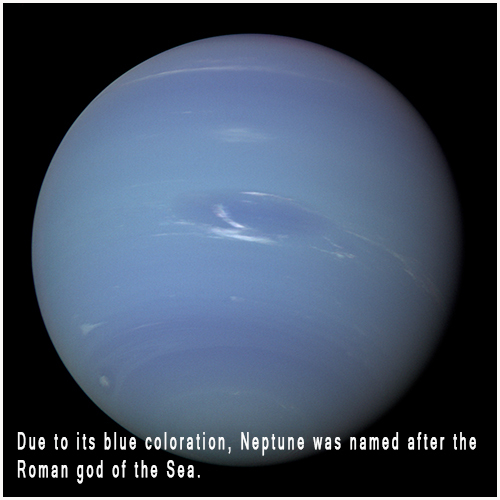
Dark, cold and whipped by supersonic winds, ice giant Neptune is the eighth and most distant planet in our solar system. Neptune takes about 16 hours to rotate once (a Neptunian day), and about 165 Earth years to orbit the sun (a Neptunian year). Neptune has 14 known moons that are named after sea gods and nymphs in Greek mythology. Neptune is so far from the Sun that high noon on the big blue planet would seem like dim twilight to us. The warm light we see here on our home planet is roughly 900 times as bright as sunlight on Neptune.
Question: What size is Neptune compared to our Earth?
9 half the size of Earth
2 twice the size of Earth
0 slightly smaller than Earth
1 four times wider than Earth
I - Pluto
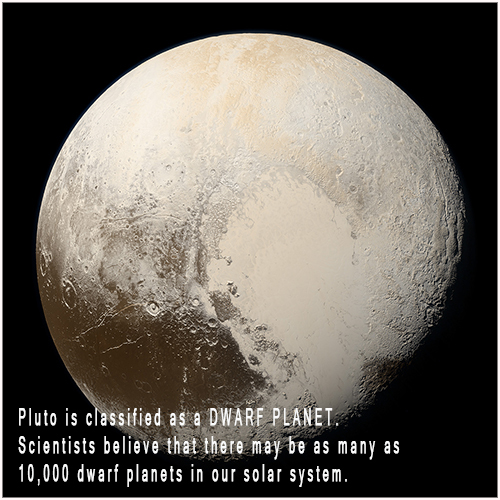
Pluto is officially classified as a dwarf planet. Pluto is the only world (so far) named by an 11-year-old girl. In 1930, Venetia Burney of Oxford, England, suggested to her grandfather that the new discovery be named for the Roman god of the underworld. He forwarded the name to the Lowell Observatory and it was selected. Pluto—which is smaller than Earth’s Moon—has a heart-shaped glacier that’s the size of Texas and Oklahoma. This fascinating world has blue skies, spinning moons, mountains as high as the Rockies, and it snows—but the snow is red. There is a moment each day near sunset here on Earth when the light is the same brightness as midday on Pluto. Find out when you can experience "Pluto Time" where you live.
Question: What is the name of Pluto's largest moon?
8 Wolf 359
4 Capella
2 Charon
3 Proxima Centauri
J - Sun
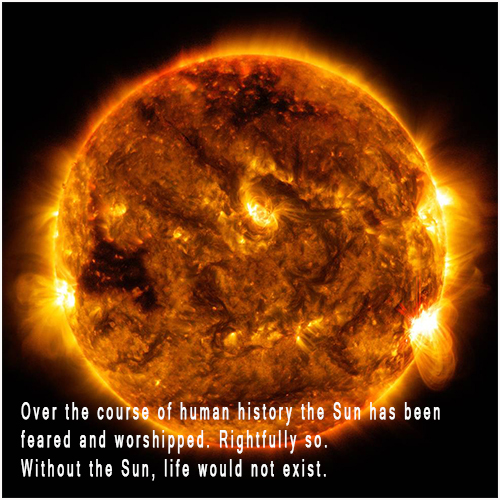
The heart of our solar system—is a yellow dwarf star, a hot ball of glowing gases. If the Sun were as tall as a typical front door, Earth would be about the size of a nickel. Its gravity holds the solar system together, keeping everything from the biggest planets to the smallest particles of debris in its orbit. Electric currents in the Sun generate a magnetic field that is carried out through the solar system by the solar wind—a stream of electrically charged gas blowing outward from the Sun in all directions. Without the Sun's intense energy, there would be no life on Earth. Though it is special to us, there are billions of stars like our Sun scattered across the Milky Way galaxy.
Question: What star type is the Sun?
4 Yellow Dwarf
3 Red Giant
5 White Dwarf
2 Red Dwarf
| During this time while we all deal with the COVID-19 virus, enjoy solving this mystery BUT please be sure that local athorities have deemed it safe for you to venture out and find this cache. Stay safe everyone! |