The context
The idea for these EarthCaches "Urbans Fossils" comes from a very beautiful fafahakkai cache: Urban Fossils in Bordeaux (itself inspired by -Ruby- and the cache RBY 7 - Urban fossils in Lille). As he was also the one who pointed out the diversity and number of fossils when we met, it was well worth a wink! ^^
What are "fossils"
"Fossil" is a very broad term, it can indeed mean:
- organisms : animal or plant remains (shell, shell, carapace, bone, tooth, seed, leaves, spore, pollen, plankton, micro-organisms) generally mineralized (whose hard parts are slowly replaced by minerals);
- mouldings : no remains, but a "3D impression" in the rock of the body's shape;
- prints : traces left by legs or the movement of organisms.
Fossils are extremely important in understanding the evolution of the planet (geological events, climate change, appearance and disappearance of species, extinctions,...) since they bear witness to 3 billion years of evolution of life on Earth. They are studied in the context of paleontology, geology (for example, they make it possible to determine the age of a rock, some fossils being characteristic of a geological period delimited in time), human prehistory and archaeology. But, since the conditions for fossilization are rarely met, the fossilization process remains rare compared to the number of dead living beings, so the fossil evidence is only incomplete.
Fossils formation
The process that causes a fossil is... fossilization ^^: organisms die, accumulate and are buried. Then, under the action of pressure and chemical processes, fossils are formed, and are the exact stone reproductions of the organism. During fossilization, the organism can be preserved without significant modification, or be variously mineralized according to processes such as calcification (replacement by calcium carbonate) or silicification (replacement by silica). Below, an example in pictures of the not easy life of a trilobite:

Some fossil species
Among the tens of thousands of fossil species identified, marine fossils are the easiest to find. Why? There are two main reasons for this:
- life has been living in the oceans for about 3.85 billion years, but on land we had to wait: the first plants only appeared about 440 million years ago. The first animals capable of moving arrived 360 million years ago, and for mammals it is still necessary to wait almost 150 million years;
- it is most often sedimentary rocks that contain fossils. However, these rocks are formed on the bottom of the oceans.
Among the very many known marine fossil species, we can mention (see image below):
- ammonites: contrary to appearances, it is not the ancestor of the snail, but of the octopus! ;
- the nérinées: they are the ancestors of snails;
- Pectinidae: rather flat shells, often with wide and thick streaks. They can be compared to our current scallops;
- gryphées: the ancestors of our mussels (unfortunately, French fries did not yet exist...), as they are often found in colonies of a large number of individuals;
- rhynchonchonella: they could be confused with other bivalves such as pectinids, but they are generally much more rounded and their striations finer and narrower;
- belemnites: ancestors of squid, generally only their rostrum is found, the only hard part of these organisms.
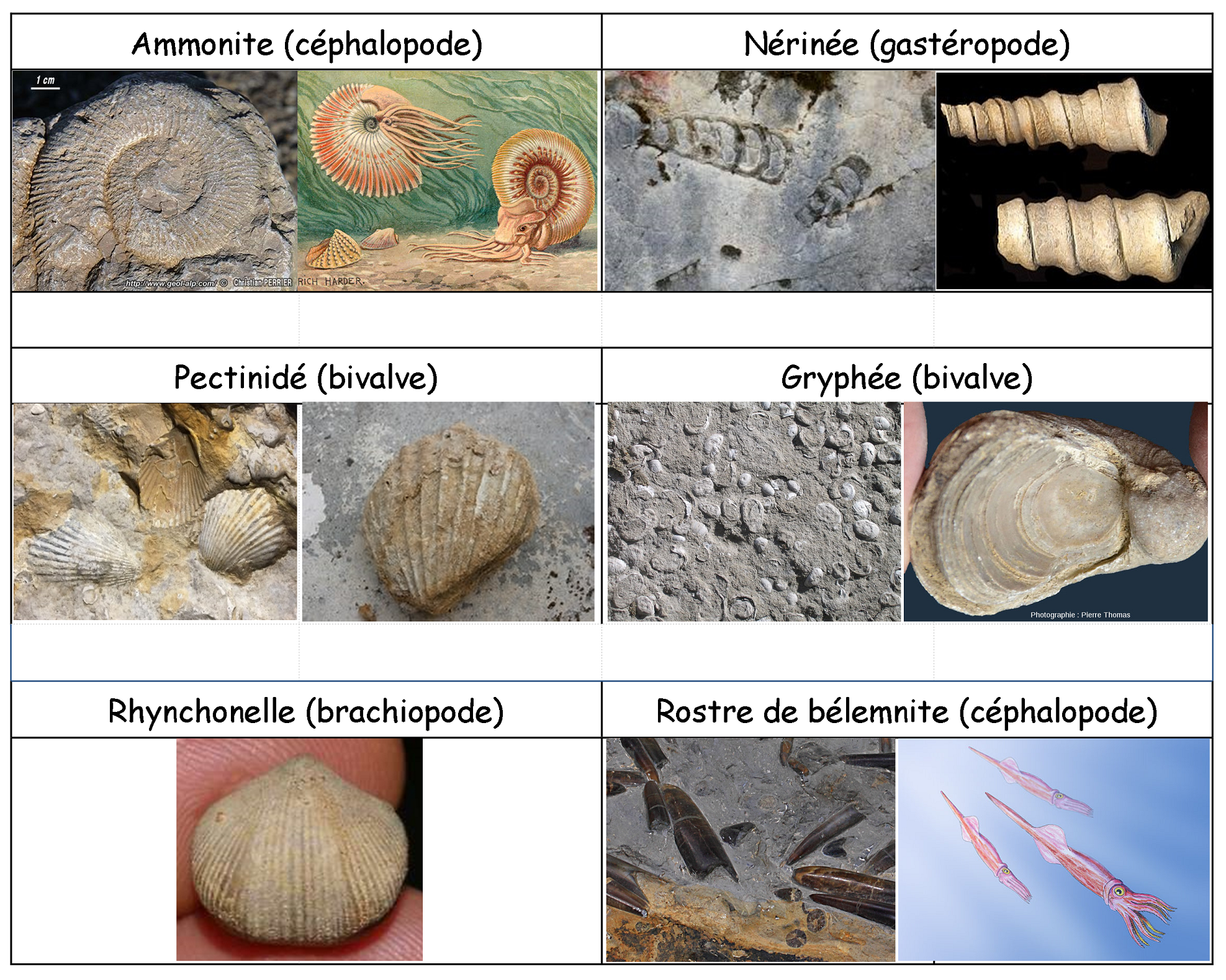
An ammonite is not a snail!
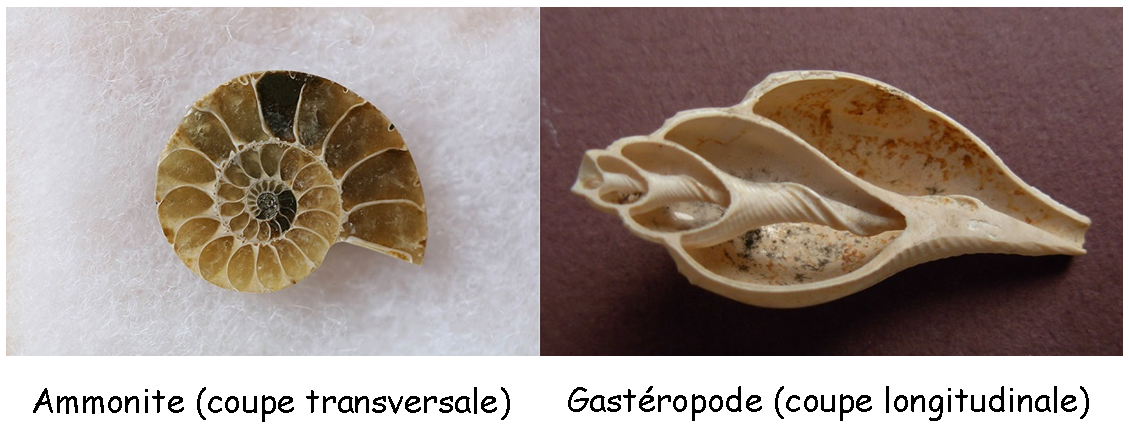
Seeing an ammonite and its characteristic winding, one would be tempted to say that it is a "kind of snail", but this is not the case at all! Already, ammonite is a cephalopod (feet on head) while snails are gastropods (stomach in foot). Then, their growth and structure are very different: ammonites have a shell wrapped in a spiral on a plane, while snails have a spiral wrapping in space. In cross-section, we will therefore distinguish the spirals of the ammonite and sometimes the empty boxes, unlike the gastropod which will reveal its helical winding:
Questions
Careful reading of the cache description, as well as an observation of the field elements and a little deduction are normally sufficient to answer the questions of this EarthCache.
Go to N45° 46.586' E3° 04.921' (listing coordinates, waypoint 1) and locate the fossil under the yellow square in the photo "Zone A". Then, go to N45° 46.541' E3° 04.937' (waypoint 2) and locate the fossil under the turquoise square in the photo "Zone B".
1. For the two fossils (zones A and B), which species is it?
2. What is the difference between these two fossils?
Go to N45° 46.558' E3° 04.943' (waypoint 3) and locate the fossil under the red square in the photo "Zone C".
3. Of which species can we observe the molding?
Go to N45° 46.593' E3° 04.933' (waypoint 4) and locate the fossil under the green square of the photo "Zone D".
4. Is it an ammonite or a gastropod? Explain your answer.
Optional: if you see a remarkable fossil, send us its picture ^^^
Optionnal: a picture of you or your GPS on site is not mandatory but highly appreciated ^^
You can log in without waiting for our confirmation, but
you must send us the answers at the same time either by email via our profile or via geocaching.com (Message Center). If there are any problems with your answers we will let you know.
Logs recorded without answers will be deleted.