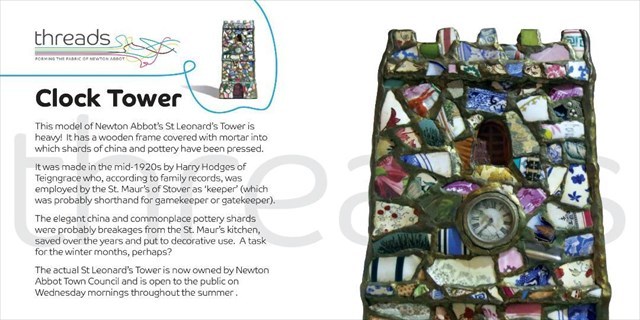
There is no cache or container at the given coordinates, but you do need to go to them firstly to admire this commonly-called ‘Clock Tower’ but more correctly named ‘St Leonard’s Tower’. There are some information plaques worthy of reading about this landmark of the ancient market town of Newton Abbot which was part of a larger building, a chapel, in the early 13th century.
This Series features 12 caches about items of historic interest to Newton Abbot and the surrounding communities. Two caches will be published each month from June to November 2019 and a 13th event cache on December 11th will complete The Baker’s Dozen. Anyone attending the event cache on December 11th who brings proof that they have found all 12 Samuel Baker series caches will receive a certificate of achievement.
Sir Samuel White Baker, (8 June 1821 – 30 December 1893), was a Newton Abbot resident, a discoverer of Lake Albert and an explorer of the Nile and interior of central Africa. Together with his wife Florence, he retired to Sandford Orleigh in 1874 and he would describe the view looking down the Teign Estuary as one which reminded him of The Nile. Their house, built by industrialist George Templer in the 1830s, featured a chimney overmantel made up of several historic oak carvings. With the property now redeveloped into flats the Sandford Orleigh Screen, as the chimney piece is known, is now housed in Newton Abbot Museum.
NOW TO FIND THE CACHE
At the given coordinates find the following values :-
St Leonard’s Tower on the Newton Abbot Town Trail’s number = A
On the nearby obvious large dark-grey metal box next to the bench mark, how many studs are there on the narrow side facing the tower = BC
On the nearby but smaller item entitled Black Box, the telephone number = 4D [0]016E9 767007
CHECK SUM A+B+C+D+E = 17
The cache can be found a short drive away [due to proximity of other caches] just out of town with nearby parking AND with a wonderful view of Newton Abbot at N50 3C.C B B W003 3A.E D C
PLEASE NOTE THAT SOME OF THE ATTRIBUTES APPLY TO THE GIVEN COORDINATES, AND SOME AT THE FINAL COORDINATES.