English description see below.
Deutsche Beschreibung siehe unten.
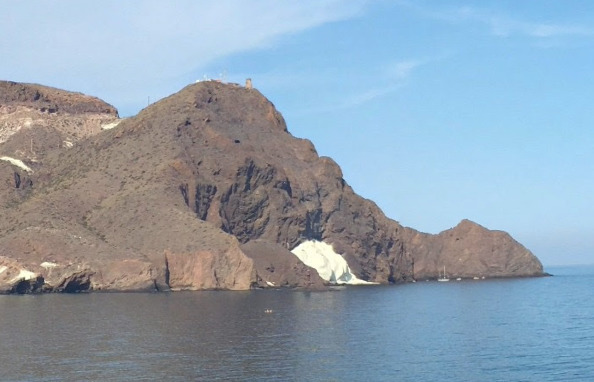
Vela Blanca - Español
Aquí, en la costa en el Stage 1, puede ver en dirección noreste el faro de "Vela Blanca". Llama la atención la gran roca blanca justo en el agua debajo de la torre. ¿Pero por qué es blanco? ¿Y cómo sucedió eso?
Vela blanca volcanic dome:
Un domo volcánica es una estructura en forma de cúpula, que se origina cuando la lava no puede fluir con facilidad, debido a su alta viscosidad, solidificándose en la propia boca del conducto de emisión (chimenea) o junto al mismo.
El cerro de „Vela Blanca“ es un magnífico ejemplo de domo de rocas de composición andesítica, en el que se observa como las cúpulas de las chimeneas encajan en otros material volcánicos de origen explosivo.
La „Vela Blanca“, la mancha que da origen al nombre del cerro, se produjo por la alteración de material volcánicos explosivos, debido a la acción de fluidos hidrotermales (aguas subterráneas de elevada temperatura) y por las aguas marinas infiltradas recalentadas en le centro de emisión volcánico, transformaron las rocas volcánicas, preexistes en arcillas blanquecinas.
Registra este cache:
Envíame las respuestas a las siguientes preguntas por correo o messenger y puede registrar el caché tal como se encuentra.
Stage 1:
1.1) ¿Qué opinas, cuántos metros sobresale la roca blanca del agua?
1.2) Tómate una foto o un objeto personal con la Vela Blanca de fondo.
Stage 2:
Aquí puede encontrar la misma "roca blanca" que en la "Vela Blanca". Pero aquí no necesitas un bote para ver la roca.
2.1) Pasa tu mano sobre la roca blanca. Describe la superficie, la forma y la textura de la roca. ¿La piedra es dura o blanda? ¿Puedes romper algo?
2.2) Compara la roca blanca con las piedras rojizas que la rodean en el área. ¿Qué diferencias (aparte del color) notas?
Stage 3:
3.1) ¿Cuál es exactamente la zona blanca de la roca? (Ver el panel de información)
Vela Blanca - English
Here on the coast at Stage 1 you can see in northeastern direction the lighthouse at "Vela Blanca". Striking is the big white rock, right on the water under the tower. But why is it white? And how did it come about?
Vela blanca volcanic dome:
A volcanic dome is a mushroom-shaped structure, wich is originated when the lava can not flow easily, due to its high viscosity, solidifying at the outlet of the emission conduit (chimney) or next to it. The hill of „Vela Blanca“, wich means „White Sail“ in Englisch, is a magnificent example of dome of andesitic rocks, in which it is observed how the domes of the chimneys fit into other volcanic materials of explosive origin.
The „Vela Blanca“, the stain that gives rise to the name of the hill, was produced by the alteration of explosive volcanic materials, due to the action of hydrothermal fluids (groundwater of high temperature) and by the infiltrate marine waters reheated in the center of volcanic emission, which is the preexisting Volcanic stones in whitish colored.
Log this cache:
Send me the answers to the following questions via mail or messenger and you can log the cache as found.
Stage 1:
1.1) What do you think, how many meters does the white rock stand out of the water?
1.2) Take a picture of yourself or a personal item with the Vela Blanca in the background.
Stage 2:
Here you can find the same “white rock” as at the “Vela Blanca”. But here you don't need a boat to see the rock.
2.1) Run your hand over the white rock. Describe the surface, shape and texture of the rock. Is the stone hard or soft? Can you break off something?
2.2) Compare the white rock to the surrounding red-brown stones in the area. What differences (apart from the color) do you notice?
Stage 3:
3.1) What exactly is the white zone of the rock? (See information board)
Vela Blanca - Deutsch
Hier an der Küste bei Stage 1 kannst du in nordöstlicher Richtung den Leuchtturm bei "Vela Blanca" sehen. Auffällig ist der große weiße Felsen direkt am Wasser unter dem Turm. Aber warum ist er weiß? Und wie ist es dazu gekommen?
Vulkanhügel: Vela blanca
Eine Vulkankuppel ist eine pilzförmige Struktur, die entsteht, wenn die Lava aufgrund ihrer hohen Viskosität nicht leicht fließen kann und sich am Auslass des Emissionskanals (Schornstein) oder daneben verfestigt. Der Hügel von „Vela Blanca“, was auf Deutsch „Weißes Segel“ bedeutet, ist ein großartiges Beispiel für eine Kuppel aus andesitischem Gestein, in der beobachtet wird, wie die Kuppeln der Schornsteine in andere vulkanische Materialien explosiven Ursprungs passen.
Die "Vela Blanca", der Fleck, der den Namen des Hügels hervorruft, wurde durch die Veränderung explosiver vulkanischer Stoffe aufgrund der Einwirkung hydrothermaler Flüssigkeiten (Grundwasser mit hoher Temperatur) und durch das im Meer wiedererwärmte Infiltrat erzeugt Zentrum der vulkanischen Emission, dass sie die vorbestehenden Vulkangesteine weißlich einfärbte.
Um den Cache zu loggen:
Sende mir die Antworten der folgenden Fragen per Mail oder Messenger und du kannst den Cache als gefunden loggen. Sollte etwas nicht stimmen, werde ich mich bei dir melden.
Stage 1:
1.1) Schätze wie viele Meter der weiße Felsen aus dem Wasser ragt.
1.2) Mache ein Foto von dir oder einem persönlichem Gegenstand mit dem "Vela Blanca" im Hintergrund.
Stage 2:
Hier findest du auch das selbe „weiße Gestein“ wie beim „Vela Blanca“. Nur brauchst du hierfür kein Boot um den Felsen betrachten zu können.
2.1) Streiche mit deiner Hand über den weißen Fels. Beschreibe die Oberfläche, Form und Textur des Gesteins. Ist das Gestein hart oder weich? Kannst du etwas abbrechen?
2.2) Vergleiche den weißen Fels mit den umliegenden rot-braunen Steinen der Umgebung. Welche Unterschiede (abgesehen von der Farbe) kannst du feststellen?
Stage 3:
3.1) Woraus genau besteht der weiße Bereich des Felsens? (Siehe Infotafel)
Happy Hunting - RauGeo