English version
Formation of the Seychelles
When the supercontinent Pangea began to collapse about 150 million years ago in the Middle Jurassic, the northern part of the landmass (Laurasia) was separated from the southern (Gondwana).
Gondwana then included the continental masses of today's South America, Africa, Australia, India, the Antarctic and the Arabian Peninsula. In the further course of continental drift Gondwana broke into a western (South America, Africa and Arabian Peninsula) and an eastern part (India, Australia and Antarctica).
About 90 million years ago (Late Cretaceous), the Indian subcontinent separated from Madagascar. This resulted in a small fracture fragment - the microcontinent Seychellea.
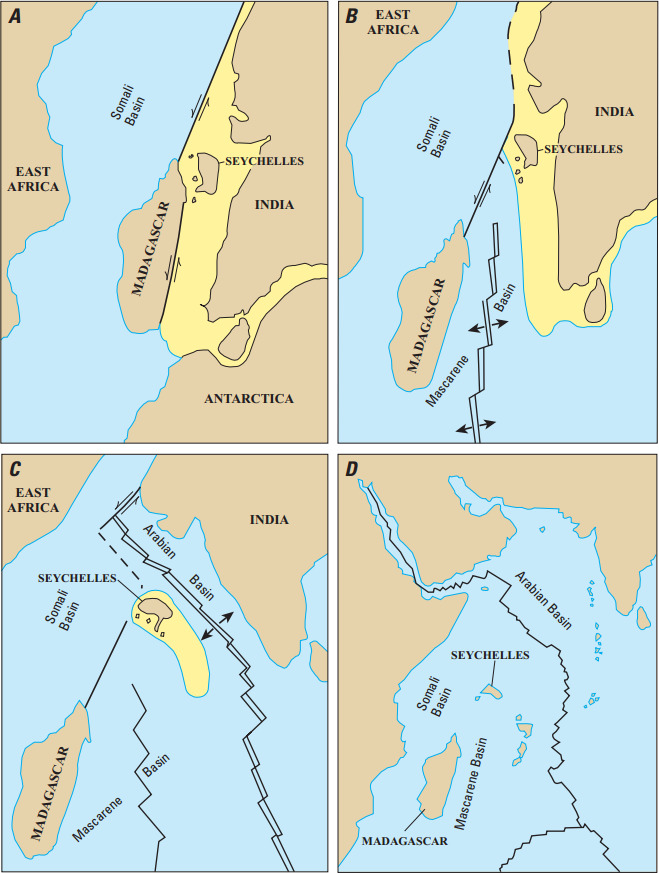
In the early Paleocene (65 to 50 million years), this completely broke away from the Indian subcontinent. While the major continents continued to move to their present position due to continental drift, Madagascar and Seychelles continued to migrate only marginally, reaching their current position in the Indian Ocean early, isolated from Africa (Goslin & Patriat 1984).
Therefore, many islands of the inner Seychelles consist of continental rocks: various granites with an age of about 750 million years (Late Precambrian) (Torsvik et al. 2001).
Geology and origin of rocks of the seychelles
Seen from a geological point of view, the Inner Islands contain a multitude of different granites of different composition. Baker (Baker 1963) identified four main types of granites: Gray Granite, Pink Granite, Northern Granite and Porphyritic Granite. According to recent scientific results by Torsvik (Torsvik et al. 2001), only on Mahé all four types of granite are found simultaneously. Praslin, La Digue and Frégate, as well as all the smaller islands are mainly made up of Pink Granite and only show subordinate other granite varieties. St. Anne and Cerf, in turn, consist only of Northern Granite. Geochemical datings show that the granites are between 748 and 764 million years old (Proterozoic age). Only the Pink Granite, which was created about 703 million years ago, is younger.
Granite is one of the Plutonites created by the crystallization of magma inside the Earth. The rocks that form when the lava solidifies are called Vulkanite.
Hereby you have to differ the two terms, magma and lava, which are mixed in common usage. The molten rocks are called magma while these are still within the inside of the earth. This melt is rich in dissolved gases. When this magma came through a volcanic eruption onto the surface of the earth, it is called lava. During this process they lose the dissolved gases. Therefore each plutonite has a chemically equivalent volcanic rock. They are distinguished primarily by their crystalline structure. Since plutonites don’t quench fast, the crystals have more time to grow. Consequently the crystals are larger, which becomes noticeable in the coarse-grained material.
The chemical different Plutonites are formed by fractional crystallization from an initially uniform composed magma. Due to the difference in density of the molten rocks compared with the surrounding rocks, the magma starts with its ascent and collects in a magma chamber. There crystallization begins in consequence of slow cooling of the magma. This process changes the composition of the magma and in consequence of this the composition of the subsequent crystals varied.
A coarse order of crystallization is given by
peridotite – gabbro – diorite – syenite – granite
These are to be classified on the basis of their SiO2 content. For each plutonite exists a chemically related volcanic rock.
| Vulkanite |
Ultramafic rock |
Basalt |
Andesite Basalt |
Andesite |
Dacite/Trachyte |
Rhyolite |
| Plutonite |
Peridotite |
Gabbro |
Gabbro-Diorite |
Diorite |
Syenite |
Granite |
| Yield of SiO2 |
less than 45% |
45-52% |
52-57% |
57-63% |
63-70% |
more than 70% |
According to the yield of SiO2 Peridote and Gabbro are labeled as basic Plutonite. Syentie and Granite are labeled as acid Plutonite.
Granites primarily consist of feldspar, quartz and mica. Chemically, granite varieties are differentiated according to the type and amount of the variable main minerals (different feldspars and mica), the minor minerals (e.g., hornblende), and visually the grain size of the individual crystals. Granites can occur in different colors. Responsible for this are usually the variations in the feldspars. On the Seychelles, the gray granite, occasionally pink granite, can be found on Mahe. The latter is very common on Praslin and La Diugue. In addition to porphyritic granite, which is characterized by particularly large feldspar crystals, one can also find Gabbro at Port Glaud.
This Earthcache will take you to some locations on three of the Inner Islands, where you can find the forms mentioned above.
Near the waypoints you'll find more interesting Earthcaches worth visiting:
Ros Lepa - Stairway to devil`s hell
The Pink Granite of Anse Lazio
Mahe Island EarthCache
And also some traditionals:
Wedding Cache
The Waterfall
Anse Lazio
Log permission
To get credit for finding the cache send answers for the following questions with email at edle_stau or about the contact options in my profile.
Please write your nickname in the subject!
Geological tasks
1. Visit at least three of the following four waypoints "Anse Lazio (A)", "Sauzier Waterfall (B)", "Cerf (C)", "Just nice (D)" and describe the appearance of the formations found there. Pay particular attention to the color, grain size and possibly recognizable spread of the constituents feldspar, quartz and mica.
2. Against the background of your observation, explain which of the Plutonite varieties described above do you see in front of you (granite, gabbro, porphyric granite, etc.)? Give reasons why you think so in a few own words.
3. Collect a small piece of rock at each of the three sites visited and later determine by scratching at which of the locations the hardest rock can be found (Mohs Test).
Tasks to check that you were there:
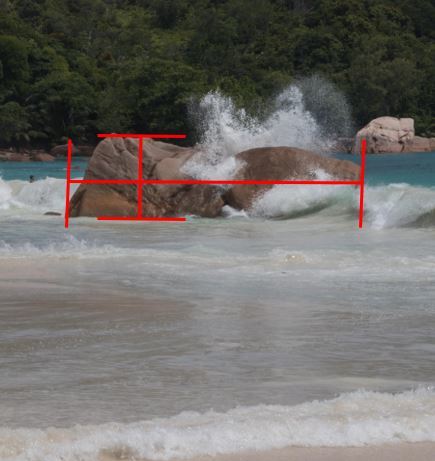
4. In case you are visiting waypoint A at Anse Lazio: Here you can see a larger rock in the sea at waypoint F "The Rock at Anse Lazio (F)". Estimate its length and height as sketched in the following picture.
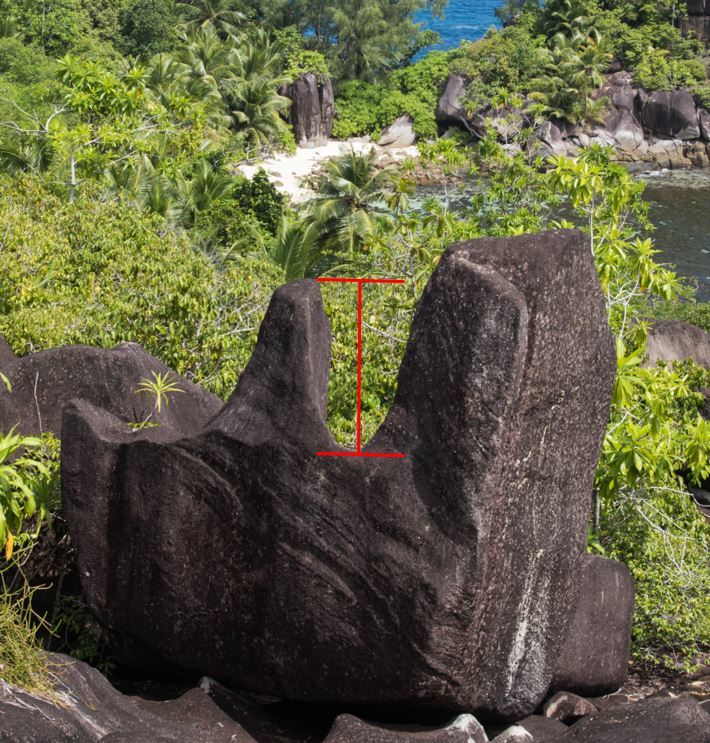
5. In case you are visiting waypoint B at Port Glaud: There you stand close to a very distinctive rock with two striking peaks. Estimate the height of the smaller tip as outlined in the following picture. Definitely worth is a visit to "Just nice (E)", a very nice little beach with a photogenic rock.
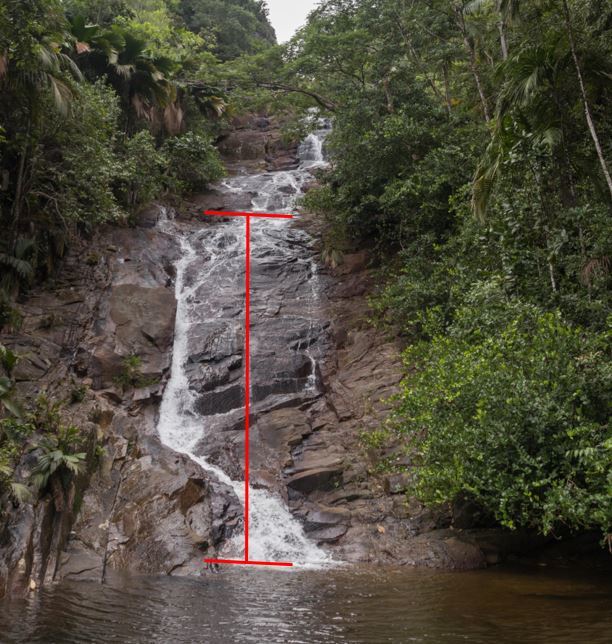
6. In case you are visiting waypint C at Sauzier Waterfall: Estimate the height of the waterfall as outlined in the following picture.
7. Please take a picture of you or a personal item (such as GPS) that indicates you were really at each waypoint visited.
After sending your answers you can log directly. If something is wrong, I'll contact you!
Even if all waypoints are easy to reach, always pay attention to your safety!
So now have fun discovering the wonderful Seychelles!
Sources and further information
Riepl, D.M. (2009) Geologie und Gesteine der Seychellen
Goslin, J. & Patriat, P. (1984): Absolute and relative plate motions and hypotheses on theorigin of five aseismic ridges in the Indian Ocean. Tectonophysics, 101: 221-224.
Baker, B.H. (1963). Geology and Mineral Resources of the Seychelles Archipelago (PDF). Geological Survey of Kenya. Retrieved 14 July 2019.
Torsvik, T.H.; Aahwal, L.D.; Tucker, R.D. & Eide, E.A. (2001): Neoproterozoic geochronology and paleogeography of the Seychelles microcontinent: the India link. Precambriam Research, 110: 47-59.
Wikipedia: Geologie der Seychellen
Wikipedia: Plutonit
Wikipedia: Gabbro
Wikipedia: Granite
Wikipedia: Porphyritic
Geology and Mineral resources of the Seychelles Archipel
Wikipedia: Granitic Seychelles
Deutsche Version
Entstehung der Seychellen
Als vor etwa 150 Millionen Jahren im Mittleren Jura der Superkontinent Pangäa zu zerbrechen begann, wurde der nördliche Teil der Landmassen (Laurasia) von den Südlichen (Gondwana) getrennt.
Gondwana umfasste damals die Kontinentalmassen des heutigen Südamerikas, Afrikas, Australiens, Indiens, der Antarktis und die der arabischen Halbinsel. Im weiteren Zuge der Kontinentaldrift zerbrach Gondwana in einen westlichen (Südamerika, Afrika und arabische Halbinsel) und einen östlichen Teil (Indien, Australien und Antarktis).
Vor ca. 90 Millionen Jahren (Späte Kreidezeit) trennte sich dann der indische Subkontinent von Madagaskar. Dabei entstand ein kleiner Bruchsplitter – der Mikrokontinent Seychellea.
Dieser löste sich im Frühen Paläozän (65 bis 50 Millionen Jahre) vollständig vom indischen Subkontinent ab. Während die Großkontinente im Laufe der Zeit weiterhin von der Kontinentaldrift in ihre heutige Position bewegt wurden, wanderten Madagaskar und Seychellea nur noch geringfügig weiter und erreichten früh ihre heutige, von Afrika isolierte Position im indischen Ozean (Goslin & Patriat 1984).
Deshalb bestehen viele Inseln der inneren Seychellen aus kontinentalem Gestein: Verschiedenen Graniten mit einem Alter von rund 750 Millionen Jahren (Spätes Präkambrium) (Torsvik et al. 2001).
Geologie und Entstehung der Gesteine
Von geologischer Seite gesehen, finden sich in den Inner Islands eine Vielzahl verschiedener Granite unterschiedlicher Zusammensetzung. Baker (Baker 1963) legte vier Haupttypen an Graniten fest: Grey Granite, Pink Granite, Northern Granite und Porphyritic Granite. Nach aktuellen wissenschaftlichen Ergebnissen von Torsvik (Torsvik et al. 2001) finden sich nur auf Mahé alle vier Granittypen. Praslin, La Digue und Frégate sowie alle kleineren Inseln sind hauptsächlich aus Pink Granite aufgebaut und zeigen nur untergeordnet andere Granitvarietäten. St. Anne und Cerf wiederum bestehen nur aus Northern Granite. Geochemischen Datierungen zufolge zeigen die Granite ein Alter zwischen 748 und 764 Millionen Jahren (proterozoisches Alter). Jünger ist nur der Pink Granite, der vor rund 703 Millionen Jahren entstand.
Granit zählt zu den Plutoniten, die durch die Kristallisation von Magma im Erdinneren entstehen. Die Gesteine, die beim Erstarren der Lava entstehen werden als Vulkanite bezeichnet.
Zu unterscheiden sind hier die beiden oft im Alltagsgebrauch vermischten Begriffe Magma und Lava. Als Magma wird die Gesteinsschmelze bezeichnet solange sich diese noch im Erdinneren befindet. Diese Schmelze ist noch reich an gelösten Gasen. Tritt diese Schmelze aus einem Vulkan aus und verliert die gelösten Gase, so spricht man von Lava. Somit hat jeder Plutonit einen chemisch äquivalente Vulkanit. Plutonit und äquivalenter Vulkanit unterscheiden sich in erster Linie durch ihr kristallines Gefüge. Da Plutonite über längere Zeit abkühlen, haben deren Kristalle mehr Zeit zu wachsen. Somit bilden sich größere Kristalle, die sich in der deutlich sichtbaren größeren Korngröße bemerkbar machen.
Die chemisch unterschiedlichen Plutonite entstehen durch fraktionierte Kristallisation aus einem zunächst einheitlich zusammengesetzten Magma. Dieses Magma beginnt aufgrund des Dichteunterschiedes der Schmelze zum umgebenden Gestein mit dem Aufstieg und sammelt sich in einer Magmakammer. Dort kristallisieren erste Mineralien durch die langsame Abkühlung aus. Dadurch ändert sich die Zusammensetzung des Magmas und damit die Zusammensetzung der nachfolgend kristallisierenden Gesteine.
Eine grobe Kristallisationsreihenfolge ergibt sich mit
Peridotit – Gabbro – Diorit – Syenit – Granit
Diese sind anhand ihres SiO2-Gehaltes zu klassifizieren. Zu jedem Plutonit findet sich ein chemisch verwandter Vulkanit.
| Vulkanit |
Ultramafit |
Basalt |
Andesitischer Basalt |
Andesit |
Dazit/Trachyt |
Rhyolith |
| Plutonit |
Peridotit |
Gabbro |
Gabbrodiorit |
Diorit |
Syenit |
Granit |
| SiO2-Gehalt |
kleiner 45% |
45-52% |
52-57% |
57-63% |
63-70% |
größer 70% |
In Anlehnung an den SiO2-Gehalt werden Peridotit und Gabbro als basisch und Syenit und Granit als saure Pultonite bezeichnet.
Granite bestehen primär aus Feldspat, Quarz und Glimmer. Chemisch unterscheidet man Granitvarietäten je nach Art und Menge der variablen Hauptminerale (unterschiedliche Feldspäte und Glimmer), der Nebenminerale (z.B. Hornblende) und optisch nach der Korngröße der einzelnen Kristalle. Granite können in verschiedenen Farben auftreten. Verantwortlich dafür sind meist die Variationen in den Feldspäten. Auf den Seychellen finden sich auf Mahe vor allem der graue Granit, vereinzelt auch pinker Granit. Letzterer kommt sehr häufig auf Praslin und La Diugue vor. Bei Port Glaud findet sich neben porphyrischem Granit, der sich durch besonders große Feldspatkristalle auszeichnet, auch Gabbro.
Dieser Earthcache bringt Euch zu einigen Orten auf drei der Inseln der Inner Islands, an denen Ihr die oben genannten Spielformen finden könnt.
Nahe an den Wegpunkten findet Ihr weitere interessante Earthcaches, die einen Besuch lohnen:
Ros Lepa - Stairway to devil`s hell
The Pink Granite of Anse Lazio
Mahe Island EarthCache
Und auch diese Tradis:
Wedding Cache
The Waterfall
Anse Lazio
Logfreigabe
Zur Logfreigabe beantwortet bitte folgende Fragen per E-Mail an edle_stau oder über die Kontaktmöglichkeiten in meinem Profil.
Nennt bitte Euren Nickname im Betreff!
Geologische Aufgaben
1. Besucht mindestens drei der folgenden vier Wegpunkte "Anse Lazio (A)", "Sauzier Waterfall (B)", "Cerf (C)", "Just nice (D)" und beschreibt das Aussehen der jeweils dort anzutreffenden Formationen. Achtet vor allem auf Farbe, Korngröße und evtl. erkennbare Verteilung der Bestandteile Feldspat, Quarz und Glimmer.
2. Was glaubt ihr an Hand Eurer Beobachtung, welche der oben beschriebenen Spielarten von Plutoniten habt ihr hier jeweils vor Euch (Granit, Grabbo, porphyrischer Granit, usw.)? Begründe die Vermutung in kurzen Worten.
3. Sammelt an allen drei besuchten Stellen einen kleinen Gesteinsbrocken und bestimmt später durch gegenseitiges Kratzen, an welchem der Standorte das härteste Gestein vorliegt (Mohs Test).
Aufgaben zur Prüfung, dass ihr vor Ort wart:
4. Für den Fall, dass Ihr den Wegpunkt A am Anse Lazio besucht: Hier seht ihr bei Wegpunkt F "The Rock at Anse Lazio (F)" einen größeren Felsen im Meer. Schätzt dessen Länge und Höhe wie im folgenden Bild skizziert.
5. Für den Fall, dass Ihr den Wegpunkt B bei Port Glaud besucht: Dort steht Ihr direkt in der Nähe eines sehr markanten Felsen mit zwei markanten Spitzen. Schätzt die Höhe der kleineren Spitze so wie im folgenden Bild skizziert. Hier lohnt sich auf alle Fälle ein Abstecher zu "Just nice (E)", einem sehr netten kleinen Strand mit einem fotogenen Felsen.
6. Für den Fall, dass Ihr den Wegpunkt C den Sauzier Wasserfall besucht: Schätzt die Höhe des Wasserfallstufe wie im folgenden Bild skizziert.
7. Macht bitte an jedem besuchten Wegpunkt ein Foto von Euch oder einem persönlichen Gegenstand (z.B. GPS) aus dem erkennbar ist, dass ihr vor Ort wart.
Nach dem Senden der Antworten könnt Ihr direkt loggen. Sollte etwas nicht stimmen, melde ich mich!
Auch wenn alle Wegpunkte gut zu erreichen sind, achtet immer auf eure Sicherheit!
So und nun viel Spaß beim Entdecken der wunderbaren Seychellen!
Quellen und weiterführende Informationen
Riepl, D.M. (2009) Geologie und Gesteine der Seychellen
Goslin, J. & Patriat, P. (1984): Absolute and relative plate motions and hypotheses on theorigin of five aseismic ridges in the Indian Ocean. Tectonophysics, 101: 221-224.
Baker, B.H. (1963). Geology and Mineral Resources of the Seychelles Archipelago (PDF). Geological Survey of Kenya. Retrieved 14 July 2019.
Torsvik, T.H.; Aahwal, L.D.; Tucker, R.D. & Eide, E.A. (2001): Neoproterozoic geochronology and paleogeography of the Seychelles microcontinent: the India link. Precambriam Research, 110: 47-59.
Wikipedia: Geologie der Seychellen
Wikipedia: Plutonit
Wikipedia: Gabbro
Wikipedia: Granit
Wikipedia: Porphyrisches Gefüge
Geology and Mineral resources of the Seychelles Archipel
Wikipedia: Granitic Seychelles
