Face NorthWest. The geological folds are on the cliffs at the top of the mountains to the NorthWest of this parking location. The face with the clearest geological fold is facing Southwest, so it will be angled slightly away from you. Take your estimates off this geological fold when answering the questions below.
In geological terms, a fold occurs any time there are stratified layers in the crust that are deformed by bending. Each fold can be classified according to its size, fold shape, and tightness.
Fold Shape
The fold shape involves identifying both the order of the strata in the layering as well as the type of bend itself. Where the axial plane bisects the limbs is called the hinge line, as the fold centers around this line. The two arms that reach to the hinge line are known as limbs.
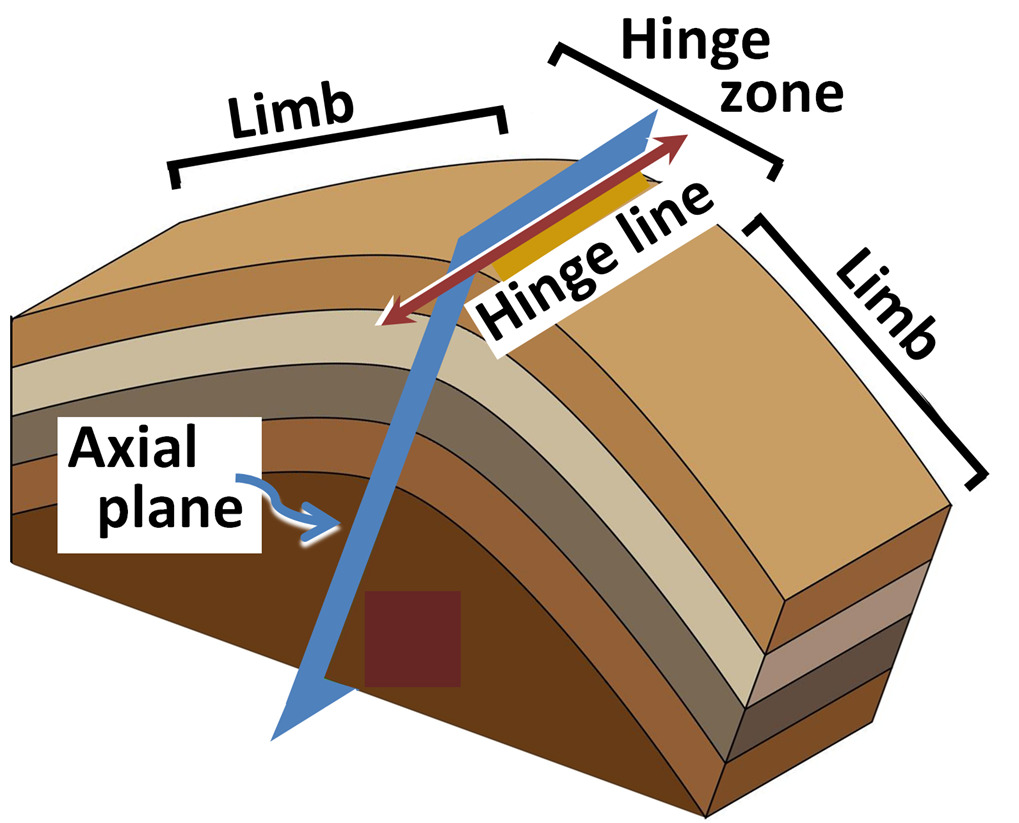
Image taken from Brews ohare [CC BY-SA 3.0 (https://creativecommons.org/licenses/by-sa/3.0)]
This image shows linear strata - each strata forms a horizontal layer. There are five categories of linear folds to choose from:
Anticline, Syncline, Antiform, Synform, and Monocline.
Anticline: When the strata have the oldest layering in the middle and the newest layering on the outside of the fold, and the limbs bend down below the hinge line. The highest point of this fold will be the hinge.
Syncline: When the strata have the oldest layering on the outside of the fold and the newest layering in the middle, and the limbs bend up above the hinge line. The lowest point of this fold will be the hinge.
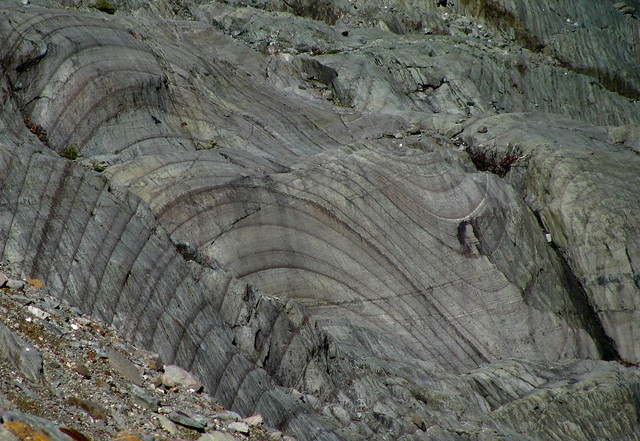
Image taken from Dru! Syncline and Anticline Accessed Aug. 05, 2019 from flickr [CC BY-SA 3.0 (https://creativecommons.org/licenses/by-sa/3.0)]
In the above image, the left end of the rock is an anticline which then transitions into a syncline on the right end of the rock form.
Antiform: When the limbs bend down below the hinge line. The highest point of this fold will be the hinge. However, the oldest layering will be on the outside of the fold, and the newest layering will be in the middle of the fold. If the age of the strata is unknown, the type is also antiform.
Synform: When the limbs bend up above the hinge line. The lowest point of this fold will be the hinge. However, the oldest layering will be on the outside of the fold, and the newest layering will be in the middle of the fold. If the age of the strata is unknown, the type is also synform.
Monocline: The strata of a monocline dip away from the hinge on one side only. The below image is a monocline at the Colorado National Monument.
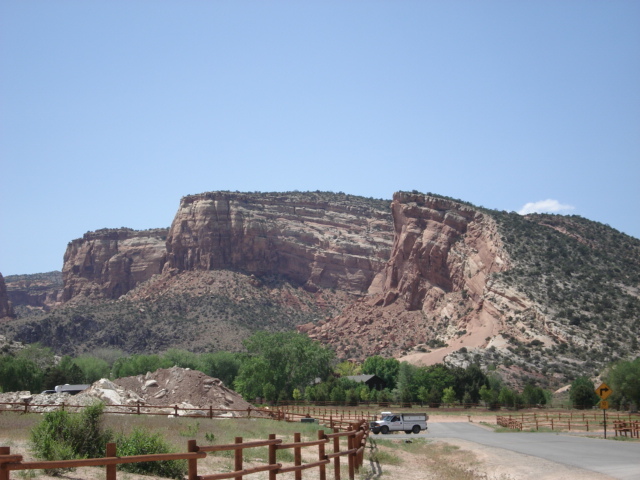
Anky-man at the English Wikipedia [CC BY-SA 3.0 (http://creativecommons.org/licenses/by-sa/3.0/)]
There are other types of folds, but for simplicity, this earthcache will only deal with these fives, as the strata are linear.
Tightness
The tightness of a fold is a measure of the angle between the two limbs. To find this angle, we would imagine a tangent line from each limb extending beyond the hinge until it meets the tangent line from the other limb. Then we would measure the smallest angle between these two lines.
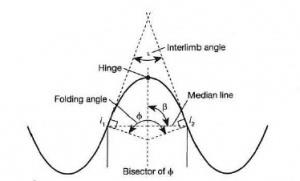
Moores Eldrige, Twiss Robert J, Structural Geology 2nd Edition. https://wiki.seg.org/index.php?curid=43679
The maximum angle of tightness would be a flat strata layer, and would be 180 degrees interlimb angle. As this angle decreases, the tightness of the fold increases.
A gentle fold ranges from 120 degrees to 180 degrees.
An open fold ranges between 70 degrees and 120 degrees.
A close fold ranges from 30 degrees to 70 degrees.
A tight fold ranges between 0 and 30 degrees.
An isoclinal fold has an angle of exactly 0 degrees.
To have an isoclinal fold, the fold must go from perfectly vertical on one limb to perfectly vertical on the other limb over the hinge.
The image shown gives the interlimb angle for an anticline fold; flipping the image vertically will give the orientation of the interlimb angle for a syncline fold.
To claim this earthcache, please submit answers to the following questions via email or the geocaching message system. Please bear in mind that I am not looking for an exact, academic answer. I'm more interesting in seeing that you have been to the location, and engaged with the concepts covered in the earthcache. You do not have to wait for me to reply to claim the smiley; however, logs without accompanying answers will be deleted.
Questions
#1) Estimate the height of the vertical face of the cliffs above the tree line. Given the distance away from you, it may be easier to use a referent size and then estimate how many of the referent. For example, I estimated the nearest trees to be about 25 feet tall, and then estimated the height of the vertical face in 'trees', and multiplied to find the height of the vertical face.
#2) Estimate the height of the trough (bottom fold).
#3) Estimate the thickness of the fold layers. This will be the vertical distance from the trough to the crest (top folded layer).
#4) Is this fold symmetrical or asymmetrical?
#5) Estimate the interlimb angle. What type of fold tightness is this?
#6) What type of fold is this? (Syncline, anticline, synform, antiform)
#7) Continuing to look at this mountain, describe evidence of other folds.
References
SEG Wiki. (Last Updated Jan. 04, 2018) Structural Fold. Accessed Aug. 05, 2019 from https://wiki.seg.org/wiki/Structural_fold
Wikipedia. (Last Updated Jun. 05, 2019). Fold (geology). Accessed Aug. 05, 2019 from https://en.wikipedia.org/wiki/Fold_(geology)
The background image is taken under a Creative Commons 3.0 License without modification, requiring owner attribution. James St. John [CC BY 2.0 (https://creativecommons.org/licenses/by/2.0)]