Earthcaches have no "box" to find. Rather, with this earthcache, you discover something about geology. For more information, see earthcache.org.
There is a tiny parking lot for Person Hall. It is best to use the UNC visitor parking lots.
It is easy to miss the two gargoyles that are attached to the front of Person Hall, but they have a facinating story. In 1933 when Mrs. Katherine Pendleton Arrington was visiting London, she walked by Big Ben as these two gargolyes were being removed from the Clock Tower. The gargoyles were only 80 years old, but had to be replaced because the London soot and weather had deteriorated them. She was allowed to purchase the gargoyles if she would buy the replacement stones. She gave the gargoyles to the University of North Carolina in Chapel Hill as a gift.
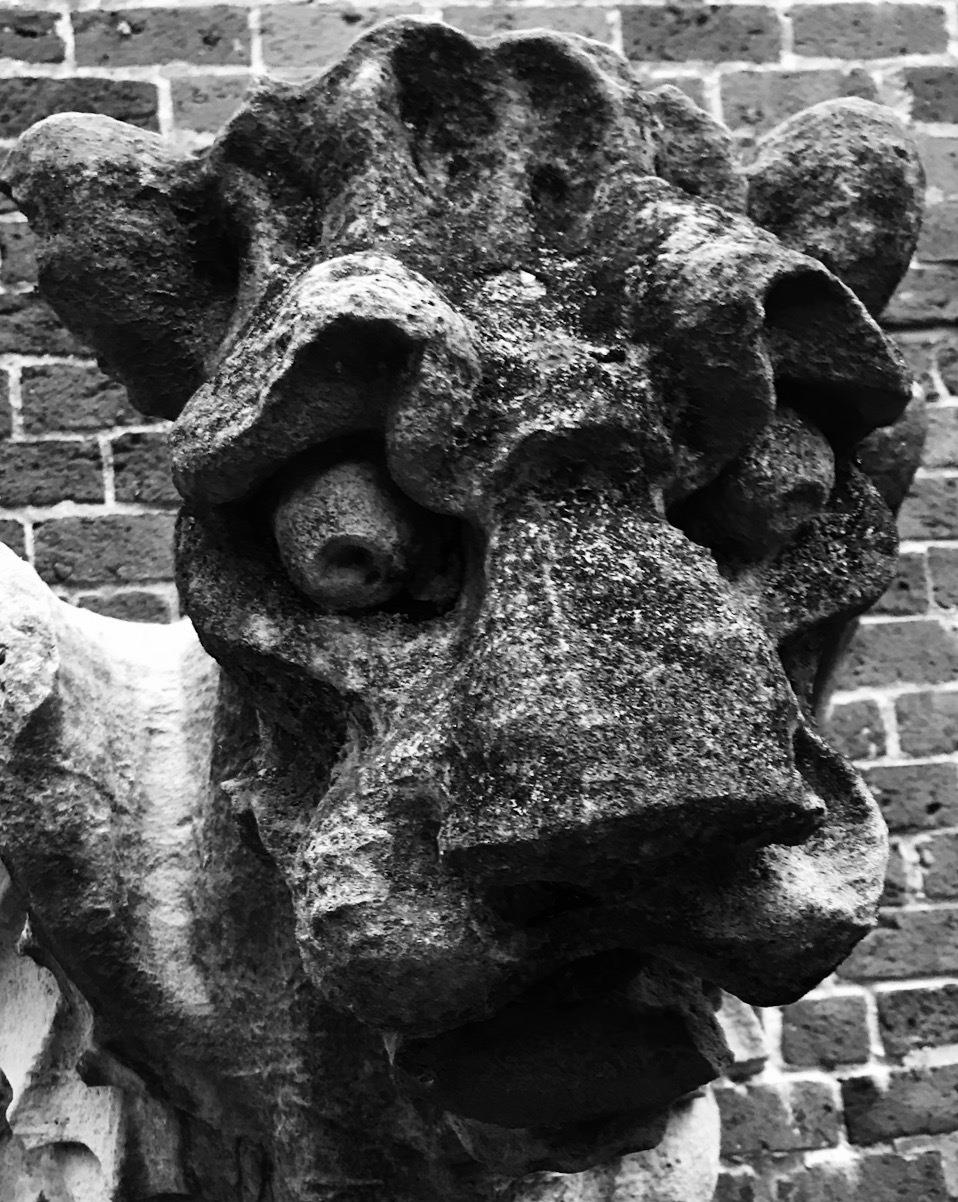
But why did these gargoyles have to be replaced so soon?
The Clock Tower (renamed Elizabeth Tower in 2012 for Queen Elizabeth's Diamond Jubilee) was completed in 1859 and was built in with a sand-colored limestone from the Anston Quarry in Yorkshire, UK. This stone was chosen because it was cheap, it could be supplied in blocks up to four feet thick, and it lent itself to elaborate carving. Unfortunately, the stone becan to quickly decay because of the pollution from coal burning in London and the poor quality of the stone. In 1928, they decided to change to Clipsham stone, a honey-colored limestone from the Medwells Quarry in Rutland, to replace the decayed Anston stone. A restoration project began in the 1930s, but it was brought to a halt during the Second World War and was completed only in 1960.
Anston stone has a "warm, yellow color" and was known at the time as "Magnesian Limestone." The term dolomite is now used. Dolomites are organic sedimentary carbonate rocks. Dolomite rock originates in the same sedimentary environments as limestone - warm, shallow, marine environments where calcium carbonate mud accumulates in the form of shell debris, fecal material, coral fragments, and carbonate precipitates. Dolomite is thought to form when the calcite in carbonate mud or limestone is modified by magnesium-rich groundwater. The available magnesium facilitates the conversion of calcite into dolomite. This chemical change is known as "dolomitization."
Dolomite is comprised of calcium and magnesium. These minerals give dolomite is hardness properties, making it sturdier than limestone, to the point that is very resistant to erosion. Although dolomite is resistant to erosion from wind and water, it is susceptible to to carbonic acid (formed by rainwater and carbon dioxide). The carbonic acid enters fractures and dissolves rock.
These rocks have been found in north-east England dating from the Permian period (last period of the Paleozoic era). The outcrop stretches from Nottingham northwards through Yorkshire and into County Durham where it is exposed along the coast between Hartlepool and South Shields.
Logging Tasks: (Required)
Please send your answers via geocaching message center (preferred) or email.
Check out one (or both) of the gargoyles. Please do not damage the stone.
- What color is the stone and is the color uniform?
- Describe the stone's texture; is it smooth, rough, pitted...?
- Does the stone appear to be eroding? How?
- Please post in your found it log a picture of you, your GPS, your group, a limb, your geo-pet, something ... with one of the two gargoyles (Left or Right).
Sources