Grand Pacific Glacier is the longest glacier in Glacier Bay National Park. At a length of roughly 35 miles, it actually exists in both Alaska and Canada.
Grand Pacific Glacier was named in 1879 by John Muir when it’s terminus was at Russell Island in Glacier Bay. As this massive glacier retreated, Harry Fielding Reid discovered in 1892 that three distinct glaciers were visible. He retained the name "Grand Pacific" for the most northerly and largest, and named the middle one "Johns Hopkins Glacier". The smallest and most southerly glacier was named "Reid Glacier". After a 15 mile retreat which formed the fjord known as Tarr Inlet, the terminus of Grand Pacific Glacier now rests very near the U.S./Canada boundary.
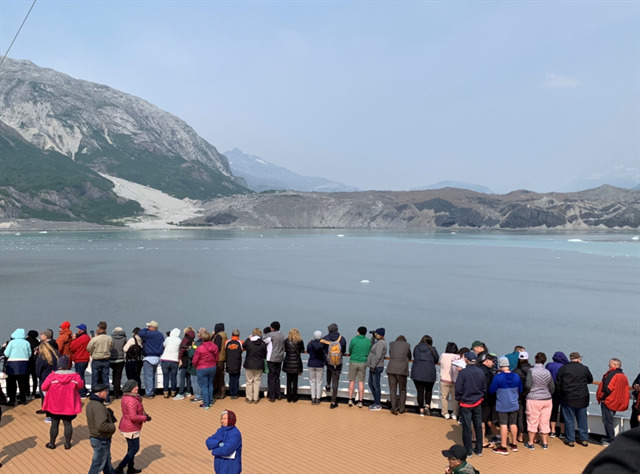
(This is what I saw on my visit to Grand Pacific Glacier. Note the white part from Ferris Glacier on the left end.)
What is a glacier?
Glaciers are large ice masses formed when snowfall stays in place long enough to turn to ice. Fallen snow compresses under its own weight and squeezes out the air gaps resulting in a larger more compact piece of ice. This process continues over hundreds or even thousands of years, forming these large masses. Some glaciers are as small as football fields, while some can be dozens of miles long.
How can glaciers alter land?
One unique characteristic of glaciers is their ability to move. Glaciers flow like very slow rivers, due to their sheer mass and weight. The movement and weight can actually cause the glacier to sculpt and carve away the Earth beneath it. Glaciated valleys, horns, and fjords are all erosional types of landforms, created when a glacier cuts away at the landscape. Other types of glacial landforms are created by the features and sediments left behind after a glacier retreats.
Glacial Horns;
Glacial horns are sometimes called pyramidal peak. These peaks are angular, sharply pointed mountain peaks which results from multiple glaciers diverging from a central point.
Glacial Valleys;
Glacial Valleys are typically U-shapes valleys with steep sides. When a glacier travels across and down a slope, the scouring action carves out this U-shape. When the ice recedes or thaws, the valley remains, often littered with small boulders that were transported within the ice.
Fjords;
Fjords are long, narrow coastal valleys that were carved out by glaciers. They are often “U-shaped,” with steep sides, very much like glacial valleys. Seawater covers the bottom of the formation creating an inlet.
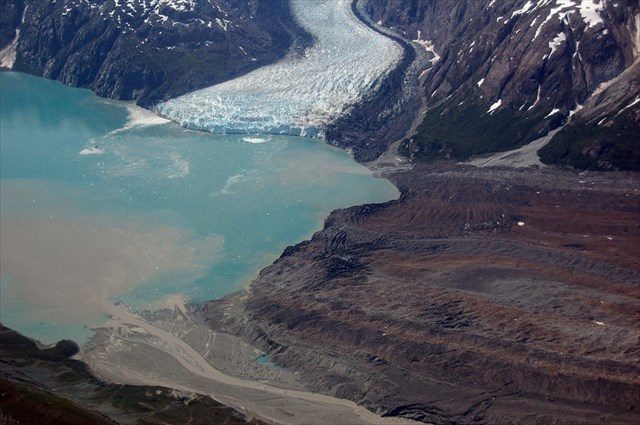
(Mountaintop view from East of Grand Pacific Glacier looking over Tarr Inlet toward Margerie Glacier.)
Why does Grand Pacific Glacier look so dirty?
As a glacier moves, it can actually dislodge boulders, rocks, and other forms of till, and push those objects along like a bulldozer or even pick those items up and transport them for great distances in the ice or on the surface of the ice. Tributary glaciers such as Ferris glacier on the west side of Grand Pacific can add to the collection of rock and till as it joins another glacier. Avalanches and rock slides caused by erosion along the glaciers path can also contribute to the debris collection on the ice.
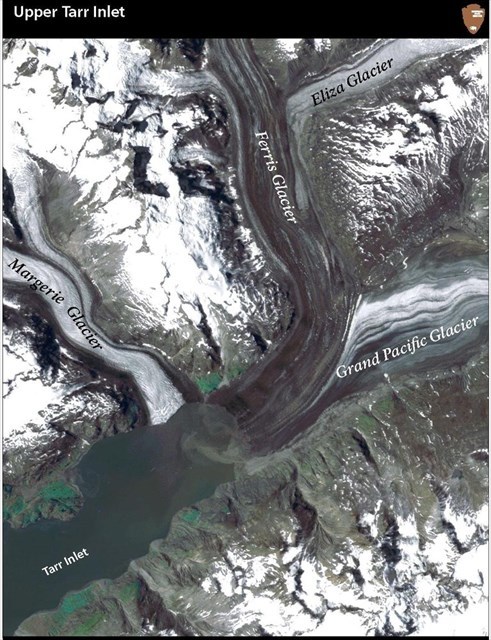
(Satellite view of the effects glaciers can have on one another.)
Logging Requirements:
1- Date and weather conditions when you visited.
2- What kind of glacial landform would you say is being left by the retreat of Grand Pacific glacier?
3- In your own words, describe what the face of Grand Pacific Glacier looks like.
4- What do you think is the primary cause of this appearance?
5- Include in your Found It log a picture you took of Grand Pacific Glacier from your visit.
DANGER!! If Logging Requirements (answers to questions) are not received within 30 days of your log, Found It logs may be deleted at any time.
https://nsidc.org/cryosphere/glaciers/questions/land.html https://www.nps.gov/glba/index.htm https://www.britannica.com/place/Glacier-Bay-National-Park-and-Preserve