Yellowstone lake is the largest body of water in Yellowstone National Park. The lake is 7732 feet above sea level and covers 136 square miles with 110 miles of shoreline. While the average depth of the lake is 139 ft, its greatest depth is at least 394 ft. Yellowstone Lake is the largest freshwater lake above 7000 ft in North America.
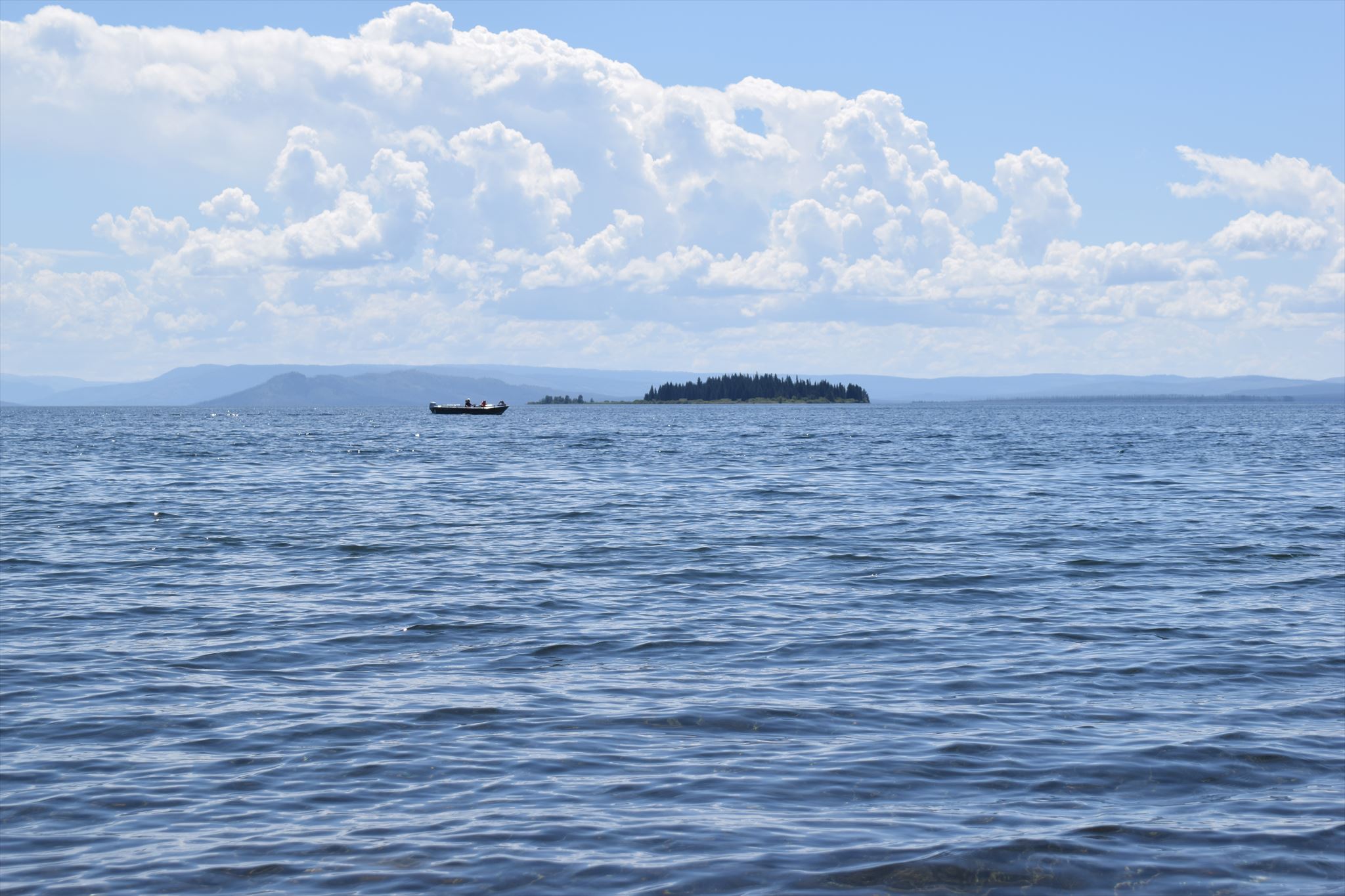
Fig. Yellowstone Lake
Larger sandy beaches can be found on the north shore of the lake, and flooded areas can be found in the southern arms.
One of this sandy beaches is the subject of our excursion today.
Alteration is a fundamental process for mineral as well as rock destruction. It is crucial for the development of soil. Moreover, the process of alteration works through exogenous forces.
The weathering creates rock an minerals disintegration into small particles, which leads to an increasing surface. This is a main driver for the weathering. In general, we distinguish some kind of alteration:
- frost wedging
- rapid changes in temperature
- pressure reliefs
- salt wedging.
Contrarily, chemical weathering describes the conversion of primary minerals to secondary weathering products. The following factors induce chemical weathering:
- solution alteration
- hydrolyse
- acid impact
- oxidation.
In general, reactions of minerals only occur on the surface of stones. Chemical weathering therefore increases with an increasing level of physical decay. This relies on the fact that the overall surface increases with a higher amount of broken pieces.
Furthermore, biological weathering describes the process of mineral and stone destruction by organisms (root wedging).
Frost wedging relies on another crucial characteristics of water. In general, water has its lowest expansion at +4 degree Celsius. From this focal point on, its expansion increases with a decrease of temperature. When freezing, water increases its volume up to 10 percent. Thus, in the case where water is filling stone cracks until 90 % of the possible volume, it will exceed the volume of the cracks. Hence, the stone pressure increases and finally results in stone explosions. Stones and minerals which can easily be split are particularly vulnerable for frost wedging. Those are for example mica, feldspat and quarz. In combination with firm rocks, frost wedging leads to rubble, slack coal, sand, silt and coarse clay. The impact of frost wedging is particulalrly strong in regions with volatile changes between frost and mild temperatures.
Moreover, volatile temperature induces increasing or decreasing volume of stones. Tensions within the stone occur for example due to temperature changes between sun and shade, within and outside the stone according to differing heat absorption, head conduction and extension of minerals. For instance, granite ans sandstone expand between 0,25 and 0,60 mm per meter of rock mass.
Alteration based on salt wedging create detached salts, which crystalize due to the evaporation of its solvent. These salts induce crystal pressure as the volume of the saturated solution and crytallized salts in total exceeds the initial solvent.
But let's go back to the decomposition on the spot! To describe the kind of soil you see, a simple test with your hand can already provide some insights. Take some soil (about half a fistful), spread it on your hand and make a little bit moist (not wet!). The following criteria might help to evaluate the soil: 1. granularity and 2. characteristics of the soil when you knead it and roll it out on your hand.
Evaluation of the share of sand:
- sand grains are visible
- it crunches when rub it between your hands
- it trickles in dry condition
- no lumps
- it does not stay in shape you press it in your hand.
Evaluation of the share of silt:
- no grains are visible
- does not crunch when you rub it between your hands
- no lumps
- it does not stay in shape when you press it in your hand
Evaluation of the share of clay:
- very sticky, in wet condition very slobbery
- the friction surface is shiny
- clumps can not be squashed in wet condition
- high plasticity in wet condition.
Moreover, the decomposition product also differs depending on its origin.
1. If it consists mainly of volcanic rocks, a higher amount of magnetic reactions occur based on the higher share of iron. Parts of the sand are drawn on by the magnet (magnetic test).
2. Fluorescence is a phenomenon that causes a mineral to "glow" in the within the visible spectrum when exposed to ultraviolet (UV) light. Typical fluorescent minerals are calcite or fluorite. Calcareous sedimentary deposits show a blueish till violett colour under UV-light. By volcanis rock there generally is no reaction.
To log this earthcache, please send the answers to the following questions to my account. You do not need to wait for a log approval. If something is not correct, I will contact you soon.
1. Go to the listing coordinates and do the previously in the listing described test with your hands. Describe the material (colours, size, profile (edged or round)). Which kind of soil you found ? Justify your decision.
2. Use the material you found to do a magnetic test. What do you see ? What do you observe when you examine the materal under UV-light ? Which kind of rock it may have been originally ?
3. Which kinds of alteration may have been here in interaction ?
Acknowledgement: I thank Tammy Wert, Fee & Film Program Manager, Yellowstone National Park, for the permission to let this Earthcache be published and the Geoaware for reviewing.
References:
Wikipedia
Photo by the cache owner August 2019