Do not park illegally. Pay attention to any no parking/stopping signs. It may be best to park 1km to the south at the entrance to the Everton Tract and walk up the road to this cache. Do not pass any No Trespassing signs. If necessary, you may do your observations and gather your answers from the road.
This is a simple earthcache with an introduction to the formation of potholes in the area.
Along the Eramosa River in the small village of Everton you will find a small concentration of glacial features consisting of many glacial potholes. This entire valley was under water as the Wisconsin glacier melted - water rushed through, and where depressions were present in the limestone bed sometimes harder rocks would be swirled around by the turbulence causing these potholes as the harder rock eroded the softer limestone. Some of the potholes here are a couple of metres in diameter - others smaller. Some are quite deep. The following image shows how this pot hole would have formed.
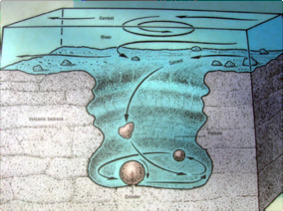
The pothole here is easily accessed at the side of the road. Follow the short trail 50m along the back of the guard rail to the river where you will find the pot hole that is the feature of this earthcache. Afterwards you can continue following the trail down stream along the Eramosa River to view an abundance or rock formations and other potholes of various sizes.
Tasks and Logging Requirements
1) Is the top of the pothole exposed, or is it completely submerged in the water? If part of it is exposed, what percentage is above the water line?
2) Calculate the amount of water currently in the pothole. Take the width of the pothole, multiply it by pi and then multiply that by the depth of the water in the pothole.
3) Feel around with your hand in the bottom of the pothole. Are there any rocks in the pothole? If yes, would the rocks in the pothole be contributing to further erosion of the pot hole?
4) How is the water moving around in or over the pot hole?
5) Is it possible that this used to be a much deeper pothole? If yes, what evidence do you see here that can back this up. Maybe look at the rocks above the pot hole.
Send me the answers to the above questions and then go ahead and log this earthcache. Feel free to post pictures too.