We are visiting from the Mainland and decided to finally host an event to meet some of the great cachers of Hawaii. We have found over 700 caches in Hawaii during numerous trips back to a place we feel is home. We were stationed here on separate occasions for 9 of the 37 years served in the USMC. Our Daughter and Grandson were born here. Truly a special place in our hearts.
It will be great to meet many of the kamaʻāina. Cache Lee, DadWrap, GeoGerms, honolulululu, sillygirl & jrr, Chestnut J’s who encouraged me to host an event, and many other great cachers.
Events we have hosted back on the mainland revolved around Whining or wining, but here we have attempted to try something that is of significance to the Hawaiians and Hawaiians at heart.
On September 28, at 08:26 Honolulu will experience a mahina nui hou (super new moon). Twenty – Four hours later we will host the event. Eh Hawaiian time Brah! End time is flexible but we have to check out of our hotel, so sometime btw 09:30 and 10:00 we will bid our Aloha’s. Remember the Date of the event is 29 SEPT. Time 24 hours after the Mahina Nui Hou
We did some research about the Mahina Nui Hou and the history and significance of moon cycles for the Hawaiians. The following paragraphs are excerpts from our research.
A super new moon occurs when the center of the Moon is less than 360,000 kilometers (ca. 223,694 miles) from the center of Earth. This will occur at 08:26 Sept 28 Honolulu time.
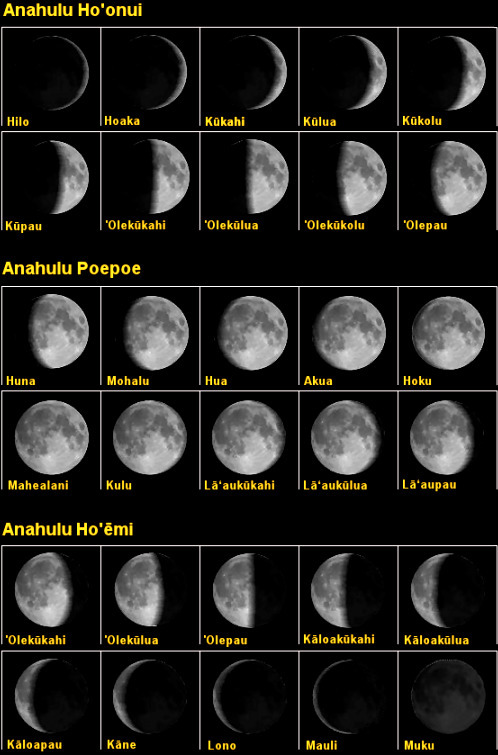
In the traditional Hawaiian calendar, the lunar month was determined by the 29.5-day cycles of mahina, the moon, and the passage of days were marked by the phases of the moon. The approximately 30 days of the moon cycle were divided into three 10-day periods known as anahulu. Every three to six years, a thirteenth lunar month was added. Each month started with the new moon, Hilo and ended with Mauli or Muku, the dark moon.
The first 10-day period was called “ho‘onui,” “growing bigger,” beginning on the first crescent
1. Hilo (faint thread; cf. puahilo, “faint, wispy”). The month began with “the first appearance of the new [crescent] moon in the west at evening,” just after sunset, as the moon moved out from behind the sun.
2. Hoaka (crescent; arch over the door; Handy and Handy say the name means “faint light” or “casting a shadow.”)
3-4-5-6. Kūkahi, Kūlua, Kūkolu, Kūpau (The four Kū days, literally, First, Second, Third, and Last Kū)
7-8-9-10. ‘Ole Kūkahi, ‘Ole Kūlua, ‘Ole Kūkolu, ‘Ole Kūpau (The four ‘Ole days, literally, First, Second, Third, and Last ‘Ole Kū. ‘Ole Kūlua was the first quarter of the moon; the names for days 7-10 match the names of days 21-24 of the last quarter moon. Days 7-10 mark the transition from less than half-lit moon to the more than half-lit moon.)
The second 10-day period was called “poepoe,” “round” or “full,” as the moon became full and round.
11. Huna (“to hide”; when the moon hides its “horns” and appears more rounded)
12. Mōhalu (“to unfold like a flower,” “to blossom”)
13. Hua (fruit, egg)
14. Akua (god; the first night of fullness)
15. Hoku (the second night of fullness; if the moon is still out at sunrise, it is called Hoku ili, “Stranded moon”; if it has set just before sunrise, it is called Hoku palemo, “Sunken moon.”)
16. Māhealani (the third night of fullness; “māhea” means “hazy, as moonlight”)
The nights of the bright moon – Akua, Hoku, and Mahealani – were referred to as “nā pō mahina kōnane,” kōnane meaning “bright moonlight.”
17. Kulua (“Kulu,” which could mean “to drop” or “to pass, as time does.”)
18-19-20. Lā‘au Kūkahi; Lā‘au Kūlua; Lā‘au Kūpau (Literally, First, Second, and Last Lā‘au Kū. During this sequence, the sharp “horns” of the moon begin to appear again.)
The third 9-10-day period was called “‘emi,” “decreasing” or “waning,” as the moon loses its light. The last quarter moon rises around midnight and sets around noon. Muku, the new moon, is unseen between the earth and the sun.
21-22-23. ‘Ole Kūkahi; ‘Ole Kūlua; ‘Ole Kūpau (Literally, First, Second, and Last ‘Ole Kū; ‘Ole Kūlua was the last quarter; the names of days 21-23 match the names of 7-10 days of the first quarter moon, and mark the transition from more than half-lit moon to less than half-lit moon. );
24-25-26. Kāloa Kūkahi; Kāloa Kūlua; Kāloa Pau (Literally, First, Second, and Last Kāloa Kū. Kāloa is short for Kanaloa, a major akua, or god.)
27. Kāne. (The name of a major akua, or god.)
28. Lono. (The name of a major akua, or god.)
29. Mauli (“Ghost,” “spirit”; Malo: “fainting”; Kepelino: “last breath”)
30. Muku (“Cut-off.” The new moon; the end of the moon cycle. The moon is in front of the sun: its backside is lit, and its frontside, facing the earth, is dark.)
Notes on the Full Moon
The moon appears full on three days, the 14th (Akua), the 15th (Hoku), and the 16th day (Māhealani).
Kamakau “The night when the moon was full was the night of Akua; the second night of the full moon was Hoku, when it began to crumble (puehu) and peel; the second night of this peeling was Māhealani”
A chant for remembering the days of the moon:
Kamali‘i ‘ike ‘ole i ka helu pō
Kamali‘i ‘ike ‘ole i ka helu pō
[Chidren who do not know how to count the nights]
Muku nei, muku ka malama
[Here is Muku, cut off is the moon/month]
Hilo nei, kau ka Hoaka
[Here is Hilo (Faint streak of light), the Hoaka (Crescent) rises]
‘Eha Kū, ‘eha ‘Ole
[There are 4 Ku days, and 4 ‘Ole days]
Huna, Mōhalu, Hua, Akua
[Huna (Hidden), Mohala (Blooming), Hua (Fruit), Akua (God)]
Hoku, Māhealani, Kulua
[Hoku (Full Moon Night), Māhealani (Full Moon Night), Kulua (Trickling away)]
‘Ekolu Lā‘au, ‘ekolu ‘Ole
[There are 3 Lā‘au (Plant) days, and 3 ‘Ole days]
‘Ekolu Kāloa, Kāne, Lono, Mauli no.
[There are 3 Kāloa (Kanaloa) days, Kāne, Lono, and Mauli (Life-Spirit). Kanaloa, Kāne and Lono are three major gods of ancient Hawai‘i.]
Here are links to sites we referenced.
https://www.timeanddate.com/moon/phases/usa/honolulu
http://www.wpcouncil.org/wp-content/uploads/2018/09/Hawaii-FishermenCal2019.pdf
Looking forward to meeting the Hawaiian Cachers. ALOHA 