Team Mollymap Proud Members Of The SCGA

NOTE: This is an earthcache, there is no physical container to find at the coordinates. To get your smiley for the cache, e-mail your answers for the questions below to the cache owner. This earthcache is located on public property and free parking is available and the nearby Space View Park.
While walking around we stumbled upon a couple of storm water projects by the city of Titusville. We were more than baffled to learn about baffle boxes and thought to highlight them in an earthcache. To date there are six new baffle boxes being constructed in Titusville.
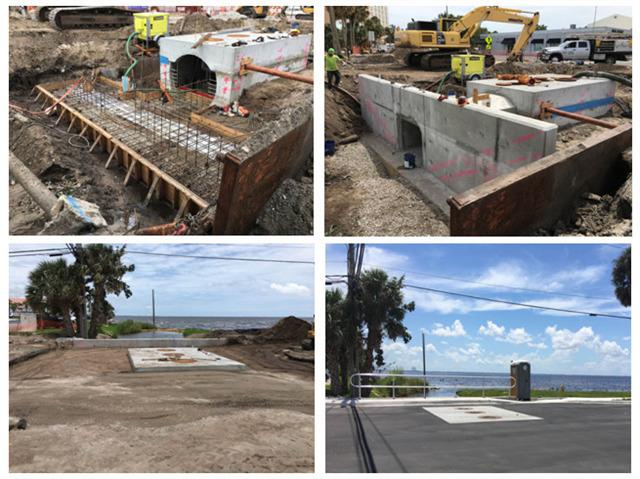
What is a Baffle Box?
A Baffle Box is a concrete or fiberglass structure with a series of sediment settling chambers separated by baffles. The main function of the box is to remove sediment and suspend particles that would be stormwater pollutants.
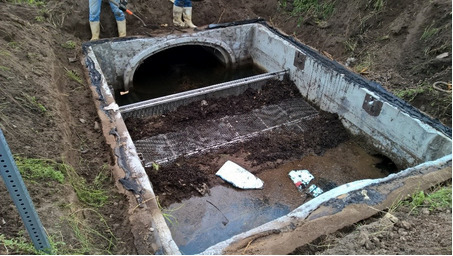
How Do Baffle Boxes Work?
Baffle boxes are usually located at the end of storm drain pipes. As storm water enters the box the water flow velocity decreases. Floatables and large trash are picked up by the screen at the top, and sediment settles in the bottom of the box. The largest sediment particles settle in the first chamber. The smaller sediment that does not settle in the first chamber moves on to the other ones. Periodically the baffle box is vacuum cleaned and the material is properly disposed of, preventing the sediment, debris and trash from ever entering the water way.

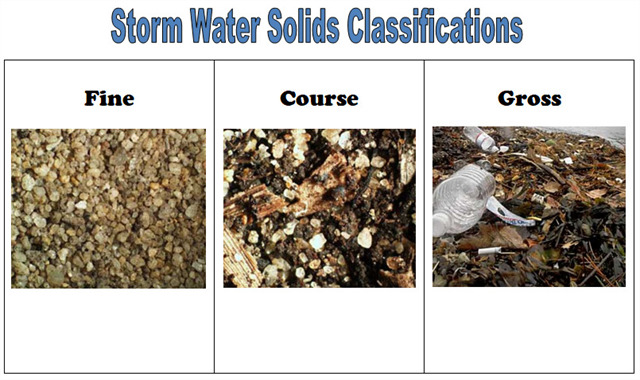
Storm Water Solids Classifications
Storm water solids can be classified in many different ways. One way to classify storm water solids is into size groups of fine, course, and gross.
Fine: clay, silt, decomposed organic material.
Course: sand, gravel, leaf components.
Gross: twigs, leaves, grass, pine needles, plastics, paper, Styrofoam.
Local Soil
For the purpose of this earthcache it may be helpful to be able to identify the local soils. Soils in this area are mainly Florida sandy soils: Myakka and Pomello. Both of these types of soil are ordered as Spodosols. Spodosols are ashy grey acidic soils usually made from iron, aluminum, and organic matter.
Myakka sand is poorly drained and is black or a dark grey color. It has a crushed sand texture and a cemented granular structure.
Pomello sand is moderately well-drained sand and has a gray fine sand texture. It also has a weak fine granular structure that is not well cemented and can be broken easily.
Now it is time for the questions. To get credit for the cache, please answer the questions below. When answering the questions do your best. It is more important that you learn a new concept about our earth and can apply your knowledge, rather than have a precise answer.
Questions:
1-Where is the water coming from that is treated by this baffle box?
2-Which baffle box chamber do you think traps the most sediment?
3-At the beginning of the culvert notice the metal grate. The storm water has just passed through the baffle box here. Observe the storm water runoff coming out of the grate. Would you classify the sediments outside the grate as fine, coarse or gross?
4-Is the baffle box working?
Thank you for visiting this earthcache. Please send your answers to the above questions to the cache owner, and once you have feel free to log it. In your "found it" log feel free to write about your experience, but don't include the earthcache answers. Thanks and we hope you enjoy beautiful Titusville shores!
Sources:
https://www.titusville.com/Page.asp?NavID=2454
http://ecosenseint.com/news/best-bang-for-your-old-bucks/
https://nepis.epa.gov
https://wahaso.com/our-services/stormwater-harvesting-systems/
www.sarasota.wateratlas.usf.edu
http://websoilsurvey.nrcs.usda.gov/app/
http://www.soilhealth.com/soil-health/organic/
https://www.sfgate.com/bayarea/article/Bay-Area-cities-must-cut-trash-in-storm-drains-3213526.php