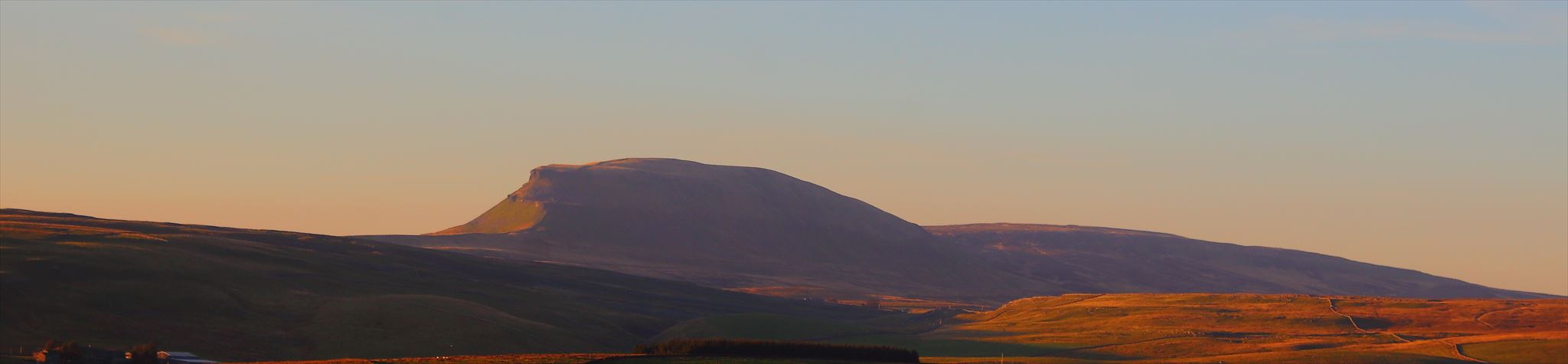
Pen-y-Ghent is shaped by the geology that underlies it, though at times, no matter which angle you look at it, it all seems the same. Drive from Halton Gill to Stainforth, or Stainforth to Horton, and it seems that the landscape is dominated by grey limestone, though if you look closely, the landscape and the geology tells a story.
This is a two stage EarthCache, if you have the time, I would recommend parking up, and then walking to the two waypoints.That way you don't have to worry about on coming traffic on the single track road, and you get to appreciate the fantastic views that there are.
The purpose of this EarthCache is to show you a certain type of limestone, a type known as the Girvanella Band.
First lets look at some basics, the area that you can see is dominated by limestone geology. Limestone is a sedimentary rock.
Sedimentary rocks are types of rock that are formed by the deposition and subsequent cementation of that material at the earth's surface and within bodies of water. Sedimentation is the collective name for processes that cause mineral and/or organic particles to settle in place. The particles that form a sedimentary rock by accumulating are called sediment. Before being deposited, the sediment was formed by weathering and erosion from the source area, and then transported to the place of deposition by water, wind, ice, mass movement or glaciers. Sedimentation may also occur as minerals precipitate from water solution or shells of aquatic creatures settle out of suspension.
Limestone is a sedimentary rock composed largely of the minerals calcite and aragonite, which are different crystal forms of calcium carbonate. Most limestone is composed of skeletal fragments of marine organisms such as coral, crinoids and molluscs.
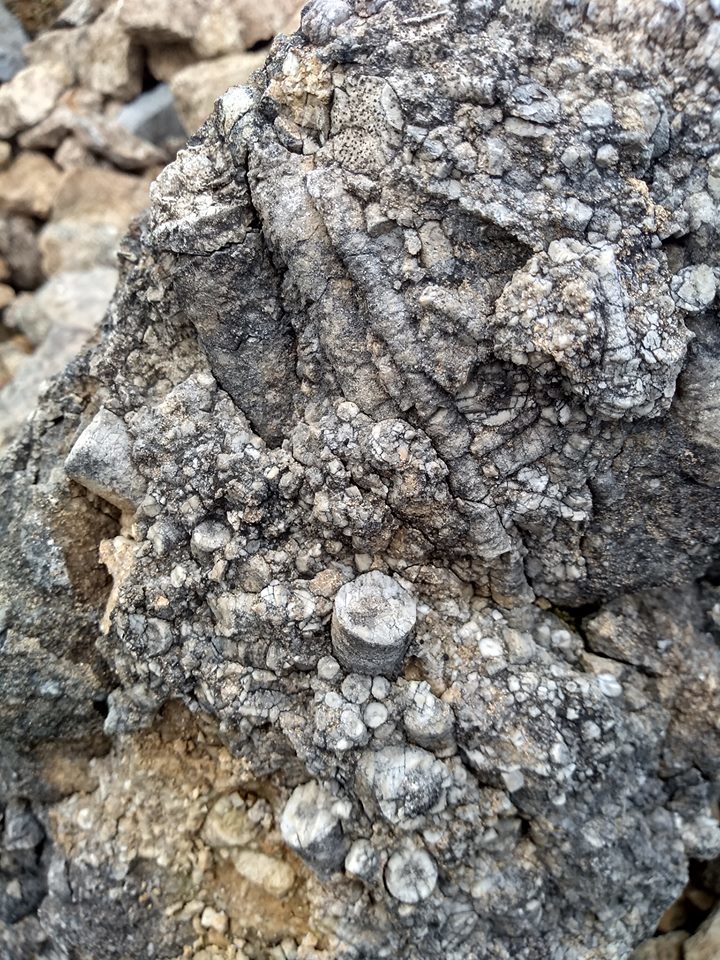
Crinoids.....
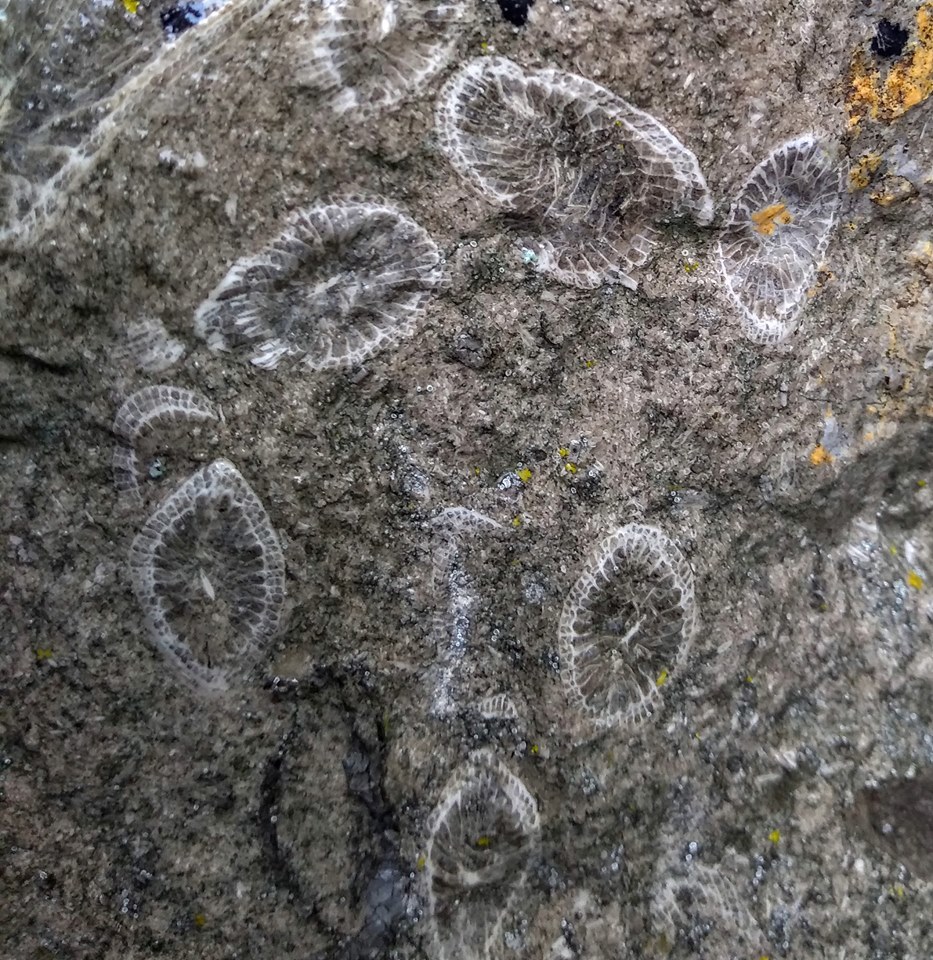
Corals ....
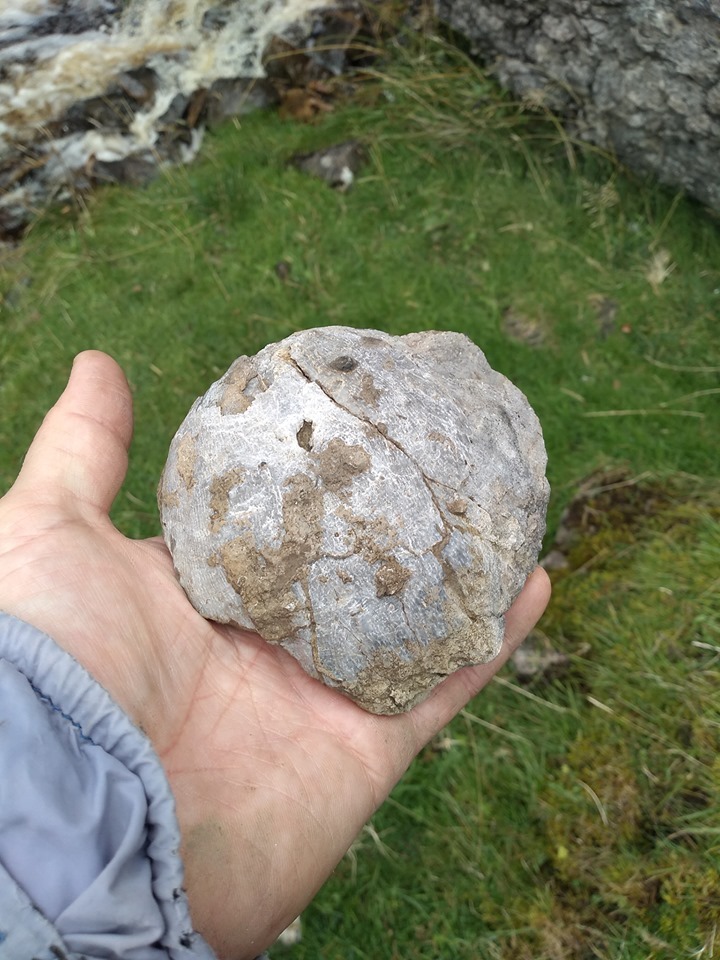
Mollusc....
BANDING OF LIMESTONE
At first, all the limestone looks a like, but look a bit closer, and you can start to see some differences in it. This is because, as with any rock we encounter, there are different sedimentary layers, which have all been laid down in different time periods. In this area, the predominant layers of sedimentations can be seperated in to:
The GREAT SCAR LIMESTONE and the YOREDALE SERIES.
In this part of the Yorkshire Dales, the tops of the mountains such as Pen-y-Ghent and Ingleborough are capped with a type of rock called mill stone grit, under which is a repetitive sequence of limestone, shale and sandstones. This repetitive sequence is known as the Yoredale Series. Under the Yoredale series are a series of limestone, which is classified into the Great Scar Limestone. The Great Scar Limestone, tends to be fine grained, and bioclastic, which means it contains fragments of once living organisms. This type of limestone can be found around Malham and the base of Ingleborough.
The limestones in the area, can be further subdivided into :D1 age and D2 age limestones.
D1 age limestone is the upper layer of the Great Scar limestone, and this tends to be fine grained, creamy/ grey in colour.
D2 age limestone is the lower layer of the Yoredale series. This limestone tends to be the most fossilarious in the area.
So how can you distinguish between the D1 and D2 limestones? Well, there is a marker which is used, and this is the Girvanella band. This band is a very dark, bitumous limestone, and is the boundary between the D1 and D2 limestones. It is also known as almond rock, and contains nodules / circular structures which are the fossil evidence of a type of algae, known as girvanella. The girvanella band gets it dark colour, partly from the algae, and partially from the conditions at the time it was laid down. its dark colour comes from impurities, which are from muds washed down by rivers into the very shallow sea that the limestone was deposited at the time.
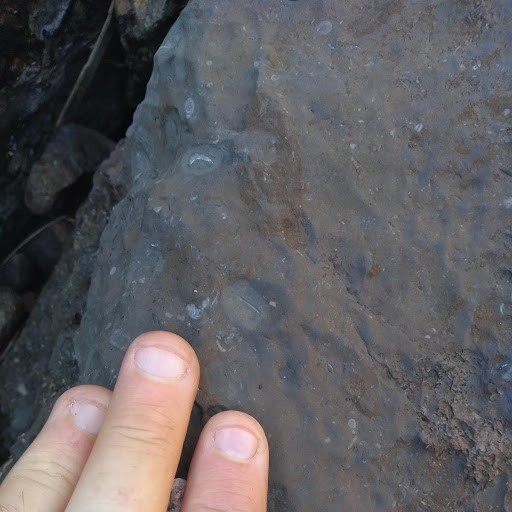
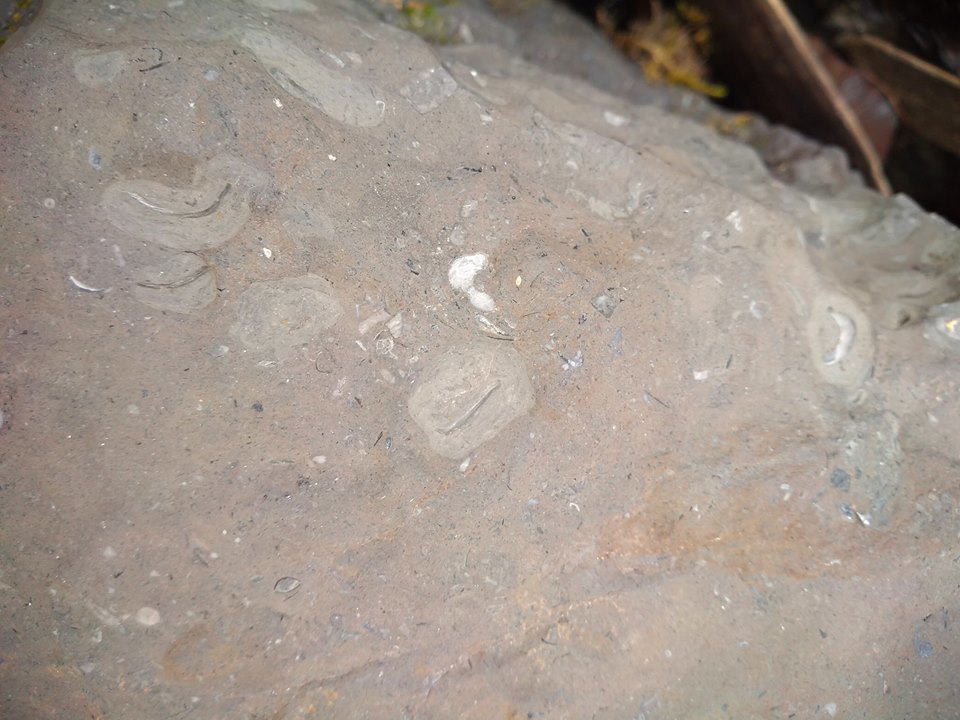
Examples of Girvanella Nodules.They are the irregular round / oval structures.
TYPES OF ROCK IN THE AREA
As described above the area is covered with different types of rock, be they from the Yoredale Series, the Girvanella Band or the Great Scar Limestone.
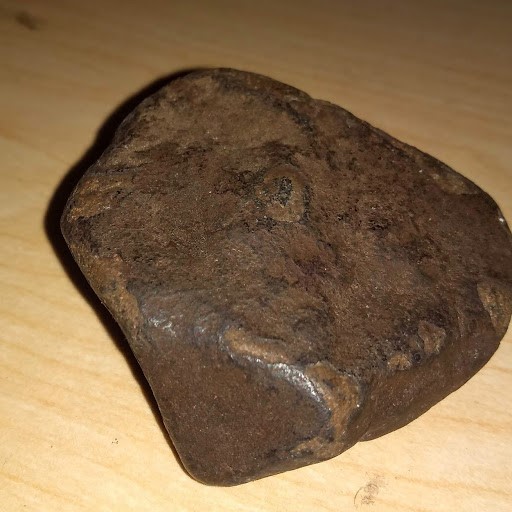
Girvanella Band Limestone
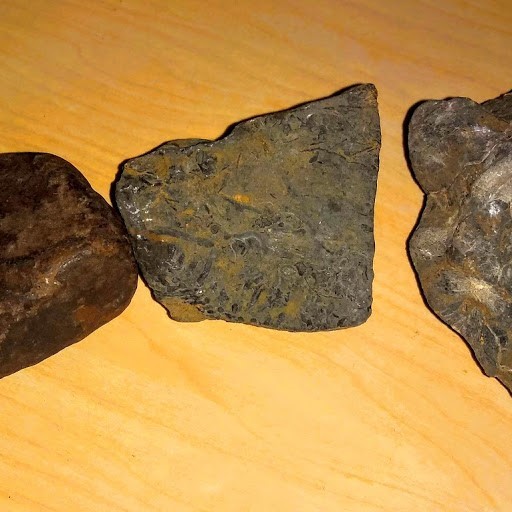
Types of Girvanella Band Limestone with fossils....
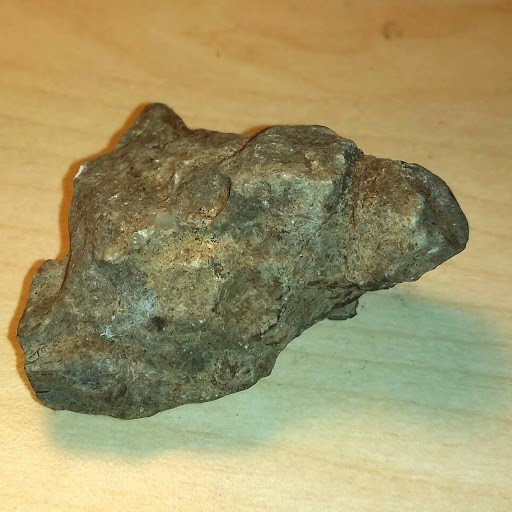
Great Scar Limestone.
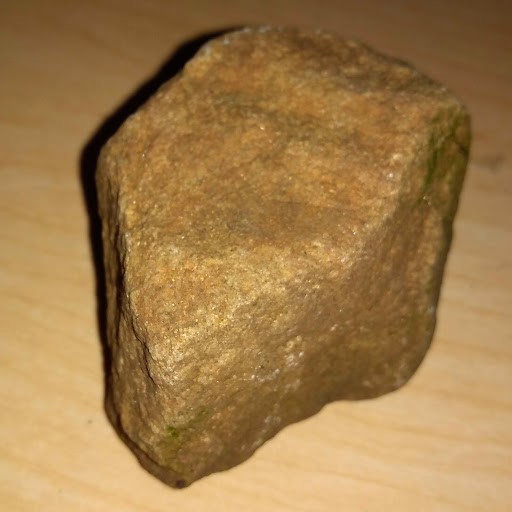
Yoredale Series Sandstone.
WAYPOINT ONE. THE LISTED CO-ORDINATES.
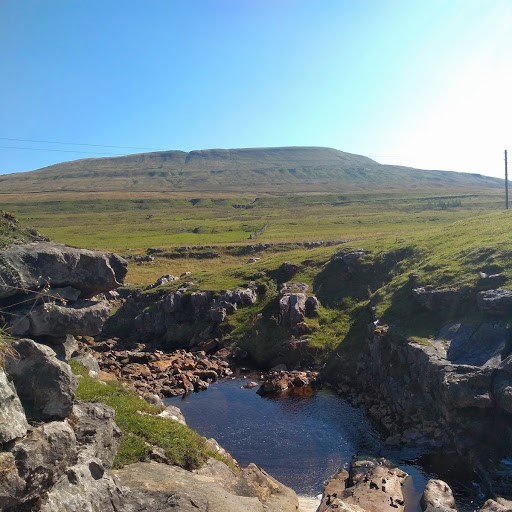
The first stage takes you to the stream bed, where there is a small waterfall, just down from the bridge. BE VERY CAREFUL HERE, AS IF THE LIMESTONE IS WET, IT IS LIKE ICE.
(1) Please tell me the height of the Girvanella Band here. (I do not mean the height above sea level).
(2) If the stream is not in spate, please try and find a Girvanella nodule, please describe its size in cm.
(3) Why is the Girvanella band the colour it is?
(4) Please describe the colour of the D1 limestone, in the stream bed immediately below the Girvanella Band.
WAYPOINT TWO. SWANS DYKE
The co-ordinates here, take you to a stream bed known as Swans Dyke, it is grassy in places, and rocky in other places. Depending on the weather conditions it may, or may not have water in it.
(5) There is Girvanella Band limestone here. Please describe its presentation, is it one uniform block or seperate boulders.
(6) From the base of the Girvanella Band to where it meets D2 limestone, please estimate its height.
(7) Immeediately above the Girvanella Band , there is a distinct block of D2 limestone, it is full of crinoid fossils. On one face of this block, there is a distinct square large crinoid fossil, how large is it?
This being an EarthCache, in order to log it, I ask that you complete the above tasks. Please send the answers to me, and do not include them in your log. You can send them to me by using the message facility or email, both of which can be found by looking at my profile.