Oklahoma City Zoo R🌎cks!
EarthCache

Located within the grounds of the Oklahoma City Zoo in front of the herpetarium, this petrified 8 foot tall tree stump is estimated by geologists to be more than 5 million years old!
To get credit for this EarthCache, be sure to complete the logging tasks at the bottom of this page.
Before We Begin:
The Oklahoma City Zoo is
open daily from 9 am to 5 pm.
Parking is free.
- The entire pathway is wheelchair accessible.
- Please be aware there is a nominal fee to enter zoo grounds.
- Here is a handy map of the zoo exhibits.
As this is an EarthCache, there is no container to find. Instead you will have an opportunity to learn about how wood can transform into a rock through a process called petrification. After completing this EarthCache, hopefully you will have learned more about the following:
- What is petrified wood?
- How petrified wood is formed?
- How minerals may affect its coloring?
Let's get started!
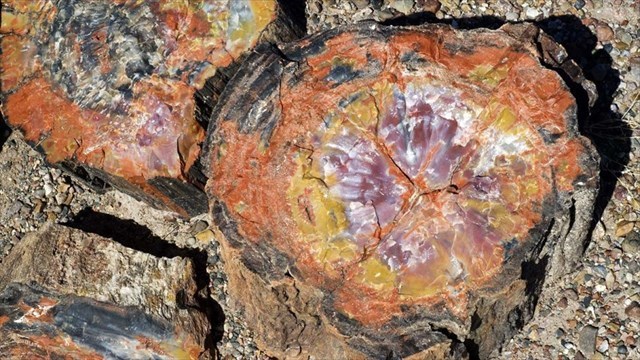
Colorful crystal patterns are displayed in a cross-section of petrified wood in the Petrified Forest National Park, located in northeast Arizona.
What is petrified wood?
"Petrified wood" is the name given to a special type of fossilized remains of terrestrial vegetation. Petrifaction is the result of a tree having transitioned to stone by a mineralization process in which mineral deposits form internal casts of organisms. Carried by water, these minerals fill the spaces within organic tissue. From the Greek root petro (meaning "rock" or "stone"), petrified wood literally means "wood turned into stone".
How does wood become petrified?
When we look at petrified wood, we're looking at a long-dead tree that was turned to stone and yet still retained its basic structure. How is such a transformation possible? Well, it can only take place under the right set of circumstances.
When an organism dies, it usually decomposes. Such is the circle of life. The process that most people call "rotting" is a type of decay which sets in as microorganisms break down organic matter. Usually, a dead, fallen tree will be subjected to this process.
Once in a while, though, a newly-deceased tree (or some other kind of woody plant) gets rapidly buried by mud, silt or volcanic ash. This blanketing material then shields the dead tree from oxygen. Because oxygen is the main driving force behind the decaying process, the smothered plant will begin to decompose far more slowly than it normally would.
Meanwhile, mineral-laden water or mud seeps into the dead tree's pores and other openings. As our plant's internal structure gradually breaks down, its organic material (wood fibers) gets replaced by silica and other minerals. Over a period of a few million years, those minerals will crystalize into quartz. The end result is a rock that appropriates the shape and structure of our original tree!
How does petrified wood take on different colors?
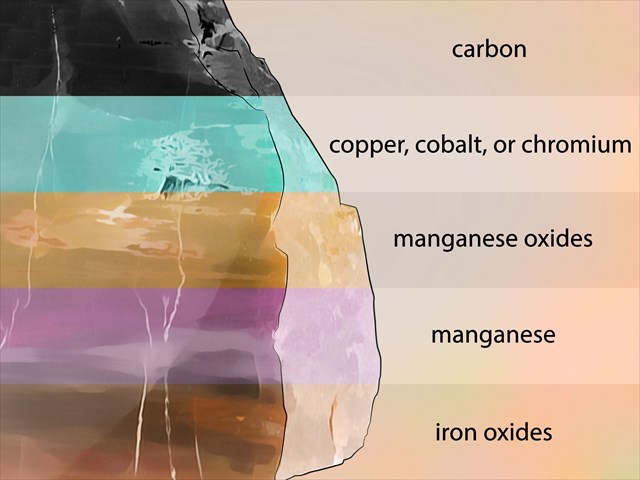
The wood, no longer wood at this point, takes on the hues of the minerals that fill its pores. The following list contains elements and how they relate to the different hues the petrified wood can take on:
- Black often indicates carbon presence.
- Blue or green shades are typically from copper, cobalt, or chromium.
- Yellow and blackish colors are often caused by manganese oxides.
- Orange and pink are due to manganese.
- Red, yellow, and brown shades are created by iron oxides.
To Get Credit For This EarthCache
Copy the questions below and send your answers via geocaching messages.
- DO NOT post the answers in your log.
- Group answers are fine, just let me know who all was there.
- Note: The photo task is a requirement for each account claiming a find. See acceptable EarthCache logging tasks effective June 10th, 2019. If you don't want to post the photo with your log, you may send it to me with your answers instead.
- Please send the answers in a timely manner or it may result in the deletion of your log (no offense intended).
Logging Tasks
1| The name of this EarthCache: Oklahoma City Zoo R🌎cks!
2| Describe the texture of the tree trunk.
3| What colors do you see throughout the trunk and which element do you think could have led to these colors?
4| In your own words, describe the process of how this petrified tree was created.
5| Provide a photo of yourself in front of the tree.
- If you prefer, it can be of a personal item instead at this location. Just make the photo unique to you and your visit. Feel free to have fun with this!
Optional: I'd love to see other photos you took from your visit here!
*IF YOU ENJOYED THIS EARTHCACHE,
CONSIDER GIVING A FAVORITE POINT!*
Sources:
Permission for this EarthCache placement was granted by the Oklahoma City Zoo.