Can you hear the trees whispering on the trail to a vanished village? Red Ochre, nails forged into spears, sacred offerings blowing in the wind. Listen and you’ll discover the stories of the Beothuk. Tour the interpretation center where exhibits and artefacts foster an appreciation for this unique now vanished culture.
From archaeological research we know that pre-contact ancestors of the Beothuk lived at Boyd's Cove, which became the site of a Beothuk village in the 17th and early 18th centuries. A hunting and fishing people, the Beothuk inhabited Newfoundland at the time of European arrival. Avoiding trade with Europeans, they nevertheless acquired metal objects from seasonally abandoned fishing premises and skilfully reworked them for their own use. Conflict, disease and starvation, the latter resulting from an expanding settler population that denied the Beothuk access to the vital resources of the sea, led to their dislocation and ultimate extinction in the 1820s.
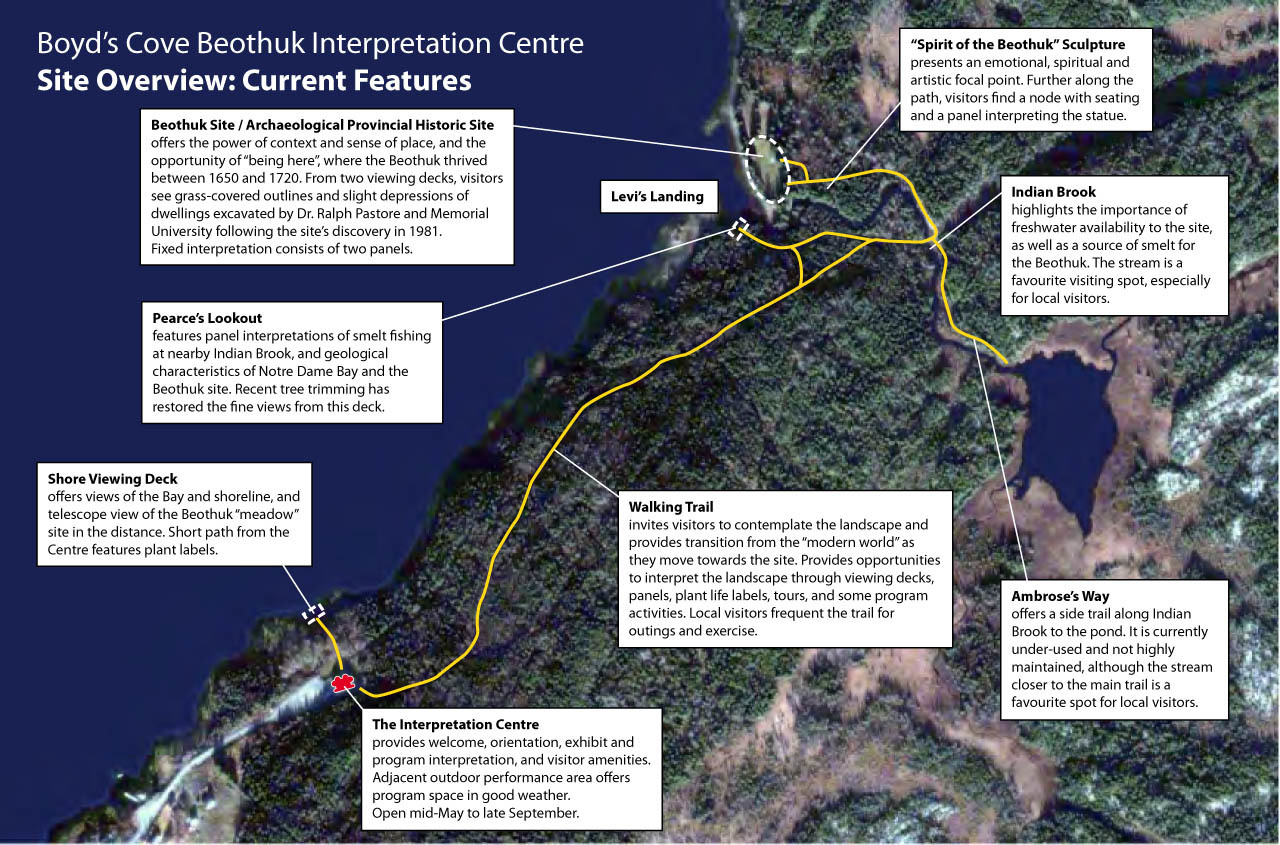
The site is positioned on a glacial moraine seven metres above sea level along the shore of Boyd’s Cove, Notre Dame Bay. An archaeological study of the site identified two areas of interest, called Area A and Area B. Area A, the northern sector of the site, is roughly 1 250 square meters and contains evidence of “Recent Indian” occupation and an earlier Palaeoeskimo presence. It has yielded artefacts that predate the Beothuk occupation and attests to continuous occupation of this site from approximately 3000 B.P. (Before Present) Area B, the south part of the site, is roughly 1 760 square metres and contains eleven Beothuk house pit features that are visible as low earthen rings surrounding shallow depressions. Other cultural features include middens, hearths, post moulds, and possible sleeping areas. Artefacts predating the Beothuk from lower levels in Area B, and matching “Recent Indian” material found in Area A and elsewhere in Newfoundland, provided long sought after evidence of an ancestral link between Beothuk and “Recent Indian” peoples.
Erected near the site is a statue by artist Gerald Squires called The Spirit of the Beothuk, placed to honour the Beothuk of Newfoundland.
From the Boyd's Cove Beothuk Interpretation Center, it's a 1.5 km trail/boardwalk to the archaeological site. Cache is a 6”x 6” Lock 'n' Lock with log, pencil and sharpener, a Canada Keychain, fidget spinner, Spiderman book and Canada fridge magnet. After crossing Bert's Bridge and following the boardwalk that parallels Indian Brook, take the trail that is on the right approximately 10m from the boardwalk end.
Remember - the decision to search for any geocache and the responsibility for your own safety lies with you.
Heritage Newfoundland and Labrador
Parks Canada