This EarthCache takes you high above Littondale, to the site of the Cold Streak Mine. There is no direct route up to the EarthCache site. You will have to either follow the footpath from Arncliffe or Kettlewell, then cut across country to the location once you are up top.
SAFETY
There is no need to enter any underground workings. Be on the look out for mine shafts. Keep to clear paths, and watch where you walk. Do not enter any bell pits - they look like shallow ringed depressions - however they could hide a deep shaft, which in many cases were covered by timber beams with earth on top. These beams are now rotting, which could make the ground very unstable.
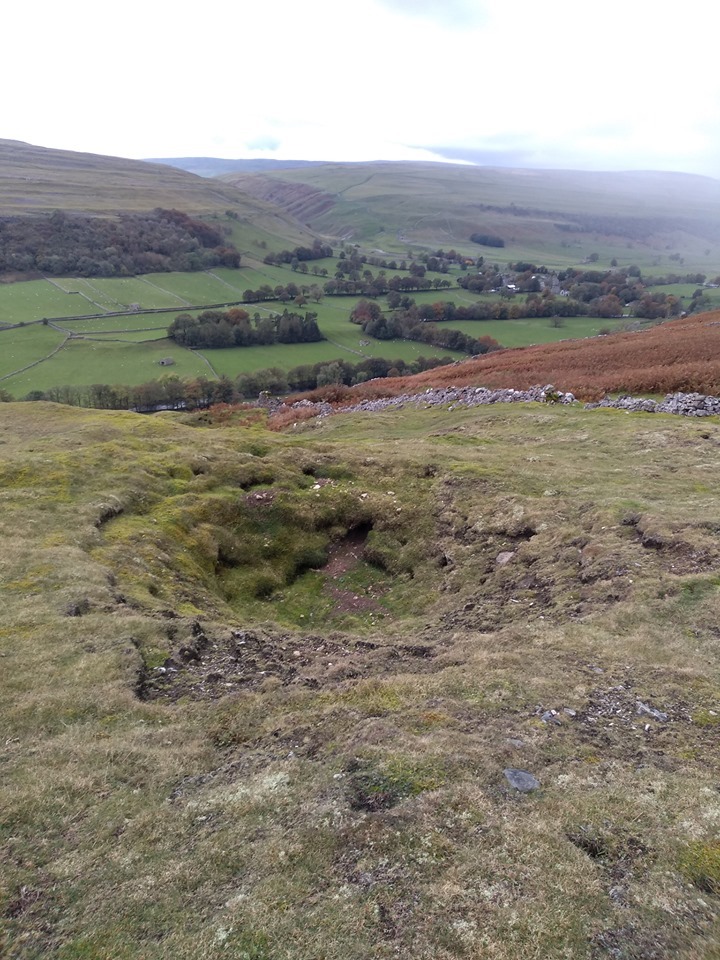
A BELL PIT.
We are here to look at a mineral vein. This part of the Dales, may now look a rural environment of sheep and cattle farms and small villages, but look closely and you can see evidence of when the Dales were an industrial landscape of lead and mineral mines. Now these mines are evidenced by barren spoil heaps, mine shafts, levels and old trackways. The cache coordinates take you to the old entrance to the level, which is now losely blocked off by rocks. DO NOT ENTER THE LEVEL. If you look above the entrance, you can see a mineral vein.
So what is a mineral vein?
Its a sheet like formation of a mineral or crystals in a rock. The rock can you see here, is limestone, which predominates in this part of the Dales. Limestone was laid down during the Carboniferous period, when this part of the Yorkshire Dales was covered by a vast shallow tropical sea. Limestone is a sedimentary rock composed largely of the minerals calcite and aragonite, which are different crystal forms of calcium carbonate. Cracks and faults in the limestone, were filled by a hotmineral rich solution, which then formed crystals through the process of precipitation, as the mineral rich solution cools. They form when minerals in the the groundwaters flowing through the rock get to a point where they are saturated. The means that basically the water is loaded with the mineral. Due to a variety of processes, such as precipitations, pressure, temperature, these minerals which are loaded in the ground water, are then deposited in cracks in the rocks which are known as veins. As the minerals are laid down, they form crystals in the veins. The mineral deposits that form when a mineral fills cracks in rocks are called veins.
So what is a fault?
In geology, a fault is a planar fracture or discontinuity in a volume of rock, across which there has been significant displacement as a result of rock-mass movement. Large faults within the Earth's crust result from the action of plate tectonic forces, with the largest forming the boundaries between the plates, such as subduction zones or transform faults. Energy release associated with rapid movement on active faults is the cause of most earthquakes.
A fault plane is the plane that represents the fracture surface of a fault. A fault trace or fault line is a place where the fault can be seen or mapped on the surface. A fault trace is also the line commonly plotted on geologic maps to represent a fault.
Since faults do not usually consist of a single, clean fracture, geologists use the term fault zone when referring to the zone of complex deformation associated with the fault plane.
This being an EarthCache, in order to log it, I ask that you answer some questions. Please send them to me, and do not include them in your log. You can send them to me by using the message facility or email, both of which can be found by looking at my profile.
1. The vein can be seen above the entrance to the level, at what angle in degrees does it point at?
2. Please compare the vein to the limestone at either side of it. Please describe both in terms of colours, width, any crystal size, feel, and appearance.
3. With in the vein, there are seperate small veins, how many are there?
5. Are the veins paralell to each other, are they straight?