Theoretical introduction
Basalt is a mafic extrusive igneous rock formed from the rapid cooling of magnesium-rich and iron-rich lava exposed at or very near the surface of a terrestrial planet or a moon. More than 90% of all volcanic rock on Earth is basalt. Basalt lava has a low viscosity, due to its low silica content, resulting in rapid lava flows that can spread over great areas before cooling and solidification.
By definition, basalt is an aphanitic (fine-grained) igneous rock with generally 45–53% silica (SiO2) and less than 10% feldspathoid by volume, and where at least 65% of the rock is feldspar in the form of plagioclase. This is as per the definition of the International Union of Geological Sciences (IUGS) classification scheme. It is the most common volcanic rock type on Earth, being a key component of oceanic crust as well as the principal volcanic rock in many mid-oceanic islands, including Iceland, the Faroe Islands, Réunion and the islands of Hawaiʻi. Basalt commonly features a very fine-grained or glassy matrix interspersed with visible mineral grains. The average density is 3.0 g/cm3.
Basalt with a vesicular texture is called vesicular basalt, when the bulk of the rock is mostly solid; when the vesicles are over half the volume of a specimen, it is called scoria. This texture forms when dissolved gases come out of solution and form bubbles as the magma decompresses as it reaches the surface, yet are trapped as the erupted lava hardens before the gases can escape.
Gadara
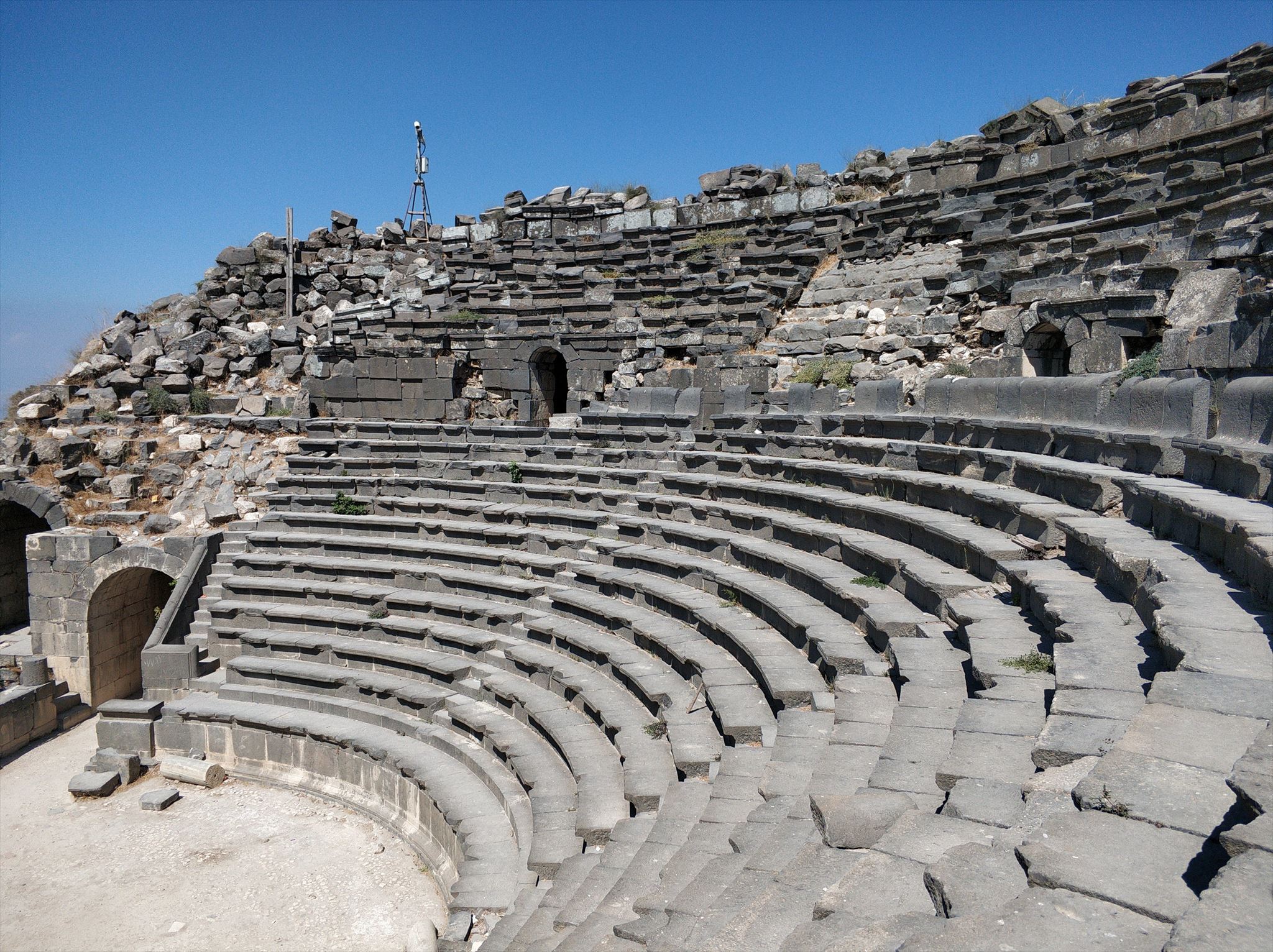
The ruins of ancient Gadara (one of the Decapolis cities) represent successive cultures starting from the Greek and ending with the Ottoman. In 323 B.C., Gadara became part of Ptolemy’s dynasty in Egypt, but in 63 B.C., it was captured by Gnaeus Pompeius, the Roman general. Around the 7th and 8th centuries A.D., most of the city buildings were destroyed by earthquakes and Gadara was then abandoned.
Tasks
To log this Earth Cache, please answer the following questions using personal message:
- At the coordinates you'll find a row of columns made from basalt. Are they made from vesicular basalt or scoria?
- How many columns are in that row? How many of them are not complete?
- On the columns you can see spots where the vesicular texture has much larger bubbles and is more intense. What are the shapes of those spots?
- Look on the basalt blocks that are near the base of the lowest column. You can see the same spots with larger bubbles but now they have a different shape. Try to explain why the shape is different. What can be the cause?
- Touch the columns and try to feel it's texture. Now go to the basalt theater and compare the texture from columns with the texture of the basalt in the theater. Is there any difference?
- Make a photo of you/your GPS/nick/personal item while in the basalt theater and attach the photo to the log.
You can log this EC right after sending me answers. You don't have to wait for my response. I'll contact you if there'll be any problem.