Theoretical introduction
A trace fossil (also called ichnofossil) is a special type of fossil. It's not a fossil of living organism itself rather than the fossil of its biological activity. Think of it as a fossil of footprint, not foot.
As you can imagine one organism can leave a lot of trace fossils, so they are much more common to find on the area of intense activity. Let us talk about the trace fossils of the all known trilobite. Trilobites together with ammonites are the most known fossils, because of the wide area of appearance.
First trilobites fossils come from the early Cambrian period 521 million years ago, and they have spent over 250 million years living on our earth. For comparison first homo sapiens appeared 300,000 years ago.
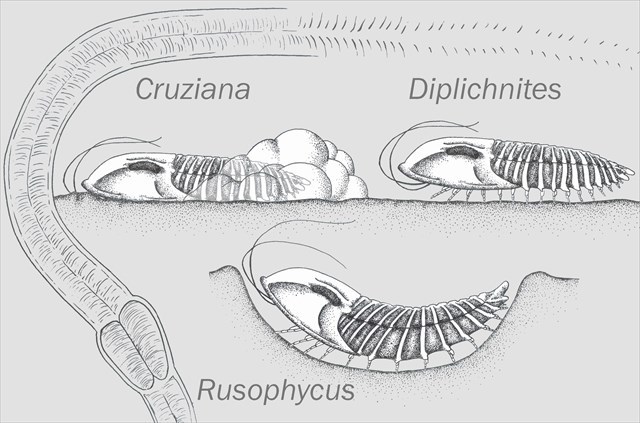
We can distinguish 3 types of trilobite ichnofossil:
- When a trilobite was resting - he often was partially buried in the mud. The trace after trilobite rest is called Rusophycus. Those fossils are often curved due to its body shape when resting and they can contain parallel marks that correspond to its legs.
- Trilobites were able to move across substrate partially buried. The widest part of the shell leaves the parallel outer furrows, while the leg movements create the chevron-shaped marks in the center of the track. Those fossiled tracks are called Cruziana
- Diplichites are created when trilobite was walking or striding freely upon the surface. It leaves a widely-spaced trace of the paired leg.
Often all three traces grade into another one, and the transitions are related to the speed of movement or whether the trilobite is partially buried of fully emerged from the substrate.
Place
This is one of many sandstone mountains you can find on wadi rum. but not on every mountain you can find so many trace fossils. One of the reasons may be that this place is not very popular, so fossils are not taken from here (remember, it's prohibited to take any fossil with you. Take as many pictures as you want but don't bring any fossil with you. You can get into trouble and others won't be able to see them by themselves). Use one of the parking spots to start your journey, or use google satellite map to see how to get there. It's a 30 minutes walk from those points. The path is quite straightforward. There will be plenty of fossils on your way, but they are easiest to find on coordinates.
Tasks
To log this Earth Cache, please answer the following questions using personal message:
- Look around and try to find some ichnofossils of a trilobite. Pick one and send me a picture of it with the name of the fossil type (Rusophycus, Cruziana or Diplichites). Explain your answer
- Measure how wide the trace is.
- On the coordinates there are many ichnofossils of other organisms. Make a picture of your favorite ichnofossil and put it in the log. Guess what kind of organism it could be - it doesn't have to be real, use your imagination, but remember - do not take any fossil with you.
You can log this EC right after sending me answers. You don't have to wait for my response. I'll contact you if there'll be any problem.