Clash 🌎f the Titans EarthCache

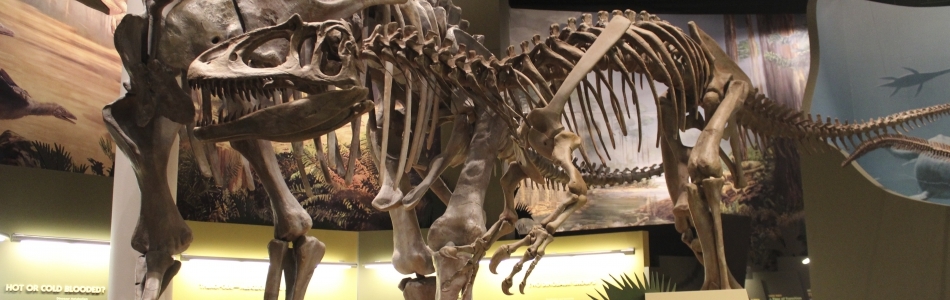
This EarthCache is located within the world-class Sam Noble Oklahoma Museum of Natural History and will give you the opportunity to see up-close actual fossils of some of Earth's biggest dinosaurs!
To get credit for this EarthCache, be sure to complete the logging tasks at the bottom of this page.
Before We Begin:
- The museum is open Monday through Saturday from 10 am to 5 pm and Sunday 1 pm to 5 pm.
- They are closed on Thanksgiving, Christmas and New Years Day.
- Parking is free.
- The museum is wheelchair and stroller accessible.
- Please be aware there is a nominal fee to enter the museum.
- Free admission for 17 & under the first Monday of every month.
- Here is a map of the first floor if you need it.
As this is an EarthCache, there is no container to find. Instead you will have an opportunity to learn about the following:
Let's get started!
How are fossils created?
Most of the dinosaur skeletons you see in museums exist because a dinosaur died in an environment that had lots of moving sediment like an ocean, riverbed or lake. This sediment quickly buried the dinosaur, offering its body some protection from decomposition.
While the dinosaur's soft parts still eventually decompose, its hard parts - bones, teeth and claws - remain. But a buried bone isn't the same thing as a fossil - to become a fossil, the bone has to become rock. After the soft parts decay, the inorganic parts create a fragile, porous mineral in the shape of the original bone.
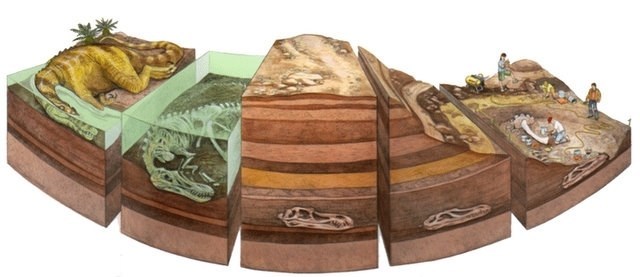
Water gradually makes its way into the bone, carrying minerals from the sediment like iron and calcium carbonate. As the water penetrates the dinosaur's bones, some of these minerals precipitate into their microscopic pores. Think of it like filling a sponge with glue - the sponge's physical structure stays the same while the pores and pockets within it fill up. The glue makes the sponge sturdier and more resistant to damage.
Over the course of millions of years, the sediment around these reinforced bones becomes sedimentary rock. Erosion, tides and other natural processes continue to deposit more sediment and these become rock too. As long as they can withstand the pressure from the surrounding rock, the bones remain safely hidden and preserved.
How do paleontologists find the age of fossils?
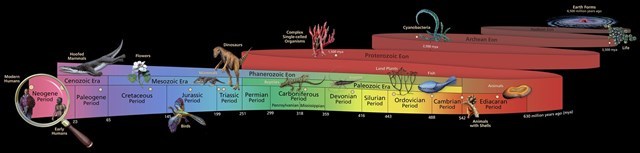
The geological time scale is used by geologists and paleontologists to measure the history of the Earth and life. It is based on the fossils found in rocks of different ages and on radiometric dating of the rocks.
Sedimentary rocks and volcanic lava flows are laid down in layers or beds. They build up over time so that that the layers at the bottom of the pile are older than the ones at the top. Geologists call this simple observation the Principle of Superposition and it is the most important way of working out the order of rocks in time. Ordering of rocks (and the fossils that they contain) in time from oldest to youngest is called relative age dating.
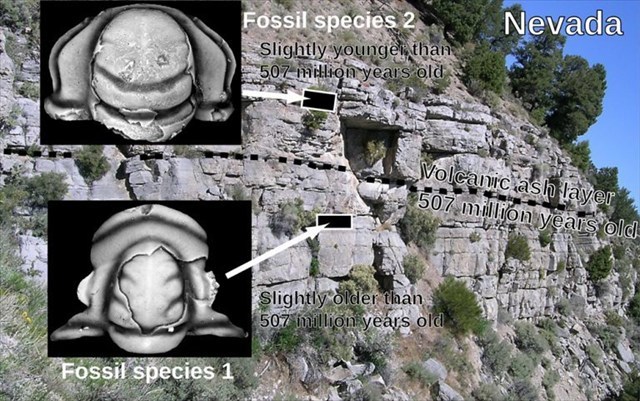
Once the rocks are placed in order from oldest to youngest, the relative ages of the fossils that were collected from them are also known. What it doesn’t tell you is the age of the fossils themselves.
To get an age in years, scientists use radiometric dating of the rocks. Radiometric dating determines the concentration of a particular radioactive isotope and it's half-life within a sample. Not every rock can be dated this way, but volcanic ash deposits are among those that can. The position of the fossils above or below a dated ash layer allows them to work out their ages.
In this example, the volcanic ash layer is dated as 507 million years old (myo). The fossil species below the ash must be slightly older than 507 million years, and the species above the ash must be slightly younger. If rocks in different places contain the same fossil species, they must be similar in age. Tracing of rocks and fossils from one place to another is called correlation.
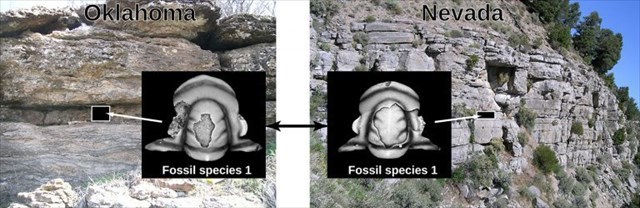
If a fossil has been dated radiometrically in one place, correlation allows one to work out the age in other places too. In the above example, it is known that the fossil in Nevada is slightly older than the ash layer dated to 507 myo. Now it can be said that same species in Oklahoma must also be about 507 myo, even though there is no volcanic ash layer present at this site.
To Get Credit For This EarthCache
Copy the questions below and send your answers via geocaching messages.
- DO NOT post the answers in your log.
- Group answers are fine, just let me know who all was there.
- Note: The photo task is a requirement for each account claiming a find. See acceptable EarthCache logging tasks effective June 10th, 2019. If you don't want to post the photo with your log, you may send it to me with your answers instead.
- Please send the answers in a timely manner or it may result in the deletion of your log (no offense intended).
Logging Tasks
1| The name of this EarthCache: Clash 🌎f the Titans
2| What is the difference between a bone and a fossil?
3| In your own words, how does a paleontologist determine a fossils age?
4| In your log, you have two options here to provide a photo of yourself inside the museum:
A) In front of the "Clash of the Titans" exhibit in the Hall of Ancient Life.
OR
B) In front of the large Wooly Mammoth statue in the Pleistocene Plaza.
- If you prefer, the photo can be of a personal item in one of these locations instead. Just make the photo unique to you and your visit. Feel free to have fun with this!
- Note: Photos taken from outside the window of the museum will not be accepted for this task. You will need to go inside to make your observations. It's worth the visit!
Optional: I'd love to see other photos you took from your visit here!
*IF YOU ENJOYED THIS EARTHCACHE,
CONSIDER GIVING A FAVORITE POINT!*
Sources:
Permission for this EarthCache placement was granted by the Sam Noble Oklahoma Museum of Natural History.