Beavers Bend N🌎vaculite EarthCache

Beavers Bend State Park was named after John T. Beavers, a local Choctaw citizen, and was built on the site of an old Choctaw settlement. The "bend" in the park's name refers to an area of the park where a portion of Mountain Fork River meanders sharply, making an almost 180-degree turn. This EarthCache is located just northeast of this bend and will give you the opportunity to see some neat rock formations first hand!
To get credit for this EarthCache, be sure to complete the logging tasks at the bottom of this page.
Before We Begin:
- This is near the entrance of the Friends Trail, the newest trail in Beavers Bend State Park in 15 years! This trail is a 1.5 mile loop that is rated as intermediate with some rugged terrain and steep inclines but has some of the most beautiful views in the park and is family and pet friendly.
- Oklahoma State Parks have began charging a nominal fee to park within park grounds. See local signs near the parking area for more information.
- BEWARE: If you hear horns sounding, they are releasing water from the spillway upstream. This could cause the water to rapidly rise so be safe!
- There are two other EarthCaches nearby. Check them out: Beavers Bend F🌎lds and Beavers Bend 🌎verlook
As this is an EarthCache, there is no container to find. Instead you will have an opportunity to learn about the following:
- What is novaculite?
- Where can you find novaculite?
- What are the uses of novaculite?
Let's get started!
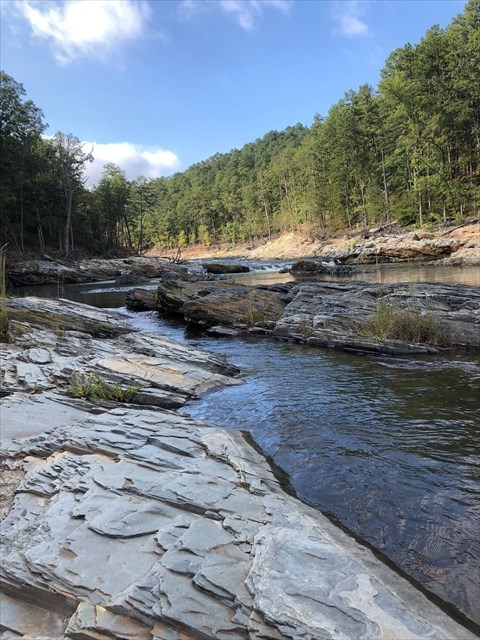
What is novaculite?
Novaculite is a unique rock found only in the Ouachita Mountains of Oklahoma and Arkansas. It varies in color (white, light to dark gray, pink, red, tan, black) but light colors are most common. It is characteristically translucent, so light can be seen through thin edges of a piece of the stone. It is a dense, hard, fine-grained siliceous rock that breaks with a conchoidal fracture.
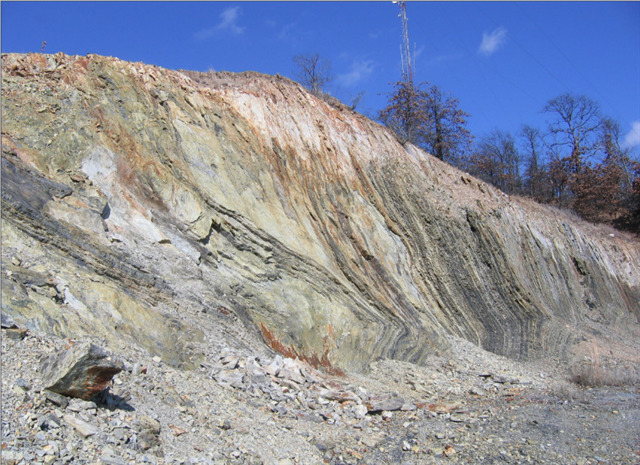
Arkansas Novaculite
It forms from sediments deposited in marine environments where organisms such as diatoms (single-celled algae that secrete a hard shell composed of silicon dioxide) are abundant in the water. When the diatoms die, their silicon dioxide shells fall to the seafloor. In some areas these diatom shells are the primary ingredient of the seafloor sediments.
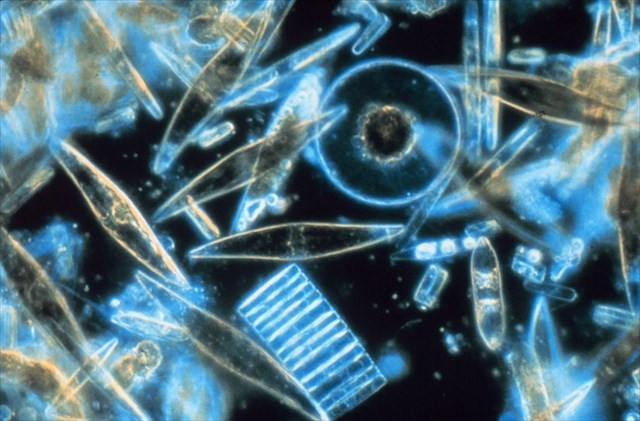
Diatoms
During diagenesis (the transformation from sediment to rock), the silicon dioxide from the diatom shells is transformed into chalcedony (a microcrystalline silicon dioxide). At this point the rock is called chert. The chert is then transformed into novaculite as further diagenesis and low-grade metamorphism (alteration of the structure of rock by heat or pressure) recrystallize the chalcedony into microcrystalline quartz grains.
The two primary differences between chert and novaculite are: 1) chert is composed mainly of chalcedony while novaculite is composed mainly of microcrystalline quartz grains; and, 2) chert is a sedimentary rock, while novaculite is a chert that has experienced a higher level of diagenetic alteration and low-grade metamorphism.
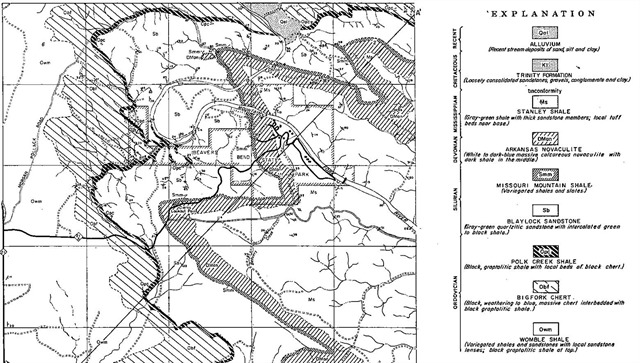
Rock Formation Zones in Beavers Bend - Click to enlarge
Where can you find novaculite?
The most famous locality for novaculite is where the Arkansas Novaculite Formation outcrops in the Ouachita Mountains of southeastern Oklahoma through central Arkansas. It is a Devonian to Mississippian-age rock unit that ranges from about 60 feet thick in the northern Ouachitas to about 900 feet thick in the southern Ouachitas.
Outcrops of the Arkansas Novaculite Formation are prominent landscape features of the Ouachita Mountains. Compared to most other types of rock, novaculite is very resistant to chemical and physical weathering. This makes it a ridge-former and a cliff-former in the areas where it outcrops. Peaks, cliffs, and ridges formed by novaculite are prominent landscape features of the Ouachitas.

Cross Section of Rock Layers in Beavers Bend - Click to enlarge
What are the uses of novaculite?
Native Americans were the first people to mine the Arkansas Novaculite Formation. They noticed its conchoidal fracture and discovered that it could be knapped - just like flint - into projectile points, scrapers, and cutting tools. They mined novaculite, used it to manufacture cutting tools and weapons, and traded the material and products over a broad area. The Quapaw, Osage, Caddo, Tunica, Chickasaw, and Natchez tribes were especially involved in the mining.

European settlers in the Ouachita region were the second people to mine the Arkansas Novaculite Formation. They valued it for a different reason. They found that novaculite could be used to sharpen metal tools and weapons. They soon began producing sharpening tools and trading them with distant partners.
Arkansas “whetstones,” “oil stones,” and “sharpening stones” became world-famous for their ability to produce a sharp edge on a metal blade. This created a demand for novaculite that was strong in the 1800s but declined as people used fewer blades that required resharpening. In the early 1900s, demand declined further as artificial abrasives and sharpening machines began to replace the sharpening stone.
To Get Credit For This EarthCache
Copy the questions below and send your answers via geocaching messages.
- DO NOT post the answers in your log.
- Group answers are fine, just let me know who all was there.
- Note: The photo task is a requirement for each account claiming a find. See acceptable EarthCache logging tasks effective June 10th, 2019. If you don't want to post the photo with your log, you may send it to me with your answers instead.
- Please send the answers in a timely manner or it may result in the deletion of your log (no offense intended).
Logging Tasks
1| The name of this EarthCache: Beavers Bend N🌎vaculite
2| Summarize how novaculite is created.
3| What is the difference between novaculite and chert?
4| What are some uses of novaculite?
5| Looking at the rock layers around you, what colors do you see?
6| In your log, please provide a photo of yourself with the rock layers.
- If you prefer, the photo can be of a personal item here instead. Just make the photo unique to you and your visit. Feel free to have fun with this!
Optional: I'd love to see other photos you took from your visit here!
*IF YOU ENJOYED THIS EARTHCACHE,
CONSIDER GIVING A FAVORITE POINT!*
Sources:
Permission for this EarthCache placement was granted by Beavers Bend State Park.