Welcome to Skenes Creek. This coastline offers a fantastic opportunity to observe two very distinct types of weathering.
The coordinates will take you near a cliff face. If you look up on the outcropping rocks and even step a bit further up on the wall, you can see a volcanic rock (Basalt), which shows spheroidal weathering.
Spheroidal weathering
Spheroidal weathering is a form of chemical weathering that affects jointed bedrock and results in the formation of concentric or spherical layers of highly decayed rock within weathered bedrock that is known as saprolite. When saprolite is exposed by physical erosion, these concentric layers peel off as concentric shells much like the layers of a peeled onion. Within saprolite, spheroidal weathering often creates rounded boulders, known as corestones or woolsack, of relatively unweathered rock.
Because water can penetrate the bedrock along these joints, the near-surface bedrock will be altered by weathering progressively inward along the faces of these blocks.
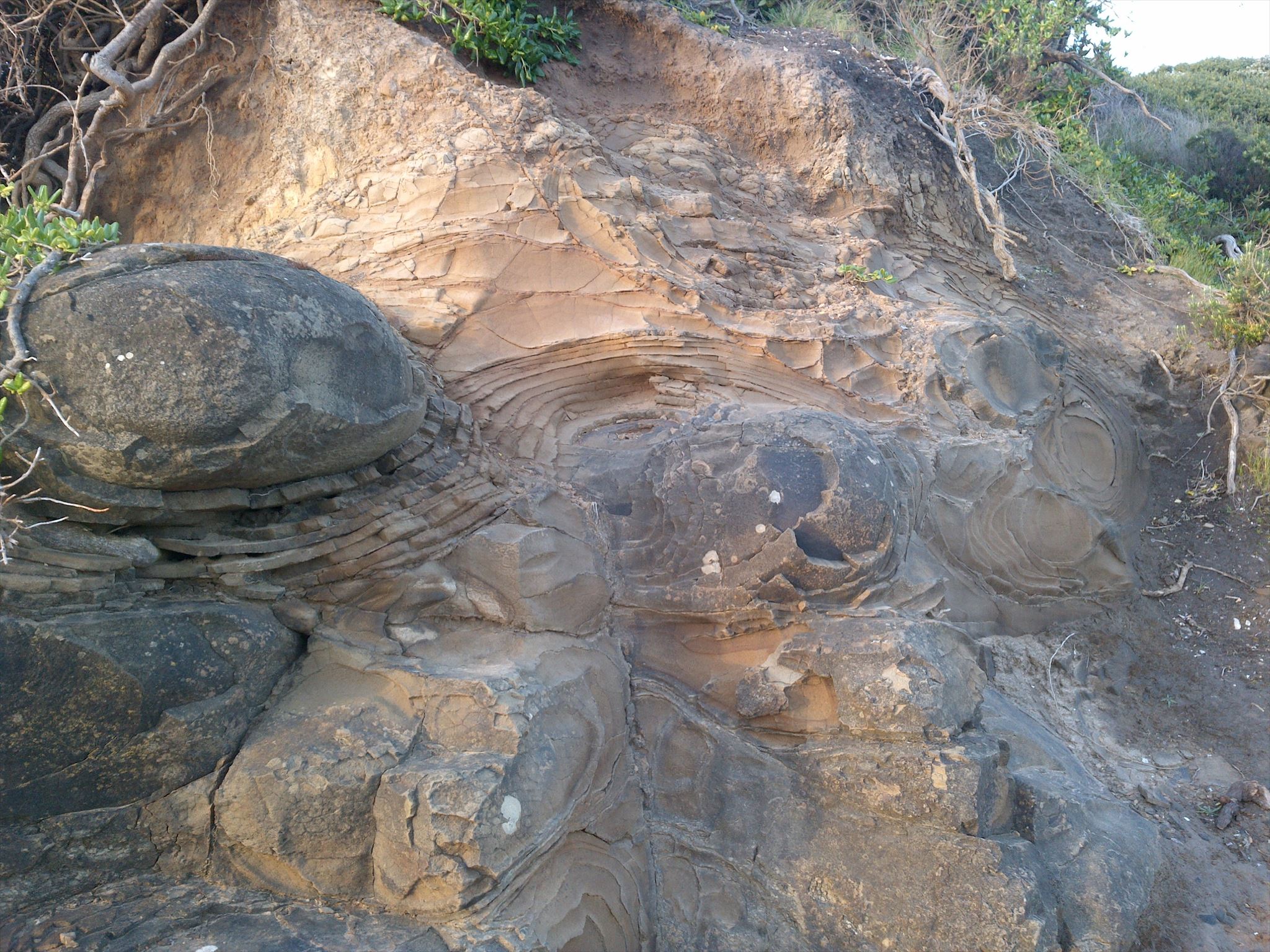
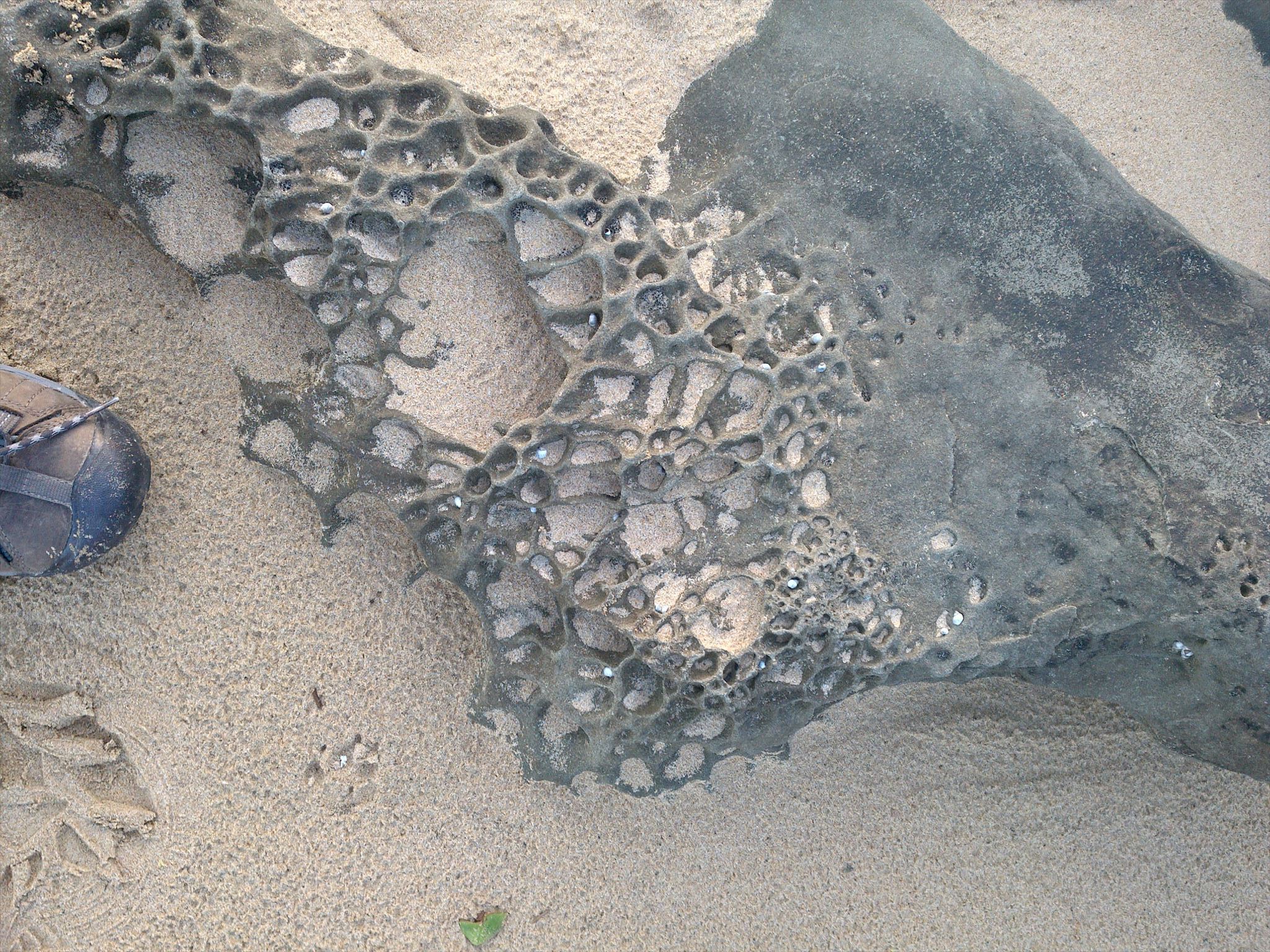
Once you had a good look at the s Spheroidal weathering come back down on to the rocks that are flat on the ground and merge with the water. Here, you can see a completely different weathering feature, which is called honeycomb weathering.
Honeycomb weathering
Honeycomb weathering is a form of cavernous weathering that consists of regular, tightly adjoining, and commonly patterned cavities that are developed in weathered bedrock.
Many explanations have been proposed for honeycomb and other cavernous weathering. These explanations include marine abrasion; wind corrosion; mechanical weathering resulting from short-term temperature variations; chemical weathering of the interior of the rock (core-softening) under a protective crust (case-hardening) followed by mechanical removal of the softened material; biogeochemical weathering by lichens; temperature variations acting on salt efflorescence in coastal regions; and salt weathering.
To log this earthcache, please send me the answers to the questions via my profile, by email or preferably messenger and I will contact you if there are any issues. You can log your find straight away.
Spheroidal Weathering
1: How thick are the layers that are peeling off the rounded core in the middle?
2: Comparing the inner core and the layers surrounding it, can you see a difference in grain size? Which one is finer / coarser?
Honeycomb weathering
3: Which of the described processes that can cause the honeycomb structure do you think is the most relevant one in this case?
4: Why do you think there are areas in the rock where you can’t see any honeycomb structures and other areas where are many small caverns next to each other (like in the image above)?
Optional: Take a photo of yourself or the coastline during your visit.
References:
https://en.wikipedia.org/wiki/Spheroidal_weathering
https://en.wikipedia.org/wiki/Honeycomb_weathering