MULTICACHE REQUIRES BEARING PROJECTION CALCULATIONS TO REACH FINAL COORDINATES
Weekly Times (Melbourne, Vic. : 1869 - 1954), Saturday 28 October 1905, page 38
________________________________________
FARMING AT COGHILL'S CREEK.
KELLOE HILL FARM.
HOW SOIL FERTILITY IS MAINTAINED.
System of rotation adopted with "ALFALFA."
The Coghill’s Creek district lies about sixteen miles north-west, of Ballarat. The soil in this and the adjacent districts is of a rich vol-canic nature. For miles around the country is studded with gently slop-ing volcanic hills rising to a height of a few hundred feet and between the hills there are fertile valleys, where the soil is also exceedingly productive. Coghill's Creek and the surrounding localities form one of the most important agricultural centres in Victoria. Here, farming has been carried on since settlement first took place in the late fifties, and the fact that, agriculturally speaking, the soil today is as productive as when first broken up, speaks volumes for the system of cultivation that has been practised.
There are two classes of farmers in the district, tenants and free-holders. Situated in the very centre of this fertile country is the Dowling Forest Estate, the property of Messrs E E and W.L.K. Clarke. This estate, which contains about I6,000 acres, was several years ago subdivided into farms by its then owner, the late Sir William Clarke. With the view of encouraging an improved system of agriculture among his tenants, the late Sir William 'Clarke originated in Victoria the system of annually offering prizes for the best managed tenant farms in the Shire of Ballarat.. These prizes for farm competitions continue to be provided for by the present owners, and they are conducted every year under the. auspices of the Ballarat Agricultural Society.
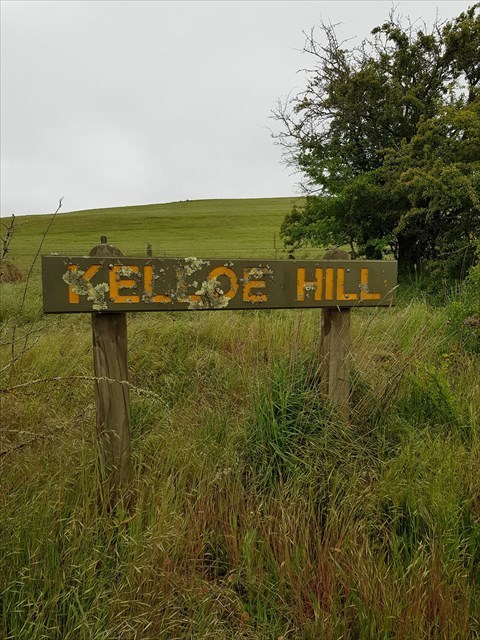
Kelloe Hill
As a body the freeholders are high-class farmers. Prominent amongst these are Messrs W. and R. Tinkler, of Kelloe Hill Farm, Coghill's Creek. The late Mr Tinkler, father of the present occupiers, purchased 100 acres from the Crown about the year 1856, and subsequently increased the area of the property to 320 acres by purchase from adjoining neighbors. Originally this land was lightly tim-bered with gum trees, but every trace of the timber has long since disappeared. Messrs Tinkler occupy altogether 500 acres, 180 acres of which is held under lease. About 300 acres are annually under crop and in preparation for the succeeding year's crop. Of this area, 200 acres are usually under cereal crops, 20 under potatoes, 10 under rape, and 40 acres fallowed. The balance is under arteficial pastures. Stock-breeding and dairying are carried on in conjunction with cultivation. Draught, mares of good type are kept for the purpose of carrying on the farm work, and by breeding these mares to a high-class draught stallion, their progeny when three years old sell at from £40 to £50 each. Six draught mares are usually kept.
System of Rotation.
With the system of rotation practised at Kelloe Hill it is claimed by the Messrs Tinkler that their farm is to-day quite as productive as when the soil was in its virgin condition. Their system, seeing that a good many stock are kept, is varied according as circumstances demand. The system mainly carried out is to fallow every third year. By this system not more than two cereal crops are taken off in succession. In addition to the ordinary fallow, land that has grown potatoes and rape is regarded as equivalent to being fallowed. This year, for instance, tho forty acres of rape and twenty acres of potatoes are a distinct change from a cereal crop, and being well manured and subsequently prepared for the cereal crop early in the season, the condition of the land is as good as if it were fallowed.
Sometimes however, as stated, this sys-tem, on a portion of the farm, is, varied, three cereal crops being taken off after a fallow, the land being then sown down to pasture for four years. On farms where stock are kept and the whole of the land is fit for cultivation, artificial pastures must necessarily form, part of the system of rotation, and the Messrs Tinkler state that the system described, with the variation to include the necessary area of pasture, gives the highest satisfaction. It has enabled them to successfully combine the keeping of stock to the extent described, with the annual cultivation of a large area of the farm, without lessening in the slightest degree the fertility of the soil.
The system of rotation adopted is a sound one, and can be strongly recommended in districts where the climate is suitable. Results at Kelloe Hill have fully demonstrated its value as a means of maintaining- profitable production without reducing the fertility of the soil.