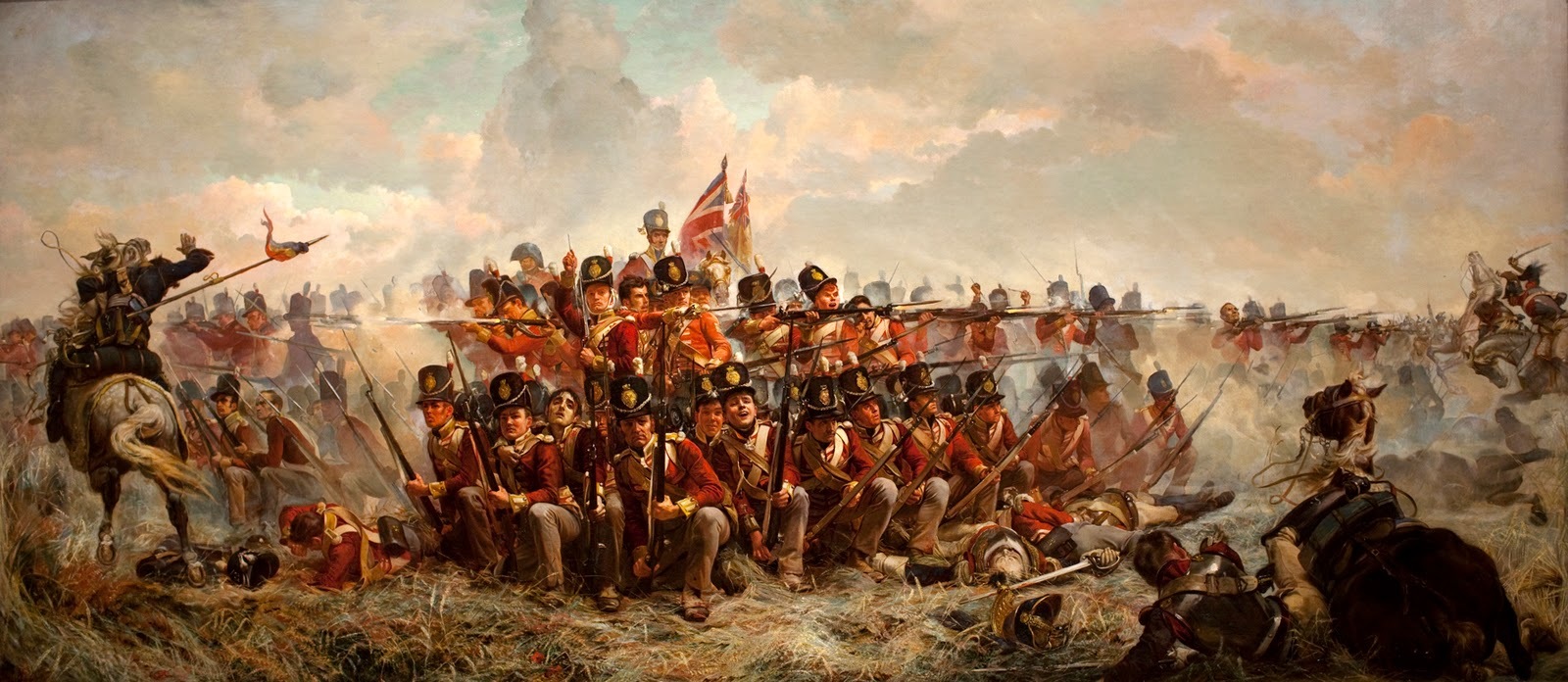
 This EarthCache takes you the the base of the Waterloo Monument, otherwise known as Wellington's Column. You will need to get up onto the granite steps, so please be careful, it does take some effort to get up and down.

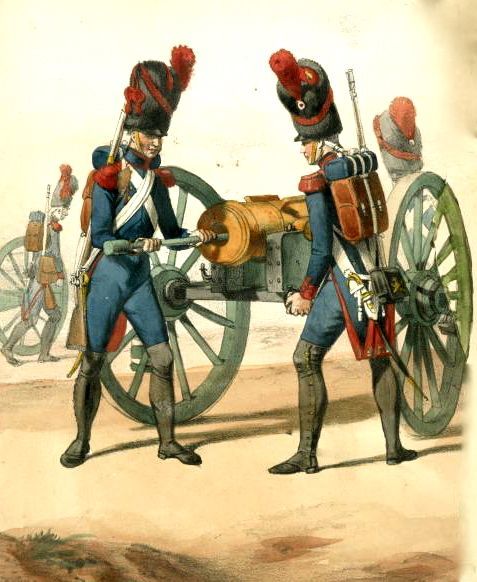
After the death of the Duke of Wellington in 1852, the city decided to erect a monument to him. It was designed by Andrew Lawson, an architect from Edinburgh. The statue of the Duke was designed by George Anderson Lawson. The foundation stone was laid in May 1861. The monument commemorates his victories, which include Waterloo, Quatre Bras, Nivelle, Toulouse, San Sebastian, Orthez, Vittoria, Bayonne, Salamanca, Badajoz, Oporto, Talavera and Assaye. The statue of the Duke is made from melted down French cannons captured at Waterloo in 1815.
The Geology of the Monument
The monument is made from two different types of rock, igneous and sedimentary. The foundations are in Runcorn sandstone, the pedestal in granite, and the column in Darley Dale sandstone.
Sedimentary rocks are types of rock that are formed by the deposition and subsequent cementation of that material at the earth's surface and within bodies of water. Sedimentation is the collective name for processes that cause mineral and/or organic particles to settle in place. The particles that form a sedimentary rock by accumulating are called sediment. Before being deposited, the sediment was formed by weathering and erosion from the source area, and then transported to the place of deposition by water, wind, ice, mass movement or glaciers. Sedimentation may also occur as minerals precipitate from water solution or shells of aquatic creatures settle out of suspension.
Sandstone (sometimes known as arenite) is a clastic sedimentary rock composed mainly of sand sized minerals or rock grains Most sandstone is composed of quartz and/or feldspar because these are the most common minerals in the Earth's crust. Like sand, sandstone may be any color, but the most common colors are: tan, brown, yellow, red, grey, pink, white, and black. Since sandstone beds often form highly visible cliffs and other features, certain colors of sandstone have been strongly identified with certain regions. The formation of sandstone involves two principal stages. First, a layer or layers of sand accumulates as the result of sedimentation,either from water (as in a stream, lake, or sea) or from air (as in a desert). Typically, sedimentation occurs by the sand settling out from suspension; i.e., ceasing to be rolled or bounced along the bottom of a body of water or ground surface (e.g., in a desert). Finally, once it has accumulated, the sand becomes sandstone when it is compacted by pressure of overlying deposits and cemented by the precipitation of minerals within the pore spaces between sand grains.
Granite is a common type of igneous rock. Igneous rock is one of the three main rock types , the others being sedimentary and metamorphic. Igneous rock forms by crystallisation either below the surface as intrusive (plutonic) rocks or on the surface as extrusive (volcanic) rocks. As the magma pushes up from deep, it eventually slowly cools into a solid, and forms rock. An intrusive rock is any form of igneous rock that forms within the crust of the planet. Large areas of magma that solidify underground before they reach the surface are known as plutons .Granitic rocks mainly consist of feldspar, quartz, mica and amphibole minerals, which form an interlocking matrix of feldspar and quartz with scattered darker biotite mica and amphibole (often hornblende) peppering the lighter colour minerals.
Quartz is the second most abundant mineral in the continental crust. It is a defining constituent of granite and other felsic igneous rocks, and is very common in sedimentary rocks such as sandstone. While the majority of quartz crystallizes from molten magma, much quartz also chemically precipitates in the magma from hot hydrothermal veins as gangue, sometimes with ore minerals like gold, silver and copper. It is formed from silicone dioxide. It can come in a variety of colours, but in the case of this type of granite it tends to be clear or milky coloured.
Feldspar is one of the most abundant group of minerals in the earth's crust, forming about 60% of terrestrial rocks. Most deposits offer sodium feldspar as well as potassium feldspar and mixed feldspars. It can be white, pale grey or pink.
Biotite Mica is typically black to brown in colour. The darker colour increases due to increased iron content.
Amphibole forms prism or needlelike crystals, and can be green, black, colourless, white, yellow, blue, or brown.
There are plenty of EarthCaches which look at granite, so we are here to look at a feature within it. We are here to look at aplite.
Aplite, is an intrusive igneous rock, with a similar composition to granite, but with much finer crystals, under 1 mm in diameter. The dominant materials are quartz and feldspar. The term 'aplite' or 'aplitic' is often used as a textural term to descrie veins of quartz and feldspar with a fine to medium-grain "sugary" texture. Aplites are usually very fine-grained, white, grey or pinkish, and their constituents are visible only with the help of a magnifying lens. The aplites of granite areas, are the last part of the magma to crystallize, which has happened rapidly, with the ingredients solidifying almost at the same time. Aplites can also be first formed as they can be the end of the 'fingers' from the magma body in to the bedrock. If you take your time to look around the steps, you will notice distinct lines in the granite, these are aplites.
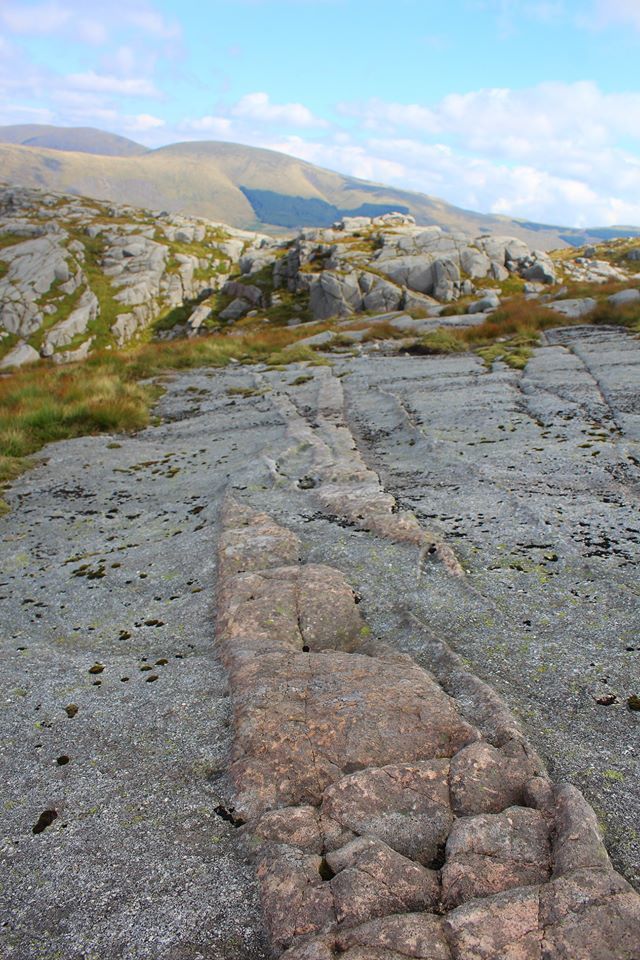
An aplite vein on the slopes of Craignaw, Galloway Hills.
As well as learning about the subject of aplites, we are also here to examine the veins, and namely what has occured to them. You will notice that some are fractured. A fracture is a break in the continuity. In the case of some of the aplites we can see here, as the granite cooled, and became less ductile, fissures occured, which then filled with aplite. As cooling took place, contraction of the rock took place which caused shear action on both side of the aplite vein, with the vein pulled in different directions on both side of the vein, and thus caused the fractures we can see in some of the aplites.

This being an EarthCache, in order to log it, I ask that you answer some questions. Please send them to me, and do not include them in your log. You can send them to me by using the message facility or email, both of which can be found by looking at my profile.
YOU WILL NEED TO EXPLORE ALL THE STEPS OF THE MONUMENT - BE CAREFUL.
1. On the south eastern corner of the monument - first step, there is a wide aplite..
(a) Please describe the aplite and granite it runs through, and compare them both in terms of crystal size, colour and feel.
(b) How wide is this aplite, and please describe its aligment through the granite block.
2. On the southern side of the monument, on one of the steps is an aplite which has been subject to shear action, and as a result has a fracture in it.
(a) Please tell me which step this is on.
(b) Please compare this aplite to the one examined in the first task, in terms of crystal size, colour.
(c) Please describe the fracture, is it the same width through the 'break', and how wide is the fracture?