PL EN FR
Kesz nie znajduje się na współrzędnych startowych.
The cache is not placed at the starting coords.
La cache ne se trouve pas aux coordonnées indiquées.
Wprowadzenie
Samogłoska to głoska, w artykulacji której uczestniczą jedynie więzadła głosowe. W kanale głosowym nie występuje żadna przeszkoda dla strumienia powietrza (co najwyżej przewężenie), dlatego przechodzi ono bez trudu. Pod względem anatomiczno-artykulacyjnym samogłoski można opisać za pomocą czterech cech. Są to:
- odległość języka od podniebienia — wraz z jej wzrostem wyróżniamy samogłoski zamknięte, półzamknięte, półotwarte, otwarte;
- pozycja pozioma języka — wraz z jego przesunięciem od przodu jamy ustnej do jej tyłu wyróżniamy samogłoski przednie, środkowe i tylne;
- zaokrąglenie ust — jeśli występuje, samogłoska jest zaokrąglona, jeśli nie — niezaokrąglona;
- pozycja języczka — podniesiony języczek uniemożliwia przepływ powietrza przez jamę nosową, mamy zatem do czynienia z samogłoską ustną. W przypadku języczka opadniętego powietrze przepływa zarówno przez jamę ustną, jak i nosową, powstaje zatem samogłoska nosowa.
Introduction
Vowel is a speech sound, which is pronounced with no stricture in the vocal tract; in theirs articulation only vocal cords take part. Speaking in anatomical-articulation manner, vowels can be described with four fearutes:
- the distance between the tongue and the palate—with its rise, we can differentiate closed, close-mid, open-mid and open vowels;
- horizontal position of the tongue—with its movement from the frontal part of the oral cavity to its back, we can differentiate front, central and back vowels;
- roundness of the lips—if the lips are rounded, so is the vowel; if not—the vowel is unrounded;
- placement od the uvula—rised uvula makes the air flow to the nasal cavity impossible, therefore the oral vowel is pronounced. When the uvula is left hanging, the air can flow through both oral and nasal cavity, so we can pronounce the nasal vowel.
Introduction
La voyelle est un son du langage qui est prononcé avec le libre passage de l'air dans le canal vocal; à son articulation ne participent que les cordes vocales. Selon le langage anatomique-articulative, les voyelles peuvent être décrites par quatre traits:
- la distance entre la langue et le palais — avec son augmentation, nous pouvons différencier les voyelles fermées, mi-fermées, mi-ouvertes, ouvertes;
- la position horizontale de la langue — avec son mouvement du devant vers l'arrière de la cavité orale, nous pouvons différencier les voyelles antérieures, centrales et postérieures;
- l'arrondissement des lèvres — quand elles sont arrondies, la voyelle est aussi arrondie, quand elles ne le sont pas — la voyelle est non arrondie;
- le placement de l'uvule — l'uvule enlevée rend l'écoulement d'air vers la cavité nasale impossible, alors nous parlons d'une voyelle orale. Quand l'uvule est baissée, l'écoulement d'air vers la cavité nasale est possible, alors nous parlons d'une voyelle nasale.
Oczywiście gdy mówimy, nie zastanawiamy się, jak należy ułożyć poszczególne organy mowy, robimy to automatycznie. Jednak najciekawsze (przynajmniej dla mnie) jest to, jak możemy rozróżnić samogłoski, słysząc je. A całym sednem sprawy jest fakt, że wymienione sposoby artykulacji zmieniają częstotliwość rezonansową trzech komór:
- w przypadku wszystkich samogłosek: jamy ustnej;
- w przypadku samogłosek nosowych: jamy nosowej;
- w przypadku samogłosek zaokrąglonych: niewielkiej przestrzeni, tworzącej się między wargami a zębami.
Jest to szczególnie ważne w projektowaniu systemów rozpoznawania mowy (speech-to-text) oraz jej syntezy (text-to-speech).
Of course, when we speak, we don't reflect on how to use all of the speech organs, we simply do it automatically. But the most interesting thing (at least for me) is, how we can distinguish between the vowels, while hearing them. And the whole thing is about the fact, that these manners of articulation change the resonance frequency of the three cavities:
- in case of all vowels: the oral cavity;
- in case of nasal vowels: the nasal cavity;
- in case of rounded vowels: the small space, forming between the lips and the teeth.
It's especially important for designing the speech-to-text and text-to-speech systems.
Bien sûr, quand nous parlons, nous ne réfléchissons pas à l'usage de tous les organes du langage, nous les utilisons simplement automatiquement. Mais la chose la plus intéressante (du moins pour moi), c'est comment nous pouvons distinguer les voyelles quand nous les écoutons. Et le truc entier se base sur le changement de la fréquence résonante de trois cavités en changeant l'articulation. Ces cavités sont:
- dans le cas de toutes les voyelles: la cavité orale;
- dans le cas des voyelles nasales: la cavité nasale;
- dans le cas des voyelles arrondies: la petite cavité, formée entre les lèvres et les dents.
C'est particulièrement important afin de mieux concevoir les systèmes de reconnaissance vocale (speech-to-text) et de synthèse vocale (text to speech).
Zagadnienie to jest niezwykle skomplikowane. Okazuje się jednak, że wiele można uprościć. Do rozpoznania poszczególnych samogłosek (przynajmniej ustnych) wystarczą mianowicie częstotliwości jedynie dwóch najniższych formantów, określanych jako (któż by się tego spodziewał) F1 i F2. Owe formanty to po prostu pasma częstotliwości, które ulegają wzmocnieniu. Jeśli naniesie się na wykres maksima częstotliwości w tych formantach przy artykulacji poszczególnych samogłosek, powstanie obrazek taki, jak poniżej. Na tym konkretnym przedstawione są samogłoski, występujące w języku francuskim.
The issue is extremely complicated. However, it turns out, that plenty of things can be simplified. For distinguishing individual vowels (at least the oral ones), the frequencies of only two lowest formants are needed. The formants are simply the frequency bands, which are amplified, and are denoted as (who would guess) F1 and F2. After plotting the frequency maxima in these formants for the articulation of individual vowels, A picture like the one below can be obtained. In this particular one, these vowels are shown, which occur in French language.
Cette question est très compliquée. Cependant, on peut beaucoup simplifier. Pour distinguer les voyelles (au moins les voyelles orales), on n'a besoin que de fréquences de deux formants plus basses, qui sont définies par (personne ne s'est attendu à cela) F1 et F2. Ces formants, ce sont simplement les bandes de fréquence qui sont amplifiées. Quand on trace les maxima de fréquences dans ces formants en articulation des voyelles particulières au diagramme, on obtient l'image comme celle ci-dessous. Celle-ci, elle montre en particulier les voyelles de la langue Française (sauf le e caduc).
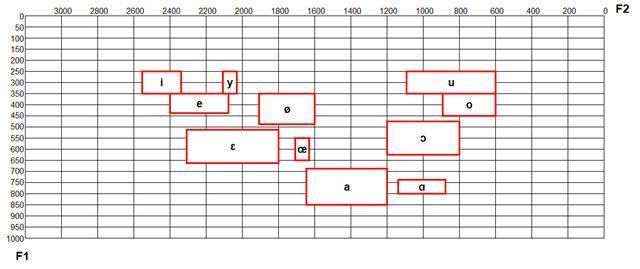
Dokładne częstotliwości maksimów różnią się ze względu na barwę głosu oraz używany język. Z powodu kształtu wykresu, który otrzymuje się biorąc pod uwagę samogłoski, występujące w danym języku, otrzymany diagram nazywa się często trapezem lub trójkątem samogłoskowym.
The exact frequencies of the maxima may vary due to the change of the timbre of the voice and the language used. Because of the shape of the diagram of vowels in the particular language, it's often called the vowel quadrilateral or triagle.
Les fréquences precises des maxima pourront varier en fonction du timbre de voix et de la langue utilisé. À cause de la forme du diagramme obtenu en considérant les voyelles dans une langue particulière, celui-ci est souvent nommé trapèze ou triangle vocalique.
Samogłoski przedstawione na powyższym diagramie:
Samogłoski występujące w języku polskim:
- /i/: samogłoska ustna, zamknięta, przednia, niezaokrąglona: w języku polskim zapisywana jest literą I.
- /ɛ/: samogłoska ustna, półotwarta, przednia, niezaokrąglona: w języku polskim zapisywana jest literą E.
- /a/: samogłoska ustna, otwarta, przednia, niezaokrąglona: w języku polskim zapisywana jest literą A; zwykle ulega centralizacji do /ä/.
- /ɔ/: samogłoska ustna, półotwarta, tylna, zaokrąglona: w języku polskim zapisywana jest literą O.
- /u/: samogłoska ustna, zamknięta, tylna, zaokrąglona: w języku polskim zapisywana jest literą U lub Ó.
Samogłoski niewystępujące w języku polskim:
- /y/: samogłoska ustna, otwarta, przednia, zaokrąglona. Powstaje przy próbie wymówienia głoski /i/ z ustami ułożonymi do /u/. Występuje m. in. w języku niemieckim, gdzie zapisywana jest literą Ü (często ulega częściowemu otwarciu i centralizacji do /ʏ/), francuskim, gdzie zapisywana jest literą U i fińskim, gdzie zapisywana jest literą Y.
- /e/: samogłoska ustna, półotwarta, przednia, niezaokrąglona. Dźwięk pomiędzy /i/ a /ɛ/. Allofon (czyli odmienna realizacja dźwiękowa tego samego fonemu, nie powodująca zmiany znaczenia słowa) głoski /ɛ/ w przypadku jej wystąpnienia po spółgłosce zmiękczonej.
- /ø/: samogłoska ustna, półzamknięta, przednia, zaokrąglona. Występuje m. in. w języku niemieckim, zwłaszcza w dialektach południowych (allofon /œ/), gdzie zapisywana jest literą Ö.
- /œ/: samogłoska ustna, półotwarta, przednia, zaokrąglona. Występuje m. in. w języku niemieckim, zwłaszcza w dialektach zachodnich (allofon /ø/), gdzie zapisywana jest literą Ö.
- /ɑ/: samogłoska ustna, otwarta, tylna, niezaokrąglona. Przypomina /a/ usłyszane jakby z głębi studni. Powstaje przy próbie wymówienia głoski /a/ z wyraźnie opuszczonym językiem.
- /o/: samogłoska ustna, półzamknięta, tylna, zaokrąglona. Dźwięk pomiędzy /ɔ/ a /u/. Dawniej zapisywana jako Ó (o pochyłe), które obecnie czytamy jako /u/.
Vowels presented in the diagram above:
- /i/: oral, closed, front, unrounded vowel; so-called long-E, as in "see" /si:/
- /y/: oral, closed, front, rounded vowel; allophone (ie. different realisation of the same phoneme, which does not cause meaning alteration) of /u/ in some dialects. It can be articulated by trying to say /i/ with lips rounded as for /u/.
- /e/: oral, close-mid, front, unrounded vowel; allophone of /ɛ/ in some dialects, inter alia conservative Received Pronunciation. Sound between /i/ and /ɛ/.
- /ø/: oral, close-mid, front, rounded vowel; allophone of /ɜ/ in some dialects (RPA, New Zeland), as in "bird" /bø:d/
- /ɛ/: oral, open-mid, front, unrounded vowel; as in "bed" /bɛd/ in the majority of dialects.
- /œ/: oral, open-mid, front, rounded vowel; allophone of /ɜ/ in some dialects (Welsh), as in "bird" /bœ:d/ or /əʊ/ (RPA), as in "go" /ɡœ:/
- /a/: oral, open, front, unrounded vowel; allophone of /æ/ in some dialects, as in "hat" /hat/. Generally used in diphthongs (combiation of two vowels in a long syllable by forming a "glide" between them) /aɪ/, as in "nice" /naɪs/ and /aʊ/, as in "now" /naʊ/.
- /ɑ/: oral, open, back, unrounded vowel; so-called short-O in American English, as in "hot" /hɑt/
- /ɔ/: oral, open-mid, back, rounded vowel; as in "saw" /sɔ:/
- /o/: oral, close-mid, back, rounded vowel; sound between /ɔ/ and /u/, allophone of /ɔ/ in some dialects (Australia, New Zeland, RPA), as in "yawn" /jo:n/
- /u/: oral, closed, back, rounded vowel; phonetic realisation of long-O in the majority of dialects, as in "too" /tu:/
Les voyelles presentées sur le schéma au-dessus:
- /i/: la voyelle orale, fermée, antérieure, non arrondie; comme dans « vie » /vi/.
- /y/: la voyelle orale, fermée, antérieure, arrondie; comme dans « mur » /myʁ/.
- /e/: la voyelle orale, mi-fermée, antérieure, non arrondie; comme dans « clé » /kle/.
- /ø/: la voyelle orale, mi-fermée, antérieure, arrondie; comme dans « peu » /pø/.
- /ɛ/: la voyelle orale, mi-ouverte, antérieure, non arrondie; comme dans « lait » /lɛ/.
- /œ/: la voyelle orale, mi-ouverte, antérieure, arrondie; comme dans « jeune » /ʒœn/.
- /a/: la voyelle orale, ouverte, antérieure, non arrondie; comme dans « la » /la/.
- /ɑ/: la voyelle orale, ouverte, postérieure, non arrondie; comme dans « tâche » /tɑʃ/; maintenant réalisée habituellement comme /a/.
- /ɔ/: la voyelle orale, mi-ouverte, postérieure, arrondie; comme dans « sort » /sɔʁ/
- /o/: la voyelle orale, mi-fermée, postérieure, arrondie; comme dans « beau » /bo/
- /u/: la voyelle orale, fermée, postérieure, arrondie; comme dans « cou » /ku/
Kilka słów o spektrogramach
Spektrogram to graficzne przedstawienie częstotliwości danego dźwięku w funkcji czasu. W przypadku analizy pojedynczej samogłoski nie ineresuje nas oś czasu, a jedynie częstotliwości, które w idealnym przypadku nie powinny zmieniać się podczas całego jej trwania.
A couple of words about spectrograms
Spectrogram is a visual representation of the frequencies of a particular sound, as a function of time. When analyzing a simple vowel, the time axis is irrelevant, only the frequencies are considered. In an ideal case, they should not change during the whole sound.
Quelques mots à propos de spectrogrammes
Un spectrogramme est une répresentation graphique des fréquences d'un son particulier, en fonction de temps. Quand on analyse une voyelle simple, l'axe de temps est insignifiant, seules les fréquences sont prisés en considération. Dans un cas idéal, elles ne doivent pas changer pendant la durée d'une voyelle entière.
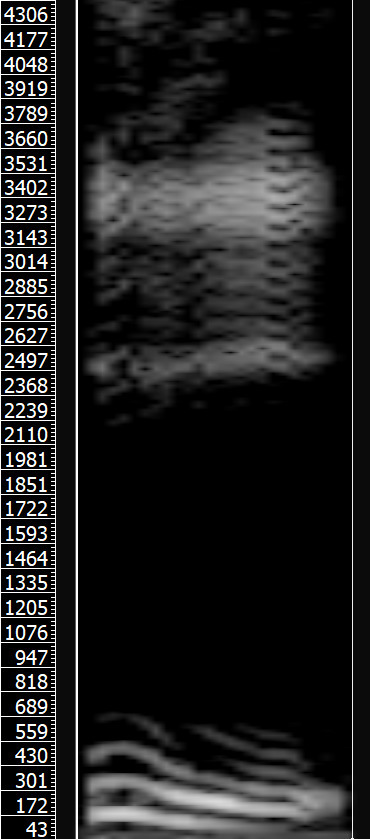
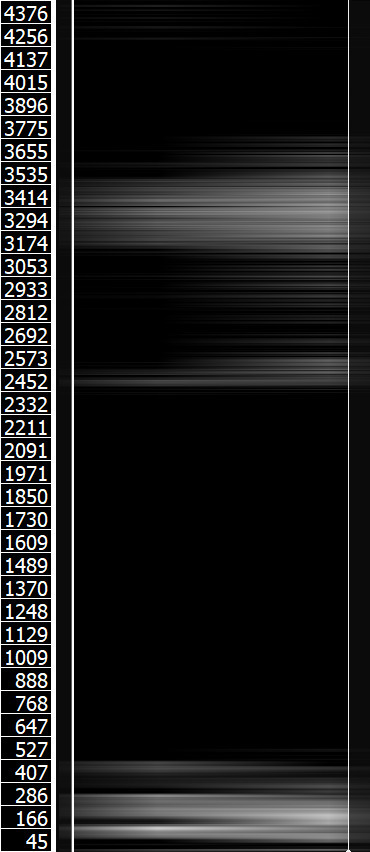
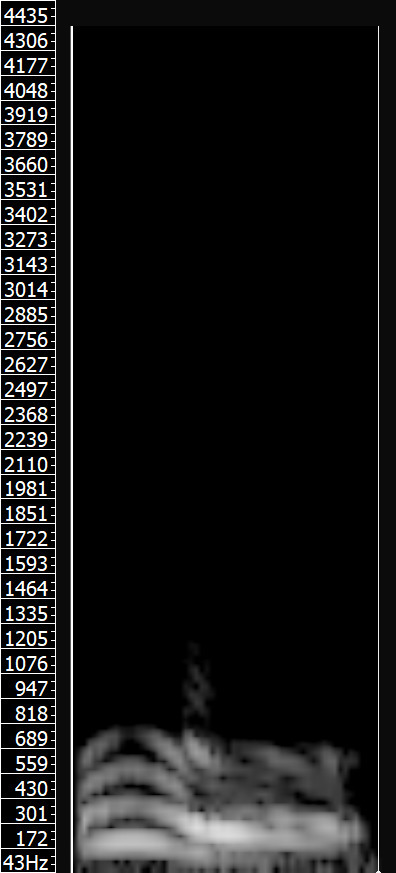
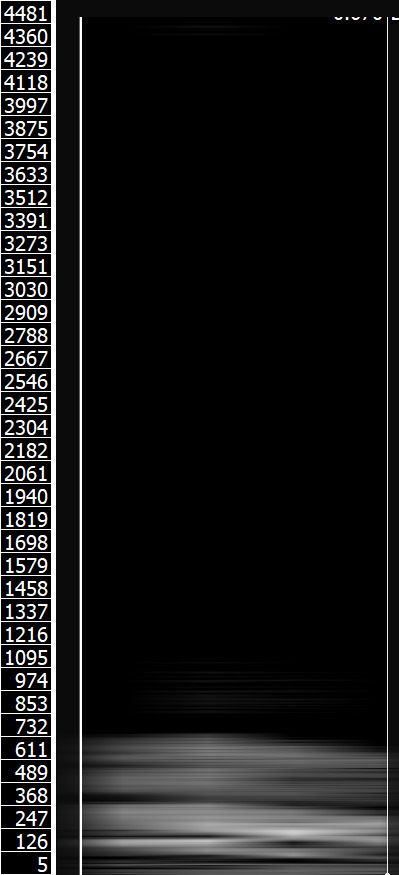
Powyższe obrazy przedstawiają kolejno od lewej do prawej: spektrogram samogłoski /i/ wysokiej jakości; uśredniony, rozmazany spetrogram samogłoski /i/; spektrogram samogłoski /u/ wysokiej jakości; uśredniony, rozmazany spetrogram samogłoski /u/ (źródło dźwięków: Wikipedia). Spektrogramy uśrednione okazują się dużo łatwiejsze do analizy — widać wyraźnie maksima częstotliwości przy 250 i 2500 Hz na spektrogramie samogłoski /i/ 250 i 600 Hz na spektrogramie samogłoski /u/. Częstotliwości te odpowiadają (przynajmniej mniej więcej) częstotliwościom tych samogłosek na wykresie. Spektrogramy wysokiej jakości wyraźnie pokazują strukturę nadtonów każdego z formantów, co znacznie utrudnia analizę, zwłaszcza w przypadku podobnej ich częstotliwości, jak w samogłosce /u/.
The images above present (from left to right): spectrogram of the /i/ vowel in high quality; averaged, blurred spectrogram of the /i/ vowel; spectrogram of the /u/ vowel in high quality; averaged, blurred spectrogram of the /u/ vowel (audio source: Wikipedia). The averaged spectrograms prove to be much easier to analyze—the frequency maxima can be easily seen at about 250 and 2500 Hz on the spectrogram of the /i/ vowel and at about 250 and 600 Hz on the spectrogram of the /u/ vowel. These frequencies correspond (at least roughly) to the frequencies of these vowels on the diagram. The high-quality spectrograms distinctly show the structure of overtones of each formant, what makes the analysis much difficult, especially when their frequencies are similar, as in /u/ vowel.
Les images ci-dessus présentent (de gauche à droite): un spectrogramme de voyelle /i/ de bonne qualité; un spectrogramme moyen, flou, de voyelle /i/; un spectrogramme de voyelle /u/ de bonne qualité; un spectrogramme moyen, flou, de voyelle /u/ (source de l'audio: Wikipédia). Les spectrogrammes moyens se rélèvent beaucoup plus faciles à analyser — les maxima de fréquence sont facilement visibles — à 250 et 2500 Hz sur le spectrogramme de la voyelle /i/ et 250 et 600 Hz sur le spectrogramme de la voyelle /u/. Les maxima de fréquence concordent (au moins à peu près) avec les fréquences de ces voyelles sur le diagramme. Les spectrogrammes de bonne qualité montrent clairement la structure harmonique de chaque formant, ce qui rend l'analyse plus difficile, surtout dans le cas des frequénces similaires, comme pour la voyelle /u/.
Zadanie
The task
La tâche
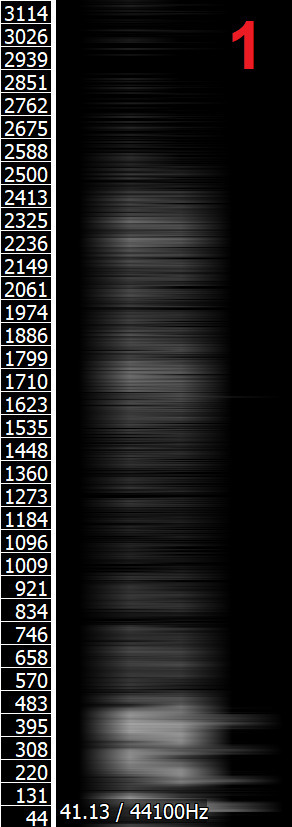
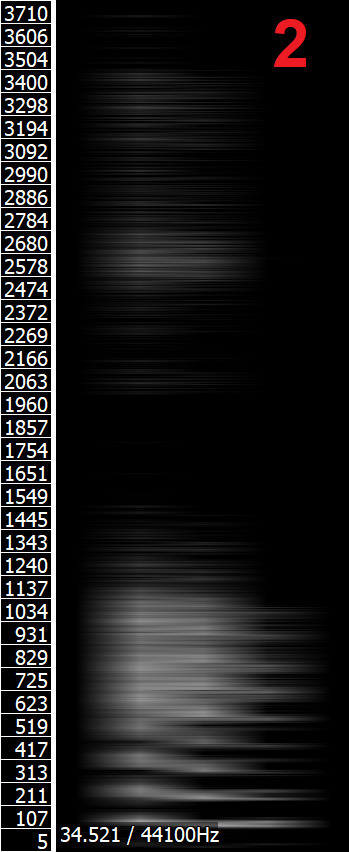
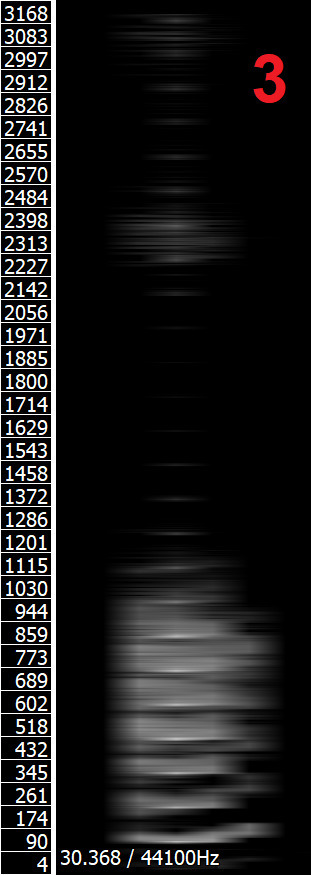
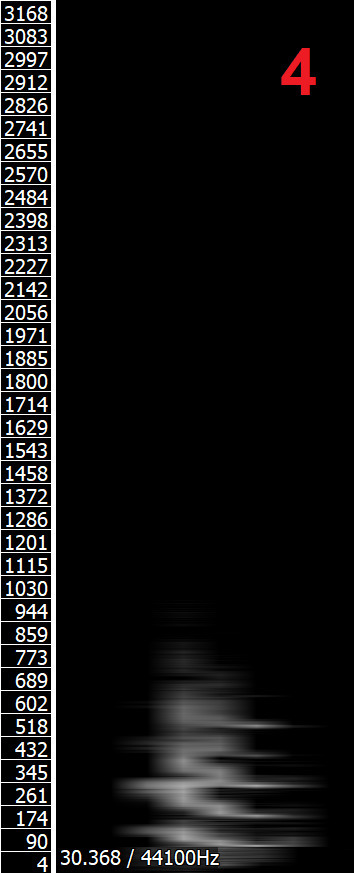
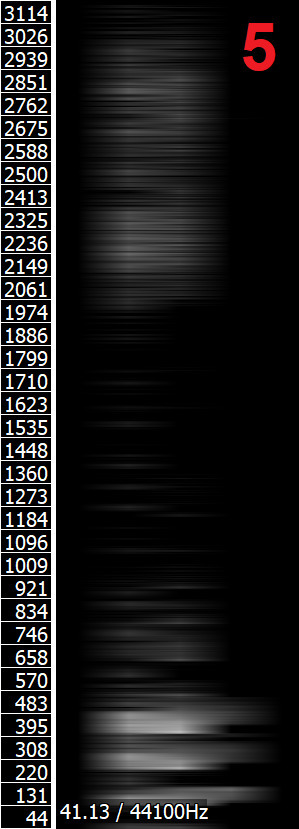
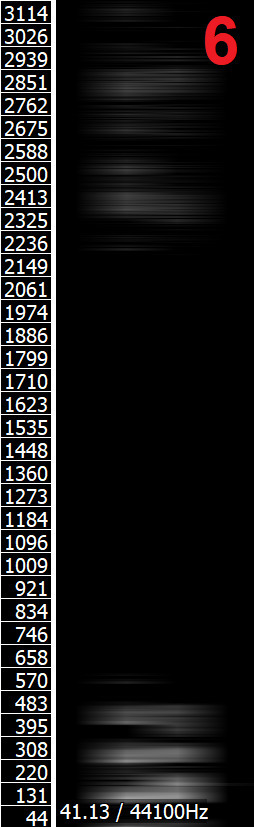
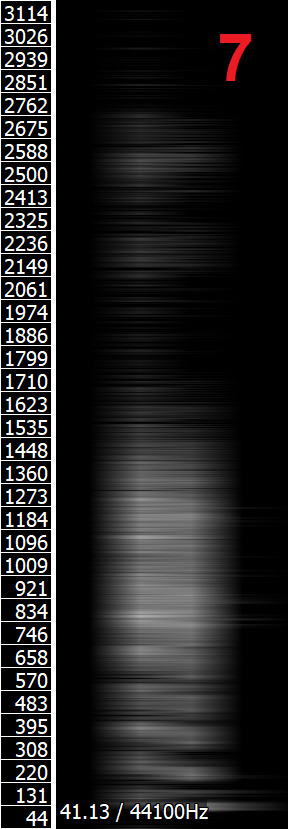
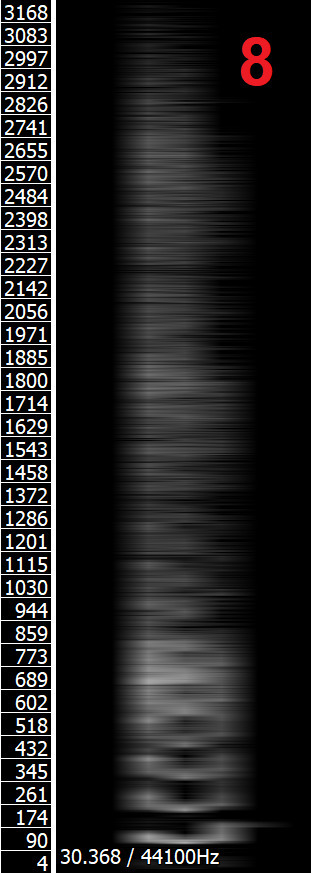
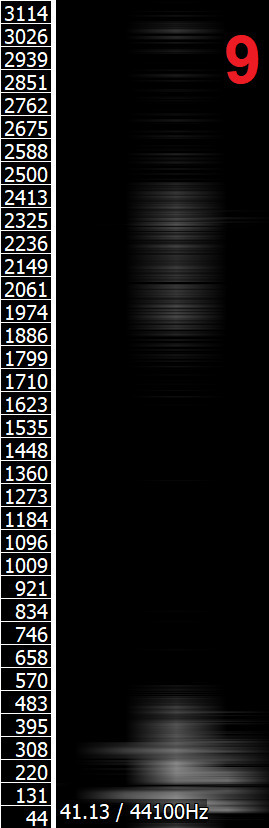
Powyższe spektrogramy przedstawiają 9 wymówionych i nagranych przeze mnie różnych samogłosek, z 11, zamieszczonych na wykresie. Dopasuj odpowiednie samogłoski do spektrogramów, oznaczonych cyframi od 1 do 9. Pozostałym dwóm samogłoskom, które przedstawione są na wykresie, ale nie występują na spektrogramach, przypisz cyfrę 0. Kesz znajdziesz na współrzędnych finałowych:
N 52 11./a//y//e/ E 20 57./ɔ//ɔ//u/
The images above present spectrograms of 9 articulated and recorded by myself different vowels, out of 11, displayed on the diagram. Match the appropriate vowels to the spectrograms, marked with digits from 1 to 9. The two vowels, which are on the diagram, but do not occur on the spectrograms, represent the digit 0. The cache can be found on the final coordinates:
N 52 11./a//y//e/ E 20 57./ɔ//ɔ//u/
Les images ci-dessus présentent les spectrogrammes de 9 voyelles différentes, articulées et enregistrées par moi-même — de 11, montrées dur le diagram. Assortis les voyelles apropriées aux spectrogrammes, marquées avec des chiffres de 1 à 9. Marque deux voyelles, qui sont sur le diagram, mais ne se montrent pas sur les spectrogrammes, avec le chiffre 0. La cache peut être trouvé sur les coordonnées finales:
N 52 11./a//y//e/ E 20 57./ɔ//ɔ//u/