Spiromania #41
This is a puzzle cache. The cache is not at the listed coordinates. As is usual in this series the solution will be represented in the shortened UTM format as VKabcdefghij standing for UTM: 15T E 4abcde N 49fghij.
During the 6th century BCE the Hexabees, from their home planet in the spiral galaxy, tried to establish a colony right here in Rice County. They were attracted by the abundance of wild flowers. The colony consisted of hexagonal cells joined together in a honeycomb fashion. As shown below the cells were numbered in a spiral fashion. Cell #1, the throne room, was occupied by the queen bee herself. Cell #2 by the current king consort. The first loop, cells numbered 3-8, contained the larvae. The second loop, cells 9-20, housed the 12 nursing drones. The third loop (21-38) contained cells for 18 interior worker drones. The fourth loop was the outer loop and held both the foragers and a few virgin queens. (Loops 0-3 are shown in the image immediately below; to see loops 0 to 4, click on "5 loops" on the list of images to the left below.)
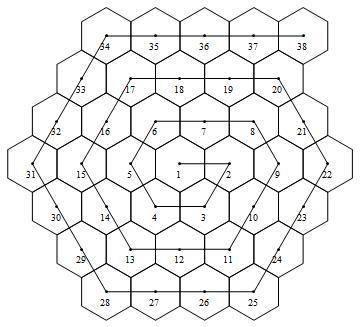
Cells numbered 2, 8, 20, 38 and 62 make up the end cells of loops 0 thru 4, resp. Outside of the hive the Hexabees continued to organize their world according to this spiral fashion. As one continues spiraling the number of cells in the nth loop and its end cell (i.e. the total number of cells up to that point) are given by the formulas in the table below. (Valid for n >0.)
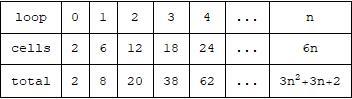
So where's the cache? If cell #1 is located at the posted coordinates, then the cache is in cell #7624 in the extended spiral. For any cell in this hexagonal grid, its center is exactly 10 meters away from each of its six neighboring centers.
Due to rounding, it's easy to get off by a bit. Therefore round your easting and northing to the nearest 5 meters and enter VKabcd5fghi0 into the coordinate checker below. If correct you will be rewarded with the lat/lon coordinates and a hint on the location.

You can validate your puzzle solution with certitude.
The first 10 solvers are: 1. pfalstad Tue, 21 Jan 2020 9:07:35 2. NYWanderer Tue, 21 Jan 2020 10:14:35 3. kcmcacher Tue, 21 Jan 2020 10:16:06 4. toolrep1 Tue, 21 Jan 2020 10:20:32 5. ctc128 Tue, 21 Jan 2020 19:23:08 6. PackADad Tue, 21 Jan 2020 22:15:45 7. Kazir Thu, 23 Jan 2020 10:14:54 8. foundinthewild Thu, 23 Jan 2020 13:33:14 9. salsman Thu, 23 Jan 2020 16:41:17 10. Boreal Walker Fri, 31 Jan 2020 16:51:20
More than you need to know.
- Numbering 2-dimensional integer coordinates in a spiraling 1-dimensional fashion is a common trick in proving the countable cardinality of some infinite sets.
- Hexagonal tilings are common in games, such as Chinese checkers and many computer-based adventure games. They have the advantage of allowing the player six choices to move rather than the four in square tilings.
- In your solution, you may have discovered a 2-dimension skewed coordinate system.
- This and similar hexagonal spirals have been used to try to reveal patterns in the distribution of prime numbers.