Have you ever wondered why, up here in the Blue Mountains, there are beautiful ripple marks on the sandstone beside the trail? You can sit on the ripple marks and enjoy the view. Access to the ripple marks can be from paying a fee to take the tram across, or from one of the two nearby roads.
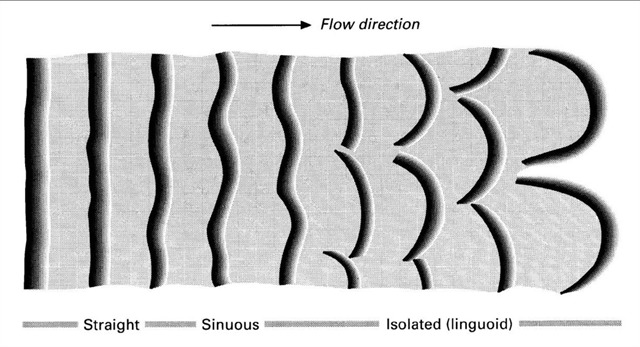
Ripple marks are formed from wave action at the bottom of a shallow bay or on a beach. They are then covered up by more sand and buried in the rock which forms from the sand. The sandstone is then pushed up and eroded until the ripple marks appear again, as good as new. Ripple marks that are formed in gentle water are straight and the more current there is, the more wavy or sinuous they become. If they are formed in rough water they can be almost oval shaped. Also, sometimes, a pebble or rounded piece of gravel is buried with the ripple mark.
Here is a diagram of ripple marks versus the strength of the flow going from gentle (long and straight) to strong, until they are short and rounded and then disappear.
These ripple marks are formed in layers of sandstone (along with claystone, mudstone and coal deposits), which deposited during the formation of the Sydney Basin in the Permian and Triassic periods (290 to 230 million years ago). It takes a long time for this process to happen.
To log this earthcache, you must post a photo of you or your GPS device at or near the the ripple marks.
Please e-mail or message me the following information. Logs without accompanying information or photo will be deleted.
1. Do you think the current which formed the marks was strong or gentle?
2. You will notice there are "pock holes" in the rock surface caused from pebbles which have eroded. What is the diameter of these holes?
Congratulations to Team Canary for their FTF.