Volcano at Paisano Pass
By Carrot Killer
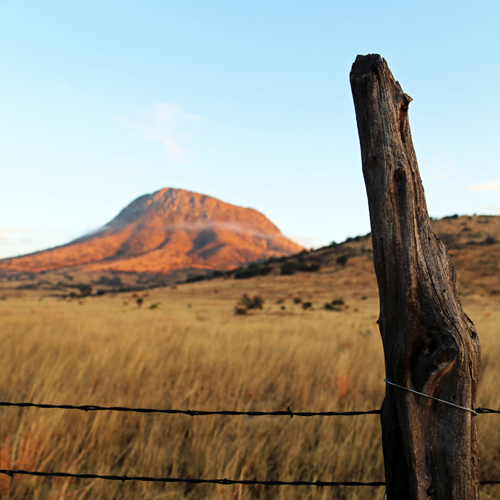
When you think of volcanos you are most likely envisioning Hawaii or Pompei with bubbling lava exploding in a fantastic symphony of destruction and creation. I doubt that you have considered the past volcanic activity here along this sleepy west Texas highway. However, you're in luck! You've pulled over to the right spot to be inundated with a rich geological history that is the legacy of this great land we all love!
All of this activity began around 48 million years ago in and around modern day El Paso. It soon spread to the Christmas mountains and the Big Bend area. 35 million years ago basaltic lavas erupted from a pluton approximately 5 miles in diameter that rose slowly from deep within the mantle and lodged into the crust approximately 2 to 3 miles below the surface. Explosive pyroclastic eruptions driven by steam and carbon dioxide ensued, followed by subsequent lava flows. After a quiet period, pyroclastic flows again began to erupt, and a caldera crater collapsed during violent explosions that partially emptied a magma chamber under the volcano. Finally, more lavas erupted, followed by late mafic dikes and plugs and much younger nepheline syenite intrusions into the older volcanic strata. Development of the broad shield complex was completed in 1 to 2 million years. Weathering and erosion continue to carve the different types of igneous rock into the colorful cliffs and wide valleys that seen around Paisano Pass today.
Stratovolcanoes
These volcanoes are majestic giants with steep sides and a symmetrical cone shape. They form from very thick, viscous, or sticky, lava that won't flow easily. The lava therefore builds up around the vent forming a volcano with steep sides – we call this a stratovolcano and it has a familar triangular shape. Because the magma is so viscous, gas can't leave the magma, therefore, when the magma rises to the surface the gas pressure builds up inside the volcano, resulting in an explosive eruption.

Shield Volcanoes
Where a volcano produces low viscosity, runny, lava it spreads far from the source forming a volcano with gentle slopes. This type is called a shield volcano. Mauna Kea and Mauna Loa are shield volcanoes. They are the world's largest active volcanoes, rising nearly 9 km above the sea floor around the island of Hawaii.

Fissure Volcanoes
As magma rises, it will find the easiest route to reach the surface. If it rises up through a long fracture, fountains of lava can form a ‘curtain of fire’ which we call a fissure eruption. The Eyjafjallajökull eruption in 2010 began with a fissure eruption on the side of the volcano

Splatter Cones
When magma contains too much gas to form an effusive lava flow, but too little to form an explosive eruption, it erupts from the volcano as blobs of magma which fall close to the vent forming a low, steep-sided cone that we call a spatter cone.

Questions
In order to log this earthcache please use the geocaching.com messenger service and send me answers to the following questions:
1)Using the information in the cache page look at the volcano before you and determine what type it was.
2) From where you are standing use the pictures on the informational sign and describe any nearby evidence of lava flows.
3) *Optional* Take a photo of yourself or group with the volcano in the background.