Welc🌎me to Arkansas! EarthCache
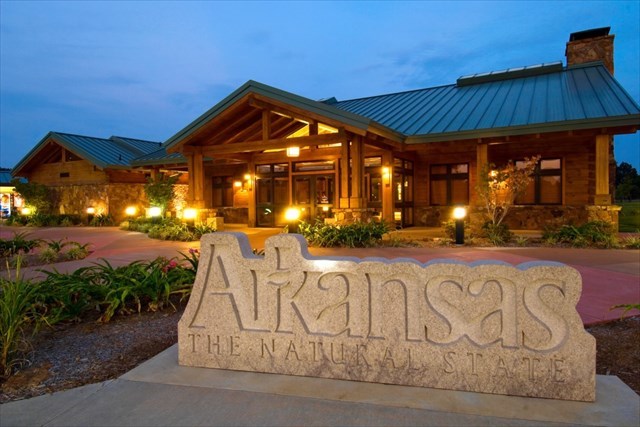
Located just 3 miles from the Oklahoma border heading eastbound into Arkansas on I-40, this welcome center houses a display showing various types of rocks and minerals that can be found in the geographically diverse state of Arkansas!
To get credit for this EarthCache, be sure to complete the logging tasks at the bottom of this page.
Before We Begin:
- This Van Buren/Fort Smith Welcome Center is open from 9am to 5pm every day with a few exceptions.
- They are closed on the following days: New Years Day, Easter, Thanksgiving, Christmas Eve and Christmas Day.
- Observations of the rocks and minerals are only available inside the building during welcome center hours of operation. It is not required to interact with any staff in order to make your observations. All answers to the questions can be found by viewing the display and reading the cache page.
- Please note: This can only be accessed by travelers going eastbound on I-40. Westbound travelers can take exit 1 and wrap around to the eastbound direction to get there.
As this is an EarthCache, there is no container to find. Instead you will have an opportunity to learn about several different types of rocks and minerals that are found in Arkansas. This EarthCache won't cover every kind that can be found in Arkansas; just the ones on display here where you can make an observation of these excellent specimens.
Let's get started!
Bauxite - State Rock of Arkansas
Bauxite is the principle ore of aluminum. Almost all of the aluminum that has ever been produced has been extracted from bauxite. The process in which it is extracted uses an enormous amount of electricity and is usually produced where electricity costs are very low. Therefore, much of the aluminum used in the United States is produced in Canada using hydroelectric power.
Many people are surprised to learn that bauxite is not a mineral but rather a rock composed mainly of aluminum-bearing minerals. It forms when laterite soils are severely leached of silica and other soluble materials in a wet tropical or subtropical climate over millions of years. Bauxite is typically a soft material with a hardness of only 1 to 3 on the Mohs scale. What is unique about this rock here is the largest deposit of bauxite in North America is found in central Arkansas, just southwest of Little Rock. In fact, the whole town is named after this rock!
Quartz - State Mineral of Arkansas
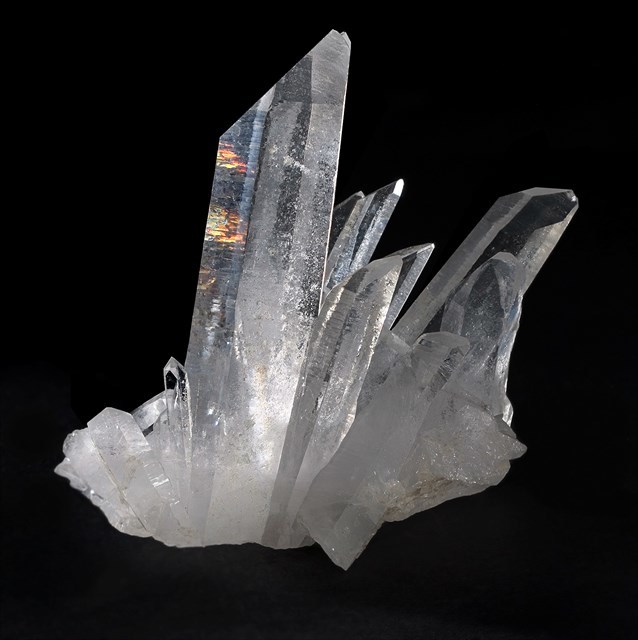
Quartz, or silica, is a hard (7 on the Mohs scale), brittle, durable mineral that exhibits considerable resistance to weathering. It occurs in nature in many varieties, but is best known from Arkansas as prismatic, elongate, transparent, glass-like crystals. Quartz is found throughout the state, but the best crystals are collected from mines in the Ouachita Mountains. This specimen in particular was collected from the Ron Coleman Quartz Mines in Jessieville, AR.

Arkansas is known worldwide for the production of quartz crystals by both collectors and scientists. One of the first uses of quartz, in the form of flint, was the production of sharp objects such as knife blades, scrapers, and projectile points such as the arrowheads.
Arkansas “whetstones,” “oil stones,” and “sharpening stones” became world-famous for their ability to produce a sharp edge on a metal blade. This created a demand for it that was strong in the 1800s but declined as people used fewer blades that required resharpening. In the early 1900s, demand declined further as artificial abrasives and sharpening machines began to replace the sharpening stone.
Satin Spar Gypsum
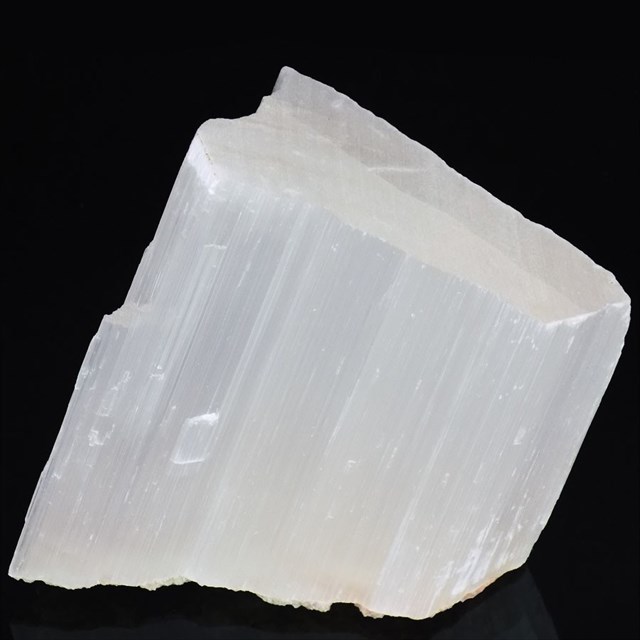
Gypsum is a sedimentary mineral commonly formed by the evaporation of seawater. Once formerly the site of an ancient ocean, thick deposits of gypsum are found in southwest Arkansas. Gypsum is a soft mineral (2 on the Mohs scale) and can be scratched by your fingernail. What is unique about this form of gypsum, called satin spar, is it is made up of long thin crystals and resembles the luster of satin cloth.
Typical uses for gypsum include the manufacture of sheetrock, cement, plaster of Paris, soil conditioning, and as a hardening retarder in portland cement. The "satin spar" version is used for a variety of ornamental purposes but due to the low hardness, there are limits to the durability.
Lamproite Breccia Tuff (Diamondiferous explosive volcanic rock)
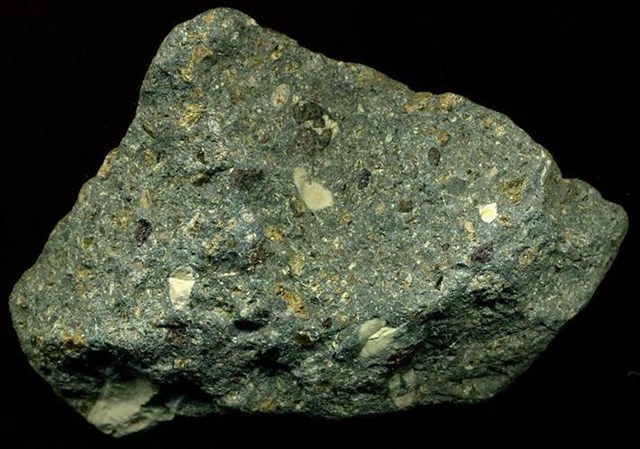
Lamproite breccia tuff (7 on the Mohs scale) is a type of igneous rock that comes from 60 to 100 miles deep in the Earth. Most people may have never heard of this rock but what it carries with it as it reaches the Earth's upper crust has profoundly impacted the whole world. As it is emplaced into the upper crust, it carries with it diamond crystals that have formed at those great depths!

Fun fact: Coal has rarely - if ever - played a role in the formation of diamonds!
What is unique about this rock is that it comes from the Crater of Diamonds State Park near Murfreesboro, Arkansas. This park has the only diamond mine in the world where tourists can hunt for and keep any diamonds they find!
Dolomite
Dolomite is the primary component of the sedimentary rock known as dolostone and the metamorphic rock known as dolomitic marble. Dolostones are very common in the rock record and can be geographically extensive and hundreds to thousands of feet thick. However, what makes this specimen unique is dolomite itself is rarely found in modern sedimentary environments. Most rocks that are rich in dolomite were originally deposited as calcium carbonate muds that were postdepositionally altered by magnesium-rich pore water to form dolomite.
In the Ozarks, dolomite is often associated with small deposits of lead and zinc ores. It is similar to calcite, the principal mineral of limestone, differing only in that dolomite has an atom of magnesium in its molecule. Dolomite (3.5 to 4 on Mohs scale) has uses ranging from the chemical industry for acid neutralization, as a feed additive for livestock, and as a reservoir rock, where the pores can be filled with oil or natural gas released from other rock units.
To Get Credit For This EarthCache
Copy the questions below and send your answers via geocaching messages.
- DO NOT post the answers in your log.
- Group answers are fine, just let me know who all was there.
- Note: The photo task is a requirement for each account claiming a find. See acceptable EarthCache logging tasks effective June 10th, 2019. If you don't want to post the photo with your log, you may send it to me with your answers instead.
- Please send the answers in a timely manner or it may result in the deletion of your log (no offense intended).
Logging Tasks
1| The name of this EarthCache: Welc🌎me to Arkansas!
2a| Describe what the sample of bauxite on display looks like (colors, shapes, sizes, etc).
2b| What element is commonly taken from bauxite?
3| What are some common uses for quartz and gypsum?
4| What valuable mineral is found in lamproite breccia tuff?
5a| Describe what the sample of dolomite on display looks like (colors, crystal sizes, etc)?
5b| From what you see, why is it this color?
6| In your log, provide a photo of yourself in front of the display where the rocks and minerals are presented.
- If you prefer, the photo can be of a personal item here instead. Just make the photo unique to you and your visit. Feel free to have fun with this!
Bonus points: Name the animal associated with the fossil that is also on display here. 
*IF YOU ENJOYED THIS EARTHCACHE,
CONSIDER GIVING A FAVORITE POINT!*
Sources:
Permission for this EarthCache placement was granted by the Arkansas Welcome Program.