This EarthCache, at the published location takes you to Norfolk Street in Sheffield. What we are here to look at it not very big, so I have included a picture to indicate the location.

We are here to look for something called a Garnet.
So what are Garnets, well they are a crystal, which can be red, brown, yellow, black or green. It is formed from silicate mineral. Garnets are found in highly metamorphased rocks and some igneous rocks. They are a a stone of great beauty and moderate economic value. Often a deep translucent or transparent red, garnet is a popular gem. One type of garnet is also used to produce commercial abrasives such as sandpaper and polishing grit.
There are Six varieties of garnets (and there are many gradations between them), they occur fairly frequently in deposits scattered about the world.
Almandine, is the most common of all garnets, is usually deep red to reddish brown and sometimes purplish. Due to its large iron content, it is paramagnetic (attracted to a magnet).
Pyrope, is less widely distributed but more valuable as a gemstone, is rose-red to reddish purple in colour.
Grossular garnets are yellow to brownish hue crystals typically found in contact with limestone or marble metamorphic rocks. These garnets are rich in calcium.
Spessartite garnets are a yellowy and orange colour, due to the prescene of magnesium in the stone.
Uvarovite garnets have a green colour.
Andradite garnets consist mainly of iron, however due to the iron being contained in different structures in the garnet, so at times some andradite garnets sometimes can emit a diamond or yellowish colour.
This is meant to be a simple EarthCache, that allows you to see something you may not often see.
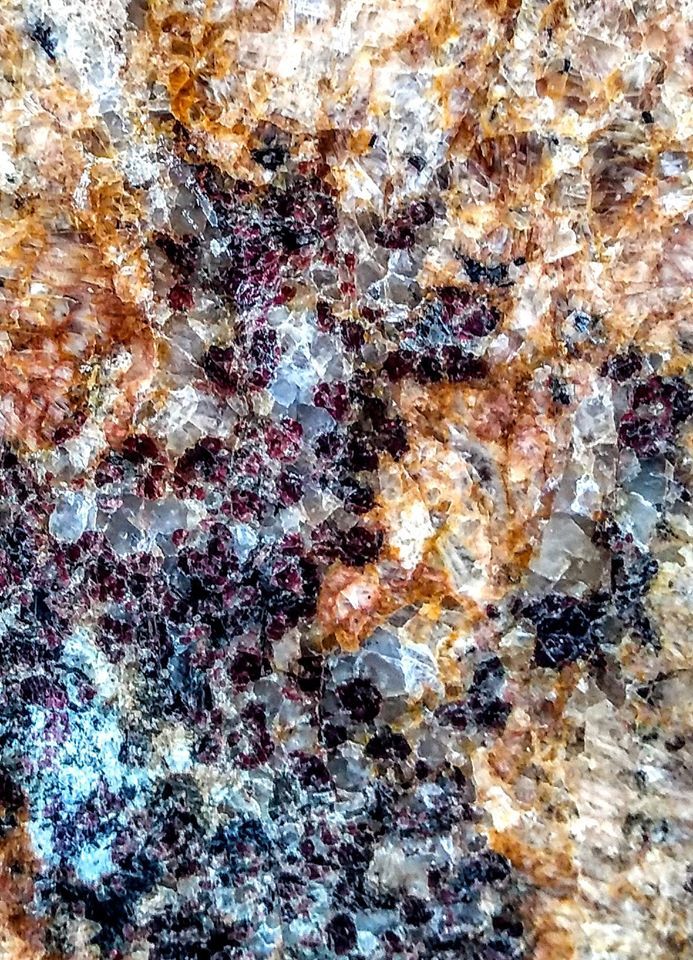
Garnets.
Igneous rock is formed through the cooling and solidification of magma or lava. Igneous rock forms by crystallisation either below the surface as intrusive (plutonic) rocks or on the surface as extrusive (volcanic) rocks.
Metamorphism is the transformation of an existing rock type, known as the protolith. The protolith is subjected to heat and pressure causing sometimes quite profound physical and/or chemical change. The protolith may be sedimentary rock, igneous rock or another older metamorphic rock.
This being an EarthCache, in order to log it, I ask that you answer the below questions. Please send them to me, and do not include them in your log. You can send them to me by using the message facility or email, both of which can be found by looking at my profile.
A magnet will be needed to undertake this EarthCache.
1. Using the above information please tell me what type of garnet there is here. What is the rationale for your answer?
2. Please describe the clusters of garnets, how may clusters are there?
3. Please describe the rock that the garnets form part of, in terms of crystal size and colours.
4. How big is the largest cluster of garnets?
5. Please measure the diameter of an individual garnet. What is it in mm?